Deutsche Tageszeitung - Потсдам, мэр Майк Шуберт, сотрудник пресс-службы мэрии Майк Брунзлоу и 55 евро за три минуты

Потсдам, мэр Майк Шуберт, сотрудник пресс-службы мэрии Майк Брунзлоу и 55 евро за три минуты


Потсдам, мэр Майк Шуберт, сотрудник пресс-службы мэрии Майк Брунзлоу и 55 евро за три минуты

Пресса часто сообщает о вопиющей некомпетентности, скандалах в государственных органах. Эти отчеты часто служат на благо и пользу широкой общественности.

Закон о печати Бранденбурга (Brandenburgisches Landespressegesetz - BbgPG) от 13 мая 1993 года в пункте 3 гласит: "Общественная задача прессы": "Пресса выполняет общественную задачу, в частности, добывая и распространяя новости, комментируя, критикуя или иным образом способствуя свободному формированию индивидуального и общественного мнения. В этом отношении он фундаментально защищает законные интересы в смысле статьи 193 Уголовного кодекса."

Change text size:

В Потсдаме, столице Бранденбурга, проживает 183 154 человека (по состоянию на декабрь 2021 года), а также 16 впечатляющих замков, дворцов и великолепных зданий; чтобы увидеть эти великолепные замки, туристам приходится парковать свои автомобили и автобусы в городе.

С ноября 2021 года Майк Шуберт (СДПГ) является мэром Потсдама и получает от граждан 10 786,67 евро в месяц (класс B7), плюс возмещение дорожных расходов и служебный автомобиль, причем жители Потсдама утверждают, что видели мэра Майка Шуберта даже во времена инфляции, сопровождающейся ростом цен на бензин и дизельное топливо, совсем недавно в роскошном лимузине Audi A8 с шофером. (Источник: https://www.gehaltsvergleich.com/news/was-verdient-eigentlich-ein-buergermeister)
В одной из следующих статей мы более подробно рассмотрим использование служебного автомобиля мэром Майком Шубертом, инфляцию и частное использование служебных автомобилей.

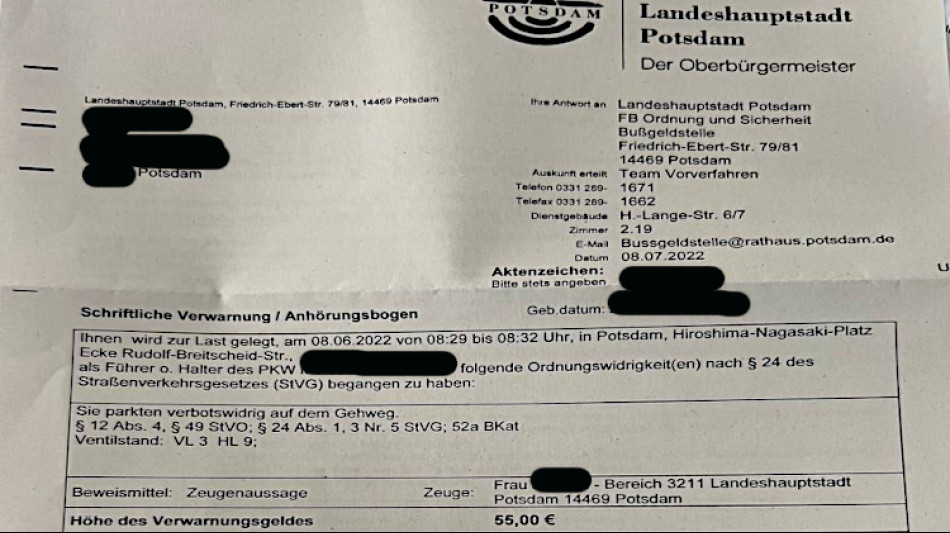
Актуальная тема - возможное нарушение правил парковки, которое в столице штата Потсдаме может быстро обойтись в 55,00 евро, как показано на нашей фотографии на обложке.
Но в чем разница между остановкой и парковкой? Остановка - это намеренное прерывание поездки, которое не вызвано дорожной ситуацией или приказом. С другой стороны, каждый, кто выходит из своего автомобиля без возможности немедленно вмешаться и уехать, или останавливается более чем на три минуты, паркуется. Парковка на пешеходной или велосипедной дорожке влечет за собой штраф в размере 55,00 евро.
Учитывая, что сотрудник отдела 3211 (рабочая группа инспекции полевой службы) столицы земли Потсдам даже записал положения клапанов, возникает вопрос: была ли это остановка или стоянка? После нашего осмотра предполагаемого места преступления, старательный сотрудник выездной службы городской инспекции должен был непременно увидеть водителя транспортного средства, ведь запись и фиксация положения клапанов не может быть сделана за несколько секунд, а является ли "стоянка" всего на "три минуты" на самом деле "стоянкой", а не остановкой, четко описано в каталоге штрафов....

Анонс нашей статьи в прессе на эту тему вызвал на сцену исполняющего обязанности руководителя пресс-службы столицы государства Яна Брунцлова, который написал нам вчера, в среду, 20 июля 2022 года в 17:38: "Вызывает сожаление, что вы или журналисты вашей редакции неоднократно не просто изложили нам факты по данному вопросу и не сделали журналистский запрос, как это сделали бы серьезные СМИ, на который мы могли бы ответить соответствующим образом, как это предписывает журналистский долг заботы согласно кодексу прессы".
Господин Ян Брунцлоу мог бы спросить у хорошо знакомой ему потсдамской региональной газеты, что в кодексе прессы (который не является законом, а лишь случайным руководством) об этом даже отдаленно не говорится. Г-н Брунцлоу также должен иметь хорошие связи в юридической среде (РЕНО), поэтому "оценка" в вышеупомянутом электронном письме исполняющего обязанности руководителя пресс-службы столицы земли Потсдам Яна Брунцлоу как представителя прессы столицы земли Потсдам кажется вообще сомнительной. (Источник: https://www.presserat.de/pressekodex.html)

Вышеупомянутое электронное письмо от исполняющего обязанности руководителя отдела прессы и коммуникаций столицы штата Яна Брунцлоу тем более удивительно, что в связи со скандалом, связанным с тяжелобольным малышом с 5-м уровнем ухода, в прошлом не так уж часто можно было услышать статьи в прессе, а мы вспоминаем этот скандал здесь: https://www.BerlinerTageszeitung.de/politik/89529-mike-schubert-brigitte-meier-ursula-nonnenmacher-oder-der-skandal-in-potsdam-um-ein-schwerbehindertes-kleinkind-und-seinen-kita-platz-2.html.

Что касается средств массовой информации, то здесь необходимо отметить, что медийный ландшафт в Федеративной Республике Германия претерпел значительные изменения! Сегодня аналогом печатной газеты из экологически вредной бумаги является присутствие в Интернете, мобильное предложение, онлайн-газеты или присутствие в социальной сети.
В 2012 году тираж печатных ежедневных газет в Германии был значительно выше, чем сегодня. В 2021 году статистика предсказывала, что в 2022 году все еще будет продаваться 11 миллионов печатных газет - и это будет конец в 2034 году. С сегодняшней точки зрения, результат для печатных газет еще более катастрофичен, поскольку, согласно текущим расчетам журналистов, последняя печатная ежедневная газета выйдет уже в 2033 году, то есть через 11 лет.
В этот момент на ум приходит причудливая поговорка: "Печатные газеты - это вчерашние новости".

Инфляционное давление растет. В Германии многие люди обеспокоены тем, что они смогут позволить себе все меньше и меньше; в июне 2022 года уровень инфляции составил ошеломляющие +7,6%, согласно данным Федерального статистического управления. Штраф в размере 55,00 евро за якобы парковку в неположенном месте, похоже, пришел как нельзя вовремя для общественного бюджета. Оправдан ли он в городе Потсдаме, в зоне ответственности мэра Майка Шуберта (СДПГ), следует, по крайней мере, поставить под сомнение в отношении каталога штрафов, а вот много ли 55,00 евро для Майка Шуберта с ежемесячной зарплатой в 10 786,67 евро, читатель может решить сам...

Вскоре мы сообщим в серии из 10 (десяти) статей в прессе о потсдамских стройках, перекрытых дорогах, отставании в муниципальном обслуживании, частном использовании служебных автомобилей, исполняющих обязанности глав и их журналистской истории, включая последующие контакты с региональной прессой, арендной плате в Потсдаме, сроках ожидания предоставления вида на жительство в Потсдаме - для украинских беженцев и, конечно же, Потсдаме как городе культуры и его продвижении.   (П.Васильевский--ДТЦ)

Featured

Toyota bZ7: Luxury EVs in China

The Toyota bZ7 is shaking up China’s electric luxury car segment. Developed jointly by Toyota and GAC, the five‑meter sedan is built exclusively for the Chinese market and measures roughly 5,130 mm long and 1,965 mm wide, similar to a Tesla Model S. Pricing starts at about 147,800 yuan (approximately US$21,500) and runs up to 199,800 yuan across five trim levels.The bZ7 showcases cutting‑edge technology. Its cockpit features Huawei’s HarmonyOS 5.0 interface on a 15.6‑inch touchscreen, complemented by an 8.8‑inch digital cluster and a 27‑inch head‑up display. Voice control recognizes multiple zones and commands, yet physical buttons remain for key functions. Momenta provides the R6 ADAS suite, combining LiDAR and 26 other sensors to deliver highway and urban navigation on autopilot plus automated parking without subscription fees.Passengers enjoy ventilated, heated and massaging seats, while the front seats use a zero‑gravity design for comfort. Dual‑chamber air suspension and a road‑preview system give a refined ride.

AC Schnitzer: When Iconic Tuners Fall Silent

The announced end of AC Schnitzer by the close of 2026 is far more than the disappearance of a well-known tuning brand. It is a warning signal with meaning far beyond the BMW enthusiast scene. When a company that for decades stood for sporty BMW refinement, forged wheels, suspension upgrades, exhaust systems and a distinctly German form of engineering passion can no longer operate its manufacturing and tuning business economically in Germany, the issue is no longer just about one brand. It becomes a question about Germany as an automotive business location. AC Schnitzer therefore turns into a symbolic case: one that reflects weakening competitiveness, a cost structure that has become increasingly hard to carry and a growing public impression that politics is reacting too slowly, too cautiously and too late.That is why the topic strikes such a deep emotional nerve. AC Schnitzer was never merely a supplier of aftermarket parts. The company represented an entire culture of refinement, balancing factory-like elegance with a more rebellious edge. For many BMW fans, it was part of the national automotive landscape: Aachen, BMW, motorsport associations, complete vehicle programs, distinctive forged wheels, aerodynamic components, performance kits and memorable special builds. In that sense, the end of AC Schnitzer is not simply a balance-sheet story. It is also the loss of a piece of industrial identity.The reasons behind the closure are revealing because they expose exactly the chain of problems that German industry has been discussing for years. At the core lies a toxic mix of rising development and production costs, slow approval procedures, intensifying international competition and shifting demand. The most striking point is the complaint about the length of the German approval system. If aftermarket parts reach the market many months after foreign competitors have already launched theirs, a specialist niche player loses precisely what matters most: timing, visibility and margins. On top of that come more expensive raw materials, volatile exchange rates, supplier disruptions, tariffs in important export markets, hesitant consumer spending and the gradual decline of the combustion-engine culture that once fueled large parts of the tuning scene. AC Schnitzer is therefore not describing a single isolated problem, but a concentration of structural burdens.

Maybach: Between Glory and a Turning Point

The new Mercedes-Maybach S-Class is far more than a carefully polished update of a familiar ultra-luxury limousine. It arrives at a moment when Mercedes is sharpening the very top of its portfolio, comprehensively modernizing the S-Class and expanding Maybach into a distinct luxury universe that now stretches from chauffeur-driven saloon to electric SUV and exclusive roadster. That is precisely why this model matters. The new Maybach is meant to feel more digital, more individual and more visibly luxurious, while still preserving the essence that made the name so powerful in the first place: serenity, space, comfort and ceremonial presence.Its exterior already makes that ambition unmistakable. The limousine remains an imposing figure at roughly 5.48 meters in length, yet the revised design pushes its presence even further. The grille grows larger, light becomes a central design instrument, Maybach insignia and other elements take on a more theatrical role, and new wheel designs sharpen the visual stance. Even smaller details, such as projected lettering when entering the car or rose-gold accents inside the headlamps, underline the idea that luxury here is not merely owned but staged. Buyers who prefer a darker, more dramatic interpretation still have that option as well. This is not design built around understatement. It is design built around effect.Inside, Mercedes makes its 2026 understanding of luxury even clearer. The new Mercedes-Maybach S-Class adopts the sweeping Superscreen layout, introduces MB.OS to a Maybach model and combines digital sophistication with a deliberate emphasis on tactile richness. The rear compartment remains the true centerpiece. Executive seating, chauffeur-oriented comfort, generous legroom, larger rear displays and a long list of comfort details create the impression of a private lounge on wheels rather than a conventional car cabin. At the same time, Maybach is moving toward a broader definition of exclusivity. Most telling is the availability of a leather-free interior using linen and recycled polyester. It signals that premium craftsmanship is no longer tied exclusively to traditional opulence, but increasingly to material intelligence, sensory quality and curated individuality.

Mercedes new electric VLE: Price and performance?

Mercedes is not simply pushing the V-Class into the electric age; it is changing the vehicle’s very character. With the VLE, the familiar people carrier becomes something much closer to a rolling grand limousine. That is the real message behind this reboot. In the future, Mercedes will draw a clearer line between the VLE, positioned roughly on E-Class territory, and the even more luxurious VLS at the top end. This restart is therefore aimed not only at European families or hotel shuttles, but at a global market in which large luxury vans have long since become status objects.The technical leap is just as significant. The VLE is the first model to sit on a dedicated electric van architecture and it brings precisely the ingredients Mercedes wants to associate with its upper-class passenger cars: 800-volt technology, very fast charging, air suspension, rear-axle steering, a much more digital cockpit and an interior that feels more like a lounge than a traditional van. Up to eight seats, a highly flexible rear compartment, generous luggage space and strong towing credentials are all meant to prove that this is not merely a beautifully staged product, but a genuinely usable one. Mercedes wants to dissolve the old compromise: the VLE is supposed to be a business shuttle, a family car, a travel vehicle and a prestige product all at once.That inevitably puts range at the centre of the debate. On paper, the package is convincing: a large battery, a modern EV-first platform, strong aerodynamics, rapid charging and a clear attempt to present long-distance usability as something tangible rather than theoretical. All of that supports the idea that the official WLTP claim is not just marketing theatre. Even so, it would be a mistake to read that figure as an everyday guarantee. A vehicle of this size already weighs roughly three tonnes before passengers or luggage are added, and the heavier versions push total weight significantly higher still. Add several occupants, baggage, winter temperatures, climate control, large wheels and brisk motorway speeds, and the usable range will naturally fall. The VLE does not defeat physics; it simply shows how far current engineering can reduce the traditional drawbacks of large electric vehicles.

Change text size: