Deutsche Tageszeitung - Cayenne Turbo Electric 2026

Cayenne Turbo Electric 2026


Cayenne Turbo Electric 2026

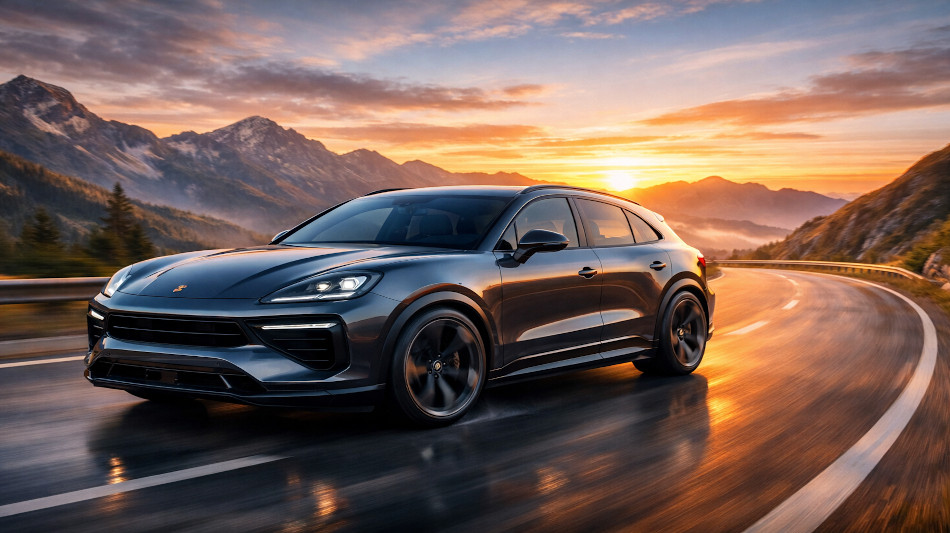
With the Cayenne Turbo Electric, the Stuttgart-based sports car manufacturer is finally entering the age of fully electric SUVs. Back in 2002, the Cayenne was the model with which Porsche conquered the luxury off-road vehicle segment. With the fourth generation, a pure battery-powered vehicle is now available for the first time. Two variants will be launched in spring 2026: the Cayenne Electric and the top-of-the-range Cayenne Turbo Electric. Both feature all-wheel drive with one permanently excited synchronous motor per axle. The electric Cayennes are longer and wider than the previous models, yet still offer the characteristic silhouette with a low bonnet, curved roofline and striking fenders.

Supercar-level performance and driving dynamics
In the Turbo version, the E-Cayenne delivers a system output of up to 850 kW (1,156 hp) when the start or ‘push-to-pass’ function is activated. In normal operation, 630 kW (857 hp) is available; an additional boost of 130 kW (176 hp) can be called up for ten seconds at the touch of a button. The maximum torque is 1,500 Nm. With this power, the SUV, which weighs just under 2.72 tonnes, sprints to 100 km/h in 2.5 seconds and reaches 200 km/h in just 7.4 seconds. The top speed is 260 km/h. The standard Cayenne Electric achieves 300 kW (408 hp) in normal driving mode and 325 kW (442 hp) with the aid of Launch Control. It accelerates from 0–100 km/h in 4.8 seconds and reaches a top speed of 230 km/h. Both versions feature electronic Porsche Traction Management (ePTM), which regulates the power distribution between the front and rear axles in milliseconds.

Change text size:

The driving dynamics are characterised by a new drive system. Direct oil-cooled electric motors on the rear axle enable high continuous power and high recuperation performance. The standard air suspension with Porsche Active Suspension Management (PASM) adjusts the damper characteristics and vehicle height in a flash. Rear-axle steering and Porsche Active Ride active chassis control, which almost completely compensates for body movements, are available as options. A limited-slip differential with Porsche Torque Vectoring Plus provides additional traction in the Turbo.

Recuperation and battery: efficiency and range
The high-voltage battery in the Cayenne Electric has a gross capacity of 113 kWh. It consists of large-format pouch cells and is temperature-controlled on both sides – a world first that enables optimum temperature maintenance. In the WLTP cycle, the Cayenne Turbo Electric achieves a range of up to 623 kilometres; the Cayenne Electric even achieves up to 642 kilometres. Energy recovery reaches Formula E level: up to 600 kW can be recovered during braking, meaning that around 97 per cent of all deceleration takes place without mechanical brakes.

Charging is carried out using 800-volt technology. The DC charging capacity is up to 390 kW; under optimal conditions, the charge level can be increased from 10 to 80 per cent in less than 16 minutes. A range of around 315 kilometres can be recharged in ten minutes. The Cayenne charges with alternating current at up to 22 kW; wireless charging is available as an option for the first time in the automotive sector: the vehicle can be fully charged overnight in around ten hours via an 11 kW induction plate in the garage. Intelligent thermal management keeps the battery temperature in the optimum range, enabling fast charging even at extreme temperatures.

Aerodynamics and design
The Cayenne Electric combines typical Porsche proportions with an advanced design. It is 4,985 mm long, 1,980 mm wide and 1,674 mm high; the wheelbase has grown by almost 13 cm to 3,023 mm. This significantly increases the interior space. Thanks to numerous measures, the SUV achieves a drag coefficient of 0.25 – the best in its segment. Active elements include adjustable cooling air flaps, an adaptive roof spoiler and, for the first time, active aeroblades at the rear of the Turbo, which extend sideways to optimise airflow and downforce. The underbody is almost completely covered, air curtains at the front reduce turbulence, and special rims and a rear diffuser further improve efficiency. For off-road use, there is a package with a modified front and a larger ramp angle. The towing capacity is 3.5 tonnes, which is outstanding in the electric SUV segment.

Interior: digital, comfortable and customisable
The cockpit of the E-Cayenne is characterised by a digital operating concept. At its heart is the Flow Display, a 14.25-inch OLED screen that angles towards the centre console and merges into an optional 14.9-inch passenger display. This is complemented by a 14.25-inch instrument cluster and a head-up display that projects an 87-inch image virtually onto the windscreen. Despite the digitalisation, analogue switches for climate and volume control remain, and a hand rest pad makes operation easier.

The seats can be adjusted electrically; in the rear, they can be moved individually and the backrest angle can be varied as standard. Mood modes adjust the seat position, ambient lighting, air conditioning and sound to suit the mood and situation. The panoramic roof can be dimmed electrically from transparent to matt, while surface heating warms the armrests and door panels in addition to the seats. Porsche offers 13 paint colours, nine wheel designs and twelve interior combinations; additional accent and exclusive packages as well as Race Tex upholstery or Pepita fabric are available as options. Thanks to Porsche Exclusive Manufaktur and the special request programme, the Cayenne can be customised down to the last detail, from the colour scheme to a matching wristwatch model.

Digital connectivity and assistance systems
With the new Digital Interaction, Porsche combines intelligent software with modern hardware. Widgets allow the display surfaces to be personalised, and the theme app adjusts the colour of all displays. A voice assistant powered by artificial intelligence understands complex questions and responds like a real conversation partner. The navigation system uses augmented reality arrows in the head-up display, and the Digital Key allows vehicle functions to be controlled via smartphone and digital keys to be shared with up to seven people. Over-the-air updates expand the vehicle's functions over time.

Space and everyday practicality
Thanks to its larger exterior dimensions, the E-Cayenne offers more space than its predecessors. The boot capacity is 781 litres and can be expanded to 1,588 litres; there is also a 90-litre frunk. The longer wheelbase means that rear passengers in particular benefit from more legroom. Despite the spacious interior, the SUV remains manoeuvrable; the optional rear-axle steering reduces the turning circle. One highlight is the towing capacity of 3.5 tonnes, which makes it truly suitable for long distances with a caravan or boat trailer.

Development and production: digital and flexible
Porsche has partially shifted the development of the Cayenne Electric to the virtual world. Around 120 classic prototypes have been replaced by digital twins. Simulations and artificial intelligence enabled a 20 per cent reduction in development time and reduced resource consumption. Nevertheless, testing took place under extreme conditions: the E-SUV was tested at -35°C in Scandinavia and +50°C in Death Valley to perfect its fast-charging capability and thermal management. The Cayenne Electric is built in Bratislava on the same line as the combustion and hybrid models. The battery modules are produced in a dedicated ‘Smart Battery Shop’ in Horná Streda; Porsche develops and manufactures them entirely in-house to maximise performance, efficiency and quality.

Prices and market launch
The variants available to order will initially be the Cayenne Electric and the Cayenne Turbo Electric. The price for the base model is €105,200, while the Turbo version starts at €165,500. The market launch is planned for spring 2026. In parallel with the electric version, variants with combustion and hybrid drives will continue to be offered to meet different customer needs.

Conclusion on the Cayenne Turbo Electric 2026
With the Cayenne Turbo Electric, Porsche is redefining the electric luxury SUV segment. The combination of brute power, long range and ultra-fast charging makes the car the benchmark among electric SUVs. At the same time, thanks to air suspension, variable mood modes and extensive customisation options, it remains suitable for everyday use and comfortable. The expansion of the digital driving experience and the consistent in-house development of the batteries underline the brand's claim to be a leader in technology and design. The Cayenne Turbo Electric is not only the most powerful production Porsche ever, but also a sign that electric mobility at Porsche goes hand in hand with emotion, tradition and technical excellence.

Featured

Genesis GV60 Magma before launch

The new Genesis GV60 Magma is a model that means much more to the brand than just another particularly powerful version of an existing electric car. The car represents a strategic change of direction. Genesis no longer wants to define itself solely through design, material quality and quiet luxury, but also through its own credible form of high performance. That's exactly why the GV60 Magma is so important: it's not just any sporty derivative, but the first production vehicle in the new Magma world – and thus concrete proof that an idea is now becoming a real product.The timing is well chosen. The regular GV60 has recently undergone noticeable technical and visual enhancements, the brand has visibly sharpened its electric expertise, and at the same time, pressure is growing in the premium segment to more closely link performance, digitalisation and brand character. Many manufacturers today can build fast-accelerating electric cars. The real question is no longer just how much power a vehicle offers, but how this power is staged, dosed and translated into a credible overall picture. This is precisely where Genesis is trying to make its mark with the GV60 Magma.Even at first glance, it is clear that the Magma is not just a cosmetically enhanced GV60. The car appears wider, lower and significantly more taut. The proportions seem more compact, the body sits more solidly on the road, and the add-on parts are not merely decorative, but designed for downforce, cooling and high-speed stability. The front end, side skirts, rear spoiler and air ducts visibly follow a functional logic. Added to this are forged 21-inch wheels, wide tyres and an overall appearance that focuses less on striking aggression and more on controlled presence. This is precisely one of the most interesting features of this vehicle: Genesis is attempting to define sportiness not through visual exaggeration, but through excitement, attitude and technical credibility.The GV60 Magma also goes a clear step beyond the previous GV60 range in terms of drive technology. Two electric motors and all-wheel drive form the technical basis. A very high level of performance is already available as standard, and in boost mode, the system performance increases significantly once again. Genesis is thus positioning the Magma at the top of its electrified model range. Added to this is a top speed that stands out in this class, as well as a 0-200 km/h time that clearly shows that this is not just the usual electric sprint from a standing start, but real performance beyond the first few metres. This is an important difference: many electric cars feel spectacular at first, but lose their punch as speed increases. The GV60 Magma is designed to close this gap.It is noteworthy that Genesis does not present the car as an uncompromising race track machine despite its performance orientation. Instead, the focus is on a synthesis of power, control and premium comfort. The battery is generously sized at 84 kWh, the fast-charging capability remains high, and the official range also shows that the vehicle does not sacrifice everyday usability for mere effect. The GV60 Magma therefore aims not only to impress, but also to remain usable. This is crucial for its future market role.A model like this has to meet two expectations at the same time: it should be emotionally charged, but at the same time not seem exhausting in everyday use. It is precisely this balancing act that Genesis has made its core message.A look beneath the surface shows that the Magma is not just a show car exercise. The chassis, geometry and roll centre have been specifically revised, and electronic damper systems, special control strategies and a braking system tuned to the increased performance level have been added. Equally important is the temperature control of the battery system. Anyone who takes high-performance electric cars seriously knows that raw peak values alone mean little if thermal management, reproducibility and stability cannot keep up. Genesis addresses precisely these points with its own high-performance battery management system. This is an indication that the GV60 Magma is not only designed for spectacular acceleration manoeuvres, but also for repeatable performance under load.The interior is particularly interesting because it encapsulates the actual philosophy of the vehicle. Genesis does not compromise on luxury – on the contrary. High-quality surfaces, a deliberately calm interior, special seats, exclusive material combinations and the brand's characteristic attention to detail remain intact. At the same time, a new, more performance-oriented operating logic has been introduced. A special Magma mode changes the instrument display, bringing important driving data to the fore, while the head-up display focuses more on driving-related information. Added to this are virtual gear changes, specific soundscapes, launch control, drift function and various driving programmes designed to noticeably change the character of the vehicle. This is interesting from both a technological and cultural perspective, because Genesis is bringing two worlds together here: the classic premium idea of calm and sovereignty on the one hand, and the digitally supported performance experience that has been reinvented in the electric age on the other.It is precisely this combination that is likely to distinguish the GV60 Magma from other high-performance electric cars on the market. While some competitors focus on maximum toughness, aggressive communication and the most spectacular driving dynamics possible, Genesis is clearly opting for a more refined interpretation. The driver should feel fast, but not overwhelmed. The car should make its reserves felt without constantly proclaiming how serious it is about them. This approach is anything but insignificant. It could become the actual identity of the model – and, in the long term, the calling card of an entire Magma family.The development programme also shows how seriously Genesis takes this claim. The GV60 Magma was not left in the protected space of a design study, but was put through a broad-based test programme. Winter testing, heat, high altitude, real roads, racetracks and fine-tuning in the home market – all this is part of the preparation. Added to this is the early public demonstration of the concept car in Goodwood, where the Magma gained attention as a serious performance project even before series production began. This is important for the brand's image. Genesis presents high performance not as an afterthought, but as something that has been systematically developed.What the GV60 Magma heralds for the coming years is also exciting. The Magma idea is bigger than this one car. Genesis sees it as a long-term programme and a testing ground for future performance models. The GV60 is a logical starting point for this: it is compact enough for agility, modern enough for a consistently digital interpretation of performance, and emotional enough to bring new substance to the brand. In this sense, the GV60 Magma is a production vehicle – and at the same time a manifesto. It shows how Genesis wants to see its future: electric, fast, luxurious and technically independent.

Speed cameras: Brazen rip-off or necessary?

Germany is once again engaged in increasingly heated debate on an issue that has long since become much more than a mere traffic matter: have speed cameras actually become a convenient source of revenue for cash-strapped towns and municipalities, or are they a necessary means of protecting lives on Germany's roads? The outrage felt by many motorists is not without reason. When you see local authorities raking in millions from speeding and red light violations while at the same time complaining about austerity measures, deficits and budget shortfalls, you quickly get the impression that this is not just about monitoring, but above all about collecting money. It is precisely this suspicion that has further fuelled the debate in recent months.In fact, the sums speak for themselves. In a recent evaluation of major German cities, numerous local authorities once again generated millions in revenue from traffic monitoring. It is particularly striking that it is not just a few outliers reporting high amounts, but that a permanently lucrative level of revenue has become established in many cities. This is politically sensitive because, although fines are justified on regulatory grounds, many citizens perceive them as a fixed component of municipal financial planning. Mistrust grows even stronger in cities that like to refer to safety but at the same time do not make a clear distinction between prevention and revenue generation.Hamburg in particular is a prime example of this tension. The figures currently available there show the scale that traffic monitoring has now reached. In 2024 alone, stationary and mobile speed monitoring generated almost £47 million in revenue. By far the largest share came from mobile controls, while stationary systems generated significantly less, but still tens of millions. In addition, there was revenue from stationary red light monitoring. Even in the following year, the city remained at a very high level: speeding offences alone again generated more than 40 million euros. Anyone who reads such figures immediately understands why the term ‘rip-off’ is no longer a polemical exaggeration for many people, but a perceived finding.There is a second point that exacerbates the criticism: in many cities, these revenues are not earmarked for improving road safety, but rather flow into the general budget. This is not surprising from a legal perspective, but it is politically explosive. Anyone who expects money from speed cameras to be automatically invested in safe routes to school, intersection renovations, better lighting, cycle paths or accident prevention is often mistaken. This creates a fatal image for citizens: the local authority measures, collects and records – but whether the revenue is visibly returned to dangerous traffic spots often remains unclear. Where transparency is lacking, suspicion grows that a legitimate safety instrument has gradually become a fiscal business model.The situation becomes particularly explosive when the financial side effect is no longer just tacitly accepted, but openly discussed in consolidation debates. A current case from Halle an der Saale illustrates this problem precisely. There, the budget consolidation concept is to include additional revenue from traffic monitoring. Last year, the revenue there was already in the millions, and now further amounts are to be added. At the same time, it is officially emphasised that the primary objective remains traffic safety. It is precisely this double message that is at the heart of the problem: as soon as a city promises more safety on the one hand, but openly expects higher revenues on the other, every new measuring system becomes politically explosive.

Germany: Electric car boom remains fragile

The German market for electric cars is showing signs of life again. After the setback caused by the abrupt end of subsidies at the end of 2023, new registrations are now rising noticeably again. At first glance, this looks like the belated return of the upswing. At second glance, however, a much more complicated picture emerges: Government support is once again in the billions, the expansion of the charging infrastructure is progressing, tax advantages remain in place – and yet many buyers, especially in the private market, continue to react with remarkable caution.This is what makes the current figures so contradictory. Pure electric cars are on the rise again in terms of new registrations, but there is no sign of a broad wave of purchases. The market is growing, but not with the momentum that might be expected after years of political prioritisation, new purchase incentives and infrastructure programmes worth billions. This is precisely the core problem of German e-mobility: it is making progress, but it is not yet convincing across the board.It is true that significantly more battery electric vehicles have recently been registered. In 2025 as a whole, Germany once again proved to be an important growth driver within Europe. At the same time, the share of purely electric cars in all new registrations remains at a level that looks more like stabilisation than a breakthrough. It is also striking that the overall market is growing only moderately and that the commercial sector continues to dominate the new car business. Where company cars, fleet vehicles and tax-privileged company cars are strong, the figures often appear more dynamic than private demand actually is.This is precisely why industry observers are now looking less at the pure number of new registrations and more at the question of who is actually buying. And here, the situation is much more sobering. In the private sector, there is still a great deal of reluctance. Many households are postponing the switch, driving their combustion engines for longer or opting for petrol, diesel or a hybrid again when buying their next vehicle. This means that mass acceptance in the everyday market has not yet been achieved.

Germany: Fuel rage and the 2026 election year

The war in Iran and the escalation in the Gulf region are no longer just foreign policy news from afar for Germany. They are having a major impact on people's everyday lives – and in the place where many feel the economic reality most directly: at the petrol pump. As soon as production volumes, transport routes and security situations in the Middle East start to slide, the price of oil jumps, traders factor in risk premiums, and ultimately the geopolitical turmoil ends up in motorists' wallets. That is exactly what is happening at the moment. What is a strategic crisis for governments, stock exchanges and commodity markets becomes a very real cost burden for commuters, families, tradespeople, delivery services and small businesses within hours.What is particularly explosive is not only the size of the price increases, but also their speed. Just a few days ago, fuel prices in Germany were already high enough for many people. But then a new dynamic set in: within a very short time, petrol and diesel prices shot up, with diesel even exceeding the two-pound-per-litre mark at times and, in some phases, exceeding the price of petrol. This picture alone reveals the nervousness of the market. Because when diesel – despite lower energy taxes – suddenly becomes more expensive than Super E10, it shows how strongly crisis fears, expectations of shortages and market mechanisms are influencing pricing.For millions of people, this is not a theoretical debate. Those who live in rural areas, work shifts, care for relatives, drive to construction sites, deliver goods or work in the field cannot replace mobility with Sunday speeches. In many regions of Germany, the car is not a convenient additional option, but a prerequisite for work, supplies and everyday life. If the price per litre rises by double-digit cents in a few days, this not only eats into purchasing power, but also directly impacts monthly budgets that are already under pressure. Those who have to fill up three times a week feel the difference not in abstract terms, but as a real additional burden. And those who drive commercially will sooner or later pass on these costs – to customers, to consumers, to the entire price chain.

Change text size: