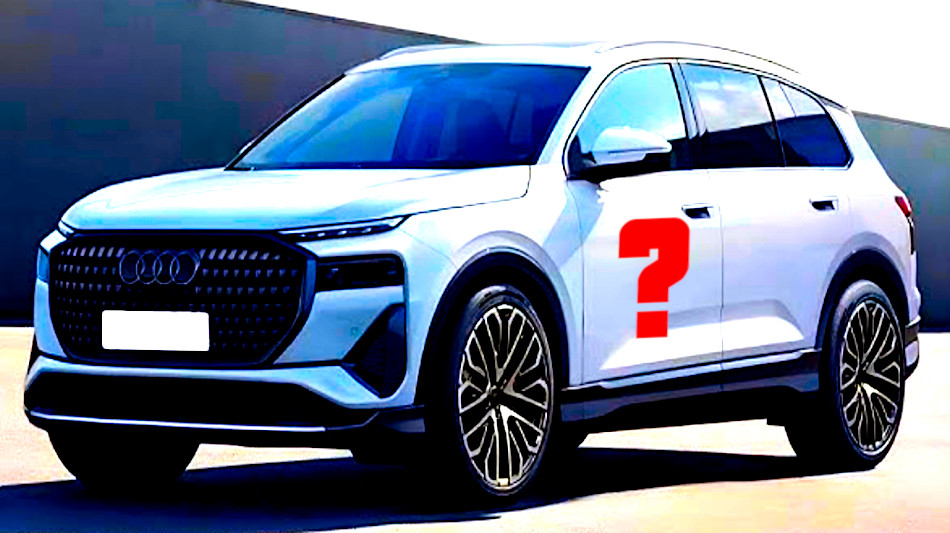
Audi Q9 – how likely is it to become a reality?

The new Audi Q9 is not arriving at a moment of effortless supremacy. It arrives while Audi is renewing its range, trimming costs and trying to restore the full credibility of its premium promise. A flagship SUV above the Q7 is strategically sensible: more presence, more margin potential and more relevance in a highly profitable class. But that also raises the burden of proof.
That burden begins with the facts. Audi has confirmed the Q9, yet there is still no official final price and no published WLTP range. Nor has the production powertrain line-up been fully disclosed in public. So the central question can only be answered provisionally today: the Q9 is not justified by default; its eventual price and its real-world electrified usefulness will have to justify themselves.
Range is where the issue becomes especially delicate. If Audi launches the Q9 as an electrified combustion model or a plug-in hybrid, a merely decent figure will not be enough in 2026. Buyers in this class expect more than paper efficiency and a premium screen landscape. They expect genuine everyday usability, calm long-distance comfort, intelligent charging and powertrain logic, and the sense that this is modern mobility done convincingly rather than transitional technology sold expensively.
The price question is even sharper. In the luxury SUV segment, six-figure pricing no longer shocks anyone on its own. What buyers have become far less tolerant of are forced package structures, option lists that spiral quickly and cabins whose tactile quality does not always match the invoice. This is where Audi currently carries some baggage. The brand still stands for disciplined design, good road manners and technical ambition. But the old certainty that an Audi would automatically feel peerlessly premium inside is not as secure as it once was.
That is why the Q9 is more than another new model. It is a test of whether Audi can still define premium rather than merely charge for it. Online debate repeats the same complaints: too expensive, too much screen logic, too many glossy surfaces, too little substance in the details, too much configuration pressure. The Q9 itself also divides opinion. Some see it as the overdue flagship Audi needs. Others see it as proof that size alone no longer creates desirability or legitimacy.
The sober interim verdict is therefore clear: the Audi Q9 could become a strong flagship, but today neither its price nor its range can be called justified by default. The official values are missing, and so is the proof that Audi has fully restored the blend of material quality, usability and credibility that once came almost automatically with the brand. Audi remains an important premium marque. But it is no longer beyond challenge. The Q9 now has to prove that Audi is selling substance first and prestige second.