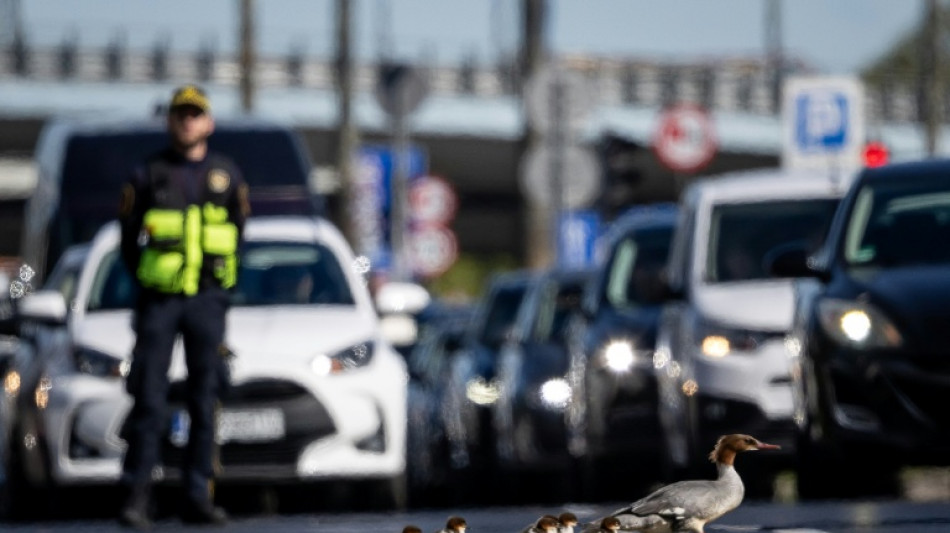
Traffic stop: Warsaw's celebrity birds on perilous urban quest / Photo: © AFP

Waddling across a Warsaw expressway, a brood of wild sea ducks brought traffic to a halt as volunteers held motorists at bay -- an annual ritual to protect the bustling Polish capital's famous ducklings.
Every spring, dozens of days-old ducklings must make the risky trek from a centrally located park where they hatch to the Vistula river.
Local volunteers are mobilised to help ensure their safe passage, scrambling in hi-vis vests to stop cars and shepherd the birds across one of Warsaw's busiest roads.
Waddling through the city of 1.8 million people, the groups of mergansers -- fish-eating sea ducks -- are led by their silver-feathered mothers, with their distinctive brown head crests.
"We call mergansers ambassadors of Warsaw's wildlife -- or our celebrities," said Barbara Rozalska from the city parks department.
She was speaking over the rumble of the six-lane expressway -- "one of the biggest threats" for the wild birds on their kilometre-long journey.
Rozalska is in charge of coordinating the volunteers, who, through April and May, monitor the park and tree cavities where ducks lay their eggs and the possible routes they may take towards the river.
Around 30 people -- trained by the city's ornithologist -- take turns to stay alert for any sighting of the mergansers.
"It's a bit like being on call at the accident and emergency department -- you get a call and you have to go, no matter if it's at dawn or in the afternoon," Rozalska told AFP.
The array of threats is not limited to road traffic.
"There are seagulls and crows, which can snatch a chick that gets away from its mother for a moment. There are also predatory fish that can drag a chick underwater," she said.
- No honking -
One of the first merganser mums to cross this season took almost 24 hours to make it from the park to the river, testing the patience of the volunteers monitoring their every step and stumble.
That included the 11 hours the birds spent nestled in the roadside greenery, waiting for their moment.
Daria Grzesiek, 38, on duty, called it a "very difficult day" for her team.
"But once she set off and began making her way towards the Vistula... the fatigue was gone. There was only the satisfaction of having successfully guided her safely along the way," Grzesiek told AFP.
The volunteers' job involves asking passersby to keep their distance and put their dogs on a leash.
They also take on the task of explaining to drivers why the traffic needs to be stopped -- normally only for a few minutes.
As their efforts have gained traction and the birds have shot to local fame, there is more understanding among those sat behind the wheel, Grzesiek said.
One person, she recounted, "was getting upset that we stopped traffic".
But "the other drivers simply explained to him that he should calm down -- because mergansers are coming".
(L.Møller--DTZ)