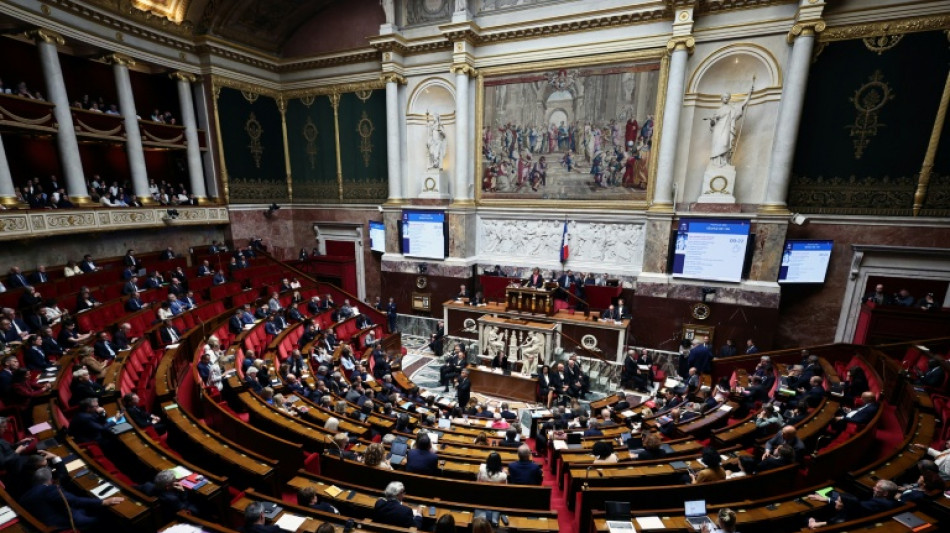
France's parliament adopts assisted dying law / Photo: © AFP/File

France on Wednesday moved closer to joining the ranks of countries that guarantee the right to assisted dying, a move championed by President Emmanuel Macron.
Macron had promised an assisted dying law when he was re-elected for a second term in 2022, in a change seen as one of the most important social reforms since France allowed same-sex marriage in 2012.
If the country's highest constitutional authority approves the legislation, France will join the Netherlands, Belgium, Switzerland and Canada in legalising assisted dying.
"In 2022, I made a commitment to open this path with the French people," Macron wrote on X.
"With seriousness, humility, and in full respect of our democracy, that commitment has been honoured."
Lawmakers applauded the bill's author Olivier Falorni, a former lawmaker-turned-mayor present for the adoption, after what he has said were "14 years of parliamentary battles".
The law had easily passed the National Assembly but was rejected by the Senate upper chamber, with the government allowing the lower house to have the final say without the Senate's assent, as permitted by the constitution.
Prime Minister Sebastien Lecornu has asked the Constitutional Council to examine the new legislation.
His office said it was called in after the lack of debate in the right-wing dominated Senate meant the text fell short of a draft "meeting both the aspirations of its proponents and the concerns of those worried about its implementation".
The council, whose rulings are binding, can in extreme cases declare an entire piece of legislation invalid or express reservations about certain sections.
Right-wing heavyweights from the traditional right Republicans party that dominates the Senate, such as speaker Gerard Larcher and former interior minister Bruno Retailleau, have staunchly opposed the legislation.
- 'Balanced' or 'very dangerous'? -
The law establishes a right to assisted dying for some adults suffering from an incurable condition.
They must be capable of expressing themselves in a "free and informed" manner and be suffering from physical pain.
This pain must either be unresponsive to treatment or, in the patient's view, unbearable, where they have chosen not to receive or to stop receiving treatment.
A physician is responsible for verifying the patient's eligibility, before a panel assesses the criteria.
Ultimately, the doctor makes the decision alone, and the patient may withdraw consent at any time.
The patient will administer a lethal substance themselves, with exceptions for those who are physically unable to be helped by a health worker.
Agnes Firmin Le Bodo, a centre-right lawmaker and former health minister who drafted the 2024 bill, said the law would be passed "because it is balanced".
But Christophe Bentz of the far-right National Rally party said the text was "very dangerous" and carries the risk of "abuses".
burs-parl/ah/phz
(M.Dorokhin--DTZ)