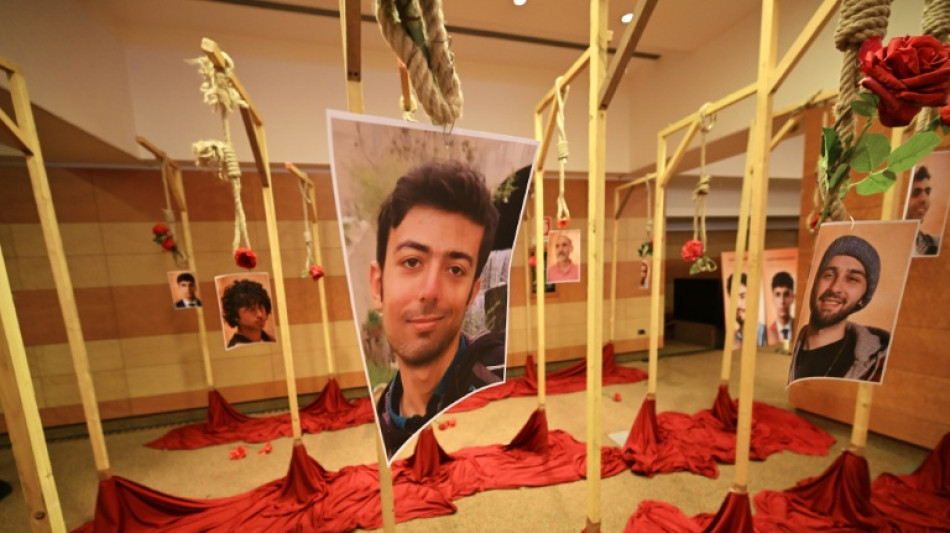
Iran ramps up executions under shadow of war / Photo: © AFP

Vahid Baniamerian's family only found out he was going to be executed when Iranian state media reports flashed on their phones, saying the supreme court would review his death sentence.
"They did not give any warning. Even the lawyer didn't know," a close relative of Baniamerian, based outside of Iran, told AFP, asking not to be identified.
"It was completely illegal, even based on their own oppressive laws."
Baniamerian, a 34-year-old academic who taught physics, was sentenced to death along with five other defendants on charges of membership of the outlawed People's Mujahedin (MEK) organisation. All six men have now been hanged.
He is one of dozens of people that rights groups say are political prisoners Iran has executed since the war with the United States and Israel started, from protesters to alleged members of banned groups and people convicted of spying.
Iran has pressed ahead with executions since the earliest phase of the war finished in March, in what activists see as an attempt to instill fear in society and prevent a repeat of the protests that shook the leadership earlier this year.
The political situation is now all the more febrile after the killing of longstanding supreme leader Ali Khamenei on the first day of the war and his replacement by his son Mojtaba, who has yet to appear in public.
- 'Where else in the world?' -
Now that a shaky ceasefire has ruptured, rights groups fear Iran will further ramp up executions to intimidate people into silence.
"With the breakdown of the ceasefire and the resumption of the war, we are deeply concerned that the authorities will exploit the situation to intensify the execution of political prisoners," said Mahmood Amiry-Moghaddam, the director of the Iran Human Rights (IHR) NGO, which tracks executions.
IHR warns "hundreds of political prisoners and protesters are currently facing capital charges" with around 100 already sentenced to death.
This includes over 70 people awaiting the gallows in a single prison -- Dastgerd in the central city of Isfahan.
IHR has repeatedly called for what it terms Iran's "killing machine" to be a central part of any dialogue with the Islamic republic.
"The international community -- and the European Union in particular -- must make an immediate moratorium on executions a central issue" in any negotiations, said Amiry-Moghaddam.
According to IHR, since the start of the war, 24 people have been hanged over the January protests and another two over a previous protest movement that shook Iran between 2022 and 2023.
Authorities say those convicted carried out deadly attacks against security forces or targeted public buildings, but rights groups say they were tortured and convicted after grossly unfair fast-track trials.
Another 13 men have been executed for alleged links to the MEK and other banned groups, while 10 people have been hanged on accusations of espionage.
But with over 400 people executed so far in this year alone, according to IHR, such high-profile cases do not form the bulk of capital punishment in the country.
Most people are hanged on drugs-related charges or for murder.
To protest the high levels of hangings at their prison, inmates at Ghezel Hesar prison in Karaj outside Tehran have staged a sit-in protest since July 13 after fellow prisoners were taken to solitary confinement ahead of hanging on drugs charges.
Footage shared by rights groups on social media showed inmates sitting outside their cells chanting "no to execution".
"These are prisoners who committed errors simply to afford the basic necessities of life, and they deeply regret their actions. Where else in the world is a human life taken for a first mistake?" the prisoners said in a statement seen by AFP.
- 'Do not cry' -
Last year, Iran put to death over 2,150 people, according to Amnesty International, making it again by a wide margin the world's most prolific executioner after China.
Baniamerian was from childhood "a kind and humble person", his relative said.
"He had a sense of responsibility. He always wanted to help," they added.
"Even in his darkest moments, he chose to encourage others instead of giving in to fear," the relative said.
In his last days in prison he tried to keep up the spirits of his fellow inmates and managed to have smuggled out an audio message to his mother.
"I said goodbye to you and did not know what lay ahead," he said referring to their final meeting.
A video also smuggled out of prison showed him singing a patriotic song in the prison yard ahead of execution.
"The day they took them to solitary, Vahid told them 'do not cry in front of the enemy. We are proud of what we are doing'," his relative said.
"They did not bow."
(L.Barsayjeva--DTZ)