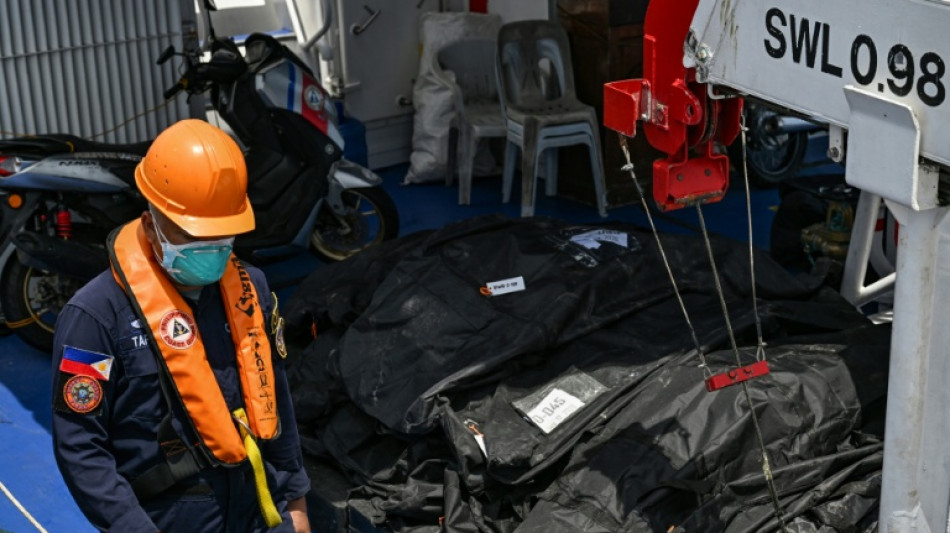
Philippine rescuers pull more victims from charred ferry / Photo: © AFP

The bodies of 41 victims of the worst Philippine ferry disaster in over a decade made their way through the blue waters of a resort area on Sunday, bound for a dock where forensic investigators awaited them.
Days after a fire ripped through the M/V June Aster, it is clear few of its victims ever made the water, with nearly all of the 76 confirmed dead found aboard the grounded vessel.
The 24-year-old ferry, known locally as a "roro" (roll-on, roll-off), was carrying vacationers, businesspeople and families headed for loved ones in Coron, Palawan, when it erupted in flames following an explosion in its hold.
Some areas, such as the cargo deck and engine room, remain to be searched.
"The water is still high," Commodore Noemie Cayabyab told reporters Sunday on the deck of the BRP Melchora Aquino, a 97-metre (318-foot) coast guard vessel.
"The focus right now is to retrieve (any additional bodies)."
The coast guard confirmed late Saturday that 41 more corpses had been found aboard the June Aster, bringing the death toll from a blaze that swept through the vessel "in seconds" to 76 passengers and crew.
Earlier in the day, 30 corpses, charred badly enough that DNA must be extracted from teeth and bones, were brought ashore to waiting examination tents.
Some will be "temporarily" buried in a local cemetery pending identification.
Thirty passengers, including two Chilean nationals and 13 crew, have been rescued, according to the coast guard. Five others were declared dead in the immediate aftermath of the incident.
- 'Weeks or months' -
AFP journalists came within a nautical mile of the grounded ferry on Sunday before stopping due to the shallow waters, transferring to a smaller boat that contained body bags holding the 41 recovered victims.
A drone flown over the ferry showed a burnt-out husk, decks covered by ash and metal twisted by the intense heat.
A floating orange barrier intended to keep fuel from leaking into the ocean surrounded the ship.
Coast guard search and rescue efforts aided by fishermen in the surrounding waters have so far yielded nothing, Cayabyab said Sunday.
About 13 people are still considered missing, including the ship's captain, though notoriously inaccurate manifests in the Philippines make it hard to be certain.
Some have already stepped forward to say family members were aboard the ship despite not appearing in records.
"Most of the victims we've retrieved are badly burned," Police Lt. Colonel Richard Mangalip, a victim identification specialist, told reporters aboard the Melchora Aquino.
"We are doing our best to collect any possible identifying marks," he said, adding the painstaking DNA process could take "weeks or months".
"As of last night, we are still at cadaver four," he said.
Victims were found clustered together in different parts of the vessel, he added, some found in positions that suggested they had embraced in their final moments.
- History of disasters -
An emotional Josenit Mayo, 40, told AFP this week that her daughter had been aboard the ferry, returning from the capital Manila for a family visit because "she was lonely" and missed her siblings.
Myra Cabilan fought back tears describing the search for her missing brother.
"His wife had just given birth a month ago. He was so happy he was given a daughter," she said.
The archipelago nation of 116 million has a long history of disasters involving the inter-island ferries that ply its seas.
Many rely on cheap and poorly regulated boats and ships for transport between the country's more than 7,000 islands, despite regular accidents.
In January, a triple-decker ferry carrying more than 340 people sank off the southern Philippines, killing at least 52 people.
On Sunday, Dindo Macalinao, a human resources official with Atienza Interisland Ferries, the June Aster's owner, said it was too early to assign blame.
With the investigation ongoing, it was hard to say "if this was negligence on the part of the company ... or truly an incident that may have occurred beyond the company's control," he said.
(V.Sørensen--DTZ)