Indian 'eternal flame' in memory of war dead is extinguished

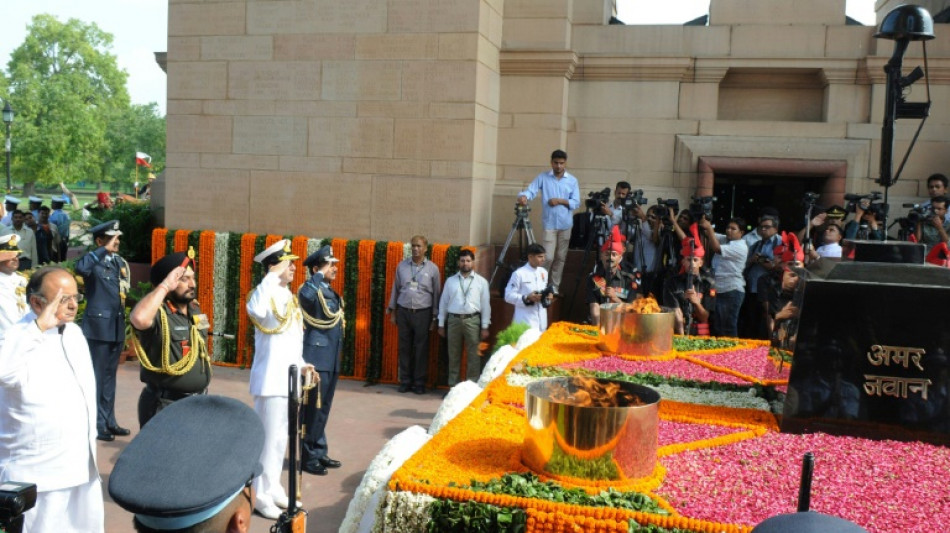
An "eternal flame" in memory of soldiers killed during the India-Pakistan War of 1971 at one of Delhi's most symbolic landmarks was put out Friday, 50 years after it was first lit.
The Amar Jawan Jyoti or flame of the immortal soldier was installed at the India Gate in New Delhi following the conflict, which eventually led to the creation of independent Bangladesh.
It had burned ever since, fuelled first by cylinders of liquified petroleum gas and later with piped gas.
But the current Hindu nationalist government of Narendra Modi inaugurated a new National War Memorial nearby in 2019, with its own eternal flame.
The Modi government has embarked on multiple projects to remodel and rename key sites and institutions in the capital and has been accused of seeking to stamp its own identity on the city.
And the India Gate has a complicated history: it dates from the British Raj, built by the colonial power in memory of Indian soldiers killed fighting for it in World War I and inscribed with their names.
A soldier in a red turban lit a single torch from each of the four flaming urns around the Amar Jawan Jyoti -- a black marble plinth topped with a rifle and helmet -- before their fuel was cut off on Friday.
The flame was taken to the National War Memorial to be merged with its own light.
Rahul Gandhi of the main opposition party Congress -- under whose grandmother Indira Gandhi the flame was installed following the 1971 war -- expressed "great sadness".
"Some people cannot understand patriotism and sacrifice," Gandhi tweeted.
Another opposition leader Manoj Kumar Jha accused the Modi regime of "memory erasure".
But Amit Malviya, a member of Modi's Bharatiya Janata Party, said the names on the India Gate were "not of those who fell in 1971 and wars before and after" involving independent India.
"National War Memorial is where they have been honoured, hence decision to merge," Malviya tweeted.
And Brigadier Basant Ponwar, who fought in the 1971 war and now heads the Counter Terrorism and Jungle Warfare College in Chattisgarh state, supported the move.
"The flame was lit in 1972 for want of a memorial," he told AFP.
"India Gate was built by the British Raj. Now we have our own memorial of independent Bharat," he added, using the Indian name for the country.
(L.Møller--DTZ)