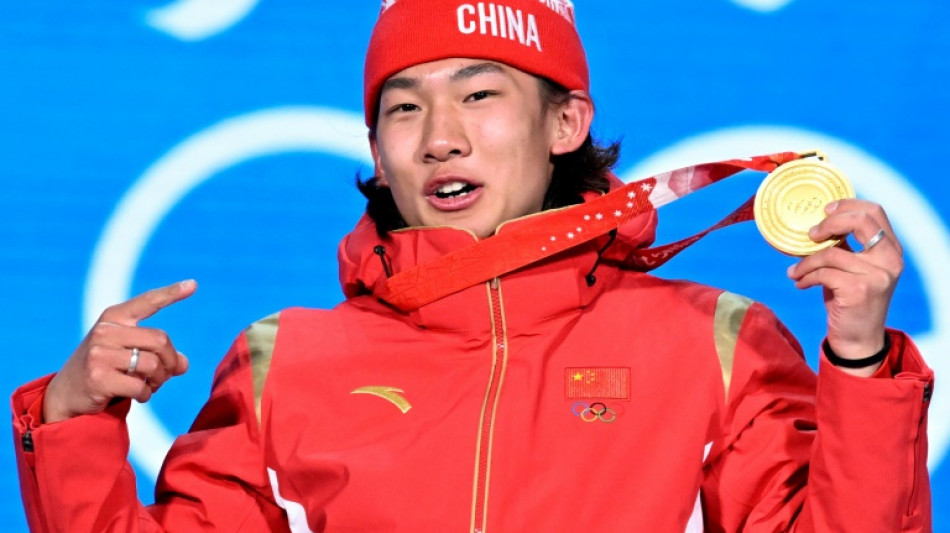
Olympic snowboard king Su Yiming showcases a more confident China

Sporting shoulder-length hair, rings and baggy trousers, teenage snowboarding sensation Su Yiming looked every inch the cool, confident ambassador of China's new youth as he swept to home Olympic gold.
The former child actor is one of the breakout stars of the Beijing Olympics having won silver and then on Tuesday gold, catapulting the 17-year-old to stardom and amassing him an avid social media fanbase at home.
Su heralds the rise of a new generation of young, patriotic Chinese athletes with the kind of aura of cool that has eluded the young Olympians who, unlike Su, are products of China's gruelling Soviet-style sports academies.
China's first men's Olympic medallist in snowboarding has earned a legion of Chinese fans through his down-to-earth demeanour, effortless style and love of music -- as well as becoming the new face of a sport that champions individualism and daredevil courage.
"Snowboarders have a particular style to them which Su fits perfectly. It's something that would definitely resonate with younger generations in China and elsewhere," said China-based sports analyst Mark Dreyer, author of "Sporting Superpower: An Insider's View on China's Quest to Be the Best".
After a scintillating run in the slopestyle last week, where he won silver, Su clasped his hands to his mouth and repeatedly screamed a profanity in English live on air.
"My worry is that at some point they're going to ask him to conform and basically be a snowboarder without (a personality)," added Dreyer.
"He could legitimately become a great soft-power ambassador for China -- but not necessarily the soft-power ambassador that China wants."
- One billion views -
Hailing from frigid northeastern China, Su first took to the slopes as a toddler. He joined the Chinese national team aged 14 after years spent balancing his passion with a fledgling acting career.
He landed his first brand deal with snowboard manufacturer Burton at age seven, although his commercial endorsements are a fraction of his fellow teenage star Eileen Gu, the Californian-born Chinese freestyle skier who has also won silver and gold.
"He's really just come into the top echelon of riders in the last four to six months," said Dreyer.
Described by his coach as mature beyond his years, the snowboarder has said in interviews that he trains "320 days a year", sometimes for six hours a day when trying to master a tricky new move.
His father says that he has an "innate passion for snowboarding".
When not training abroad, Su surfs on China's southern island of Hainan during the summer off-season.
"For him to compete and stay at the top level, he’s got to be in Europe and the United States. He's getting all those influences and becoming more of an international person," said Dreyer.
Within hours of his Big Air gold on Tuesday, the hashtag "Su Yiming gold medal" racked up more than one billion views on China's Twitter-like Weibo.
"If you have a goal, have courage to try it and give your all to it," Su told state broadcaster CCTV.
- Privilege debate -
These young, culturally confident stars -- including the 18-year-old Chinese-American Gu -- are a valuable addition to China's soft-power arsenal at a time when Beijing is keen to project cultural influence abroad and showcase domestic confidence.
The cosmopolitan lifestyles of Su and Gu have sparked social media reflection on their relative privilege compared to figures such as 14-year-old Olympic diver Quan Hongchan, who has spoken about earning competition money to support her farmer parents.
While Beijing has held a firm grip on its rigid state academy system for athletes -- prioritising sports with greater medal chances -- experts said it has slightly relinquished control in certain disciplines, particularly as it pushes winter sports.
Zheng Jinming, professor of sport management at Singapore's National Institute of Education, said this has allowed market forces to create a more organic interest in "cool" sports among younger generations of Chinese who have grown up in better economic conditions.
"But can those who are interested in these cool sports successfully access resources which can enable them to embark on, undertake quality training and progress in these sports?" asked Zheng.
Analysts also questioned whether these new sports celebrities would be able to retain authenticity as their popularity in China snowballs.
The more China wants Su to conform to their idea of a healthy role model, "the more it takes away from his appeal in the first place", said Dreyer.
(Y.Ignatiev--DTZ)