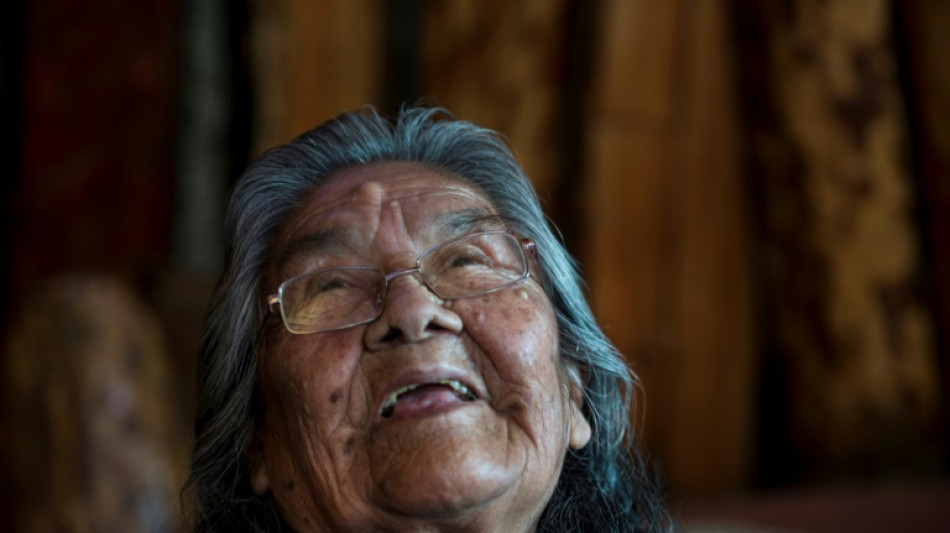
Chile's last Yaghan speaker dies aged 93

Cristina Calderon, the last native speaker of Chile's indigenous Yaghan language, has died at the age of 93, her family said Wednesday, in a blow for a dwindling culture at South America's extreme southern tip.
Calderon, known locally as "Grandma Cristina," was recognized in 2009 by the Chilean government as a "living human treasure" for her work in preserving a culture at risk of extinction.
Until near the end of her long life, she spent her days making traditional reed baskets and other handicrafts, and imparting the language and culture of her people to her descendents.
The melodic Yaghan language has no written form.
"I'm the last speaker of Yaghan. Others can understand it but don't speak it or know it like I do," Calderon told journalists in 2017 in Villa Ukika, where the last few dozen of her people live.
Her daughter Lidia Gonzalez Calderon announced the death on Twitter Wednesday as "sad news for the Yaghan."
"Everything I do in my work will be in your name. And in it will also be reflected your people," she added.
The younger Calderon is vice president of the Constitutional Convention writing a new founding law for Chile.
- 'Alive for ever' -
The Yaghan once lived off fishing, paddling their canoes along coastal waterways, but mostly rely on tourism now, making handicrafts and working as seasonal laborers.
"The younger generation know the language but not to the same degree that Cristina does," Maurice van de Maele, an anthropologist living in the region, warned five years ago.
Chile's President-elect Gabriel Boric, who is from Punta Arenas in Chile's extreme south, said on Twitter that Calderon's "teachings and struggles from the south of the world, where everything begins, will remain alive for ever."
The Yaghan have lived in the "End of the World" region at the tip of South America for some 6,000 years and numbered about 3,000 before the arrival of European settlers about 150 years ago.
They fished the region's notoriously dangerous waters, wearing little clothing and smearing their bodies in seal fat, only donning seal skins when temperatures plummeted.
The presence of the settlers changed the Yaghan, causing them to adopt a more sedentary lifestyle and to start wearing clothes.
While they retain some of their customs, such as weaving baskets with reeds, the Yaghan are losing their tribal legends as well as knowledge of ancient trails.
Calderon was long a symbol of cultural resistance for Chile's indigenous communities.
(L.Møller--DTZ)