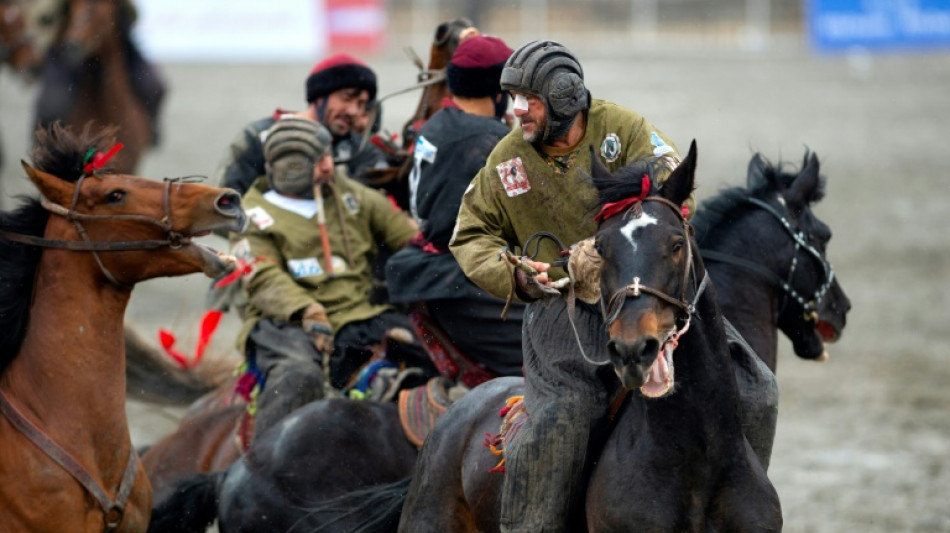
Not for the faint-hearted, Taliban embrace buzkashi in new Afghanistan

The announcer roared over the public address system as a lone rider separated from a melee of horses and galloped towards a chalk circle drawn in the middle of a muddy field in the Afghan capital.
Despite being pursued by what appeared to be a cavalry charge, the rider dumped his "prize" in the circle and raised an arm in triumph.
Kandahar had taken the lead against Kunduz in Sunday's grand final of Afghanistan's national buzkashi championships.
Banned as "immoral" when the Taliban first ruled from 1996 to 2001, the hardline Islamists have embraced buzkashi since returning to power in August, and the winning team hails from their heartland despite it having no real tradition of the sport.
"Unfortunately, buzkashi was not allowed previously and was only played in provinces where the Taliban didn't rule," Qais Hassan, the owner of the winning Kandahar team, told AFP.
"Today, luckily, buzkashi is not only being played all over Afghanistan, but the government, the Islamic Emirate, is organising this competition."
The sport is both spectacular and violent -- a lot like the country, many Afghans are quick to tell you -- and steeped in history.
Two teams with six horsemen a side fight for possession of, traditionally, a beheaded animal carcass -- buzkashi means "dragging the goat" in Persian -- with the aim of dropping it into the "circle of truth".
- Injuries are common -
It has been played for centuries in Central Asia, with slight variations from country to country.
These days a 30-kilogram (15-pound) stuffed leather bag resembling a carcass is used instead of the real thing, but the skills required to compete remain the same.
Horses and riders can be substituted from 12 on each side -- a necessity as injuries are common, although most riders shrug them off after brief treatment.
The mounts barge violently against each other, rearing and throwing their hooves into the mix. Riders lash the flanks of their steeds -- and frequently their opponents too.
Sometimes a horse and rider fall, and on Sunday a member of the Kunduz team broke his nose, but the powerfully built 50-year-old soon returned to the fray.
Kandahar and Kunduz were also finalists last year, but the game was called off in controversy after a security alert with just 40 minutes played.
This time, the contest took place under tight Taliban security, six months after the fundamentalist Islamists returned to power.
As spectators waited for the action to start, religious songs were broadcast over the public address system and white Taliban flags fluttered in the breeze.
The sport has become commercialised too.
Large billboards were set up around the field, and riders wore different-coloured numbered jackets -- some even sporting advertising patches.
Since returning to power the Taliban have promised a softer version of the harsh rule that characterised their first government, when they banned most sports -- including football because it showed men's legs.
"The government has allowed the independence of the Olympic administration and along with buzkashi, we have football, wrestling and other sports -- all supported by the government," said Ahmadullah Wasiq, head of Afghanistan's national TV, which co-organised the tournament.
For the record, Kandahar won 2-0, with the winning team carrying off a handsome trophy presented by a senior Taliban official.
The mud and rain made conditions treacherous, but Kandahar's Abdul Salam Aymaq -- who took up the sport as a teenager -- shrugged them off.
"There was nothing difficult for us," the 32-year-old told AFP.
(W.Uljanov--DTZ)