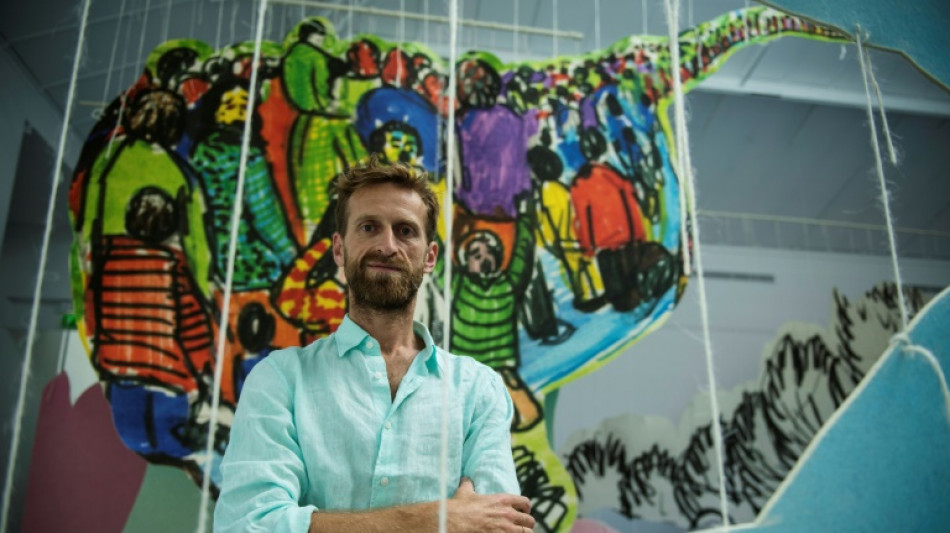
Revisiting trauma with a child-refugee-turned artist / Photo: © AFP

Petrit Halilaj knows something about how art can help pull children out of the horror of war -- but also the dangers of them being used as a propaganda tool.
As a 13-year-old refugee from the conflict in Kosovo in 1999, his felt-tip pen drawings of soldiers killing civilians were singled out by then-UN secretary general Kofi Annan as a powerful depiction of the war's impact on young minds.
Halilaj, now 36, has since become a successful artist and has revisited those drawings with a radical show for Britain's Tate and now at the kamel mennour gallery in Paris -- pulling his original pictures apart and blowing up elements into huge installations.
In the process, he tried to recall why he had ultimately refused to hand over the drawing he had prepared for Annan.
"At first, I thought this was my chance to stop the war. I was rushing to complete a big drawing before he arrived," Halilaj told AFP with a laugh.
It was, he thinks, his grandfather who cooled his excitement.
"My grandfather was almost annoyed by my enthusiasm -- he couldn't deal with my joy in drawing the picture. He told me (Annan's visit) was just theatre."
When Annan visited the camp in Albania, accompanied by the world's media, and asked if he could take the drawing to a major UN meeting, Halilaj said no.
"Maybe I was thinking about my grandfather's words," said Halilaj. "But maybe I just had a sense that this is my drawing and I wanted to keep it!"
- 'Afraid of strangers' -
The teenage Halilaj made the drawings under the supervision of an Italian child psychologist who was volunteering in the camp.
His experiences have obvious relevance as millions of children are again forced to flee a brutal European war, this time in Ukraine.
"In war, you learn to be afraid of strangers and the other. Only once I was in the camp did I learn to start connecting to strangers again and having art was so important as a way to express ad share," he told AFP.
But his new show emphasises the importance of being guided by a psychological expert.
Its co-curator, Amy Zion, said she was concerned to see pictures by Ukrainian children being used to depict the war in newspapers recently.
"It worried me that it could so easily become a journalistic trope," she told AFP.
"Petrit had a psychologist trained in working in traumatic situations who really understood how to present the situation as therapy first and foremost, and not something to be instrumentalised."
- 'Coming out' -
That is perhaps why many of the drawings did not feature violence, but rather peaceful scenes of nature and animals.
In revisiting them, Halilaj was fascinated to rediscover elements that suggested other issues stirring in his young mind.
He highlights the huge colourful peacock that now dominates the exhibition space in Paris.
"Clearly, this was also me coming out in silence as a queer teenager. When I see the colours I think: this is a pride march!" he said, laughing.
"I had more going on inside than just the war."
(O.Zhukova--DTZ)