Google's new California offices bank on in-person work / Photo: © AFP

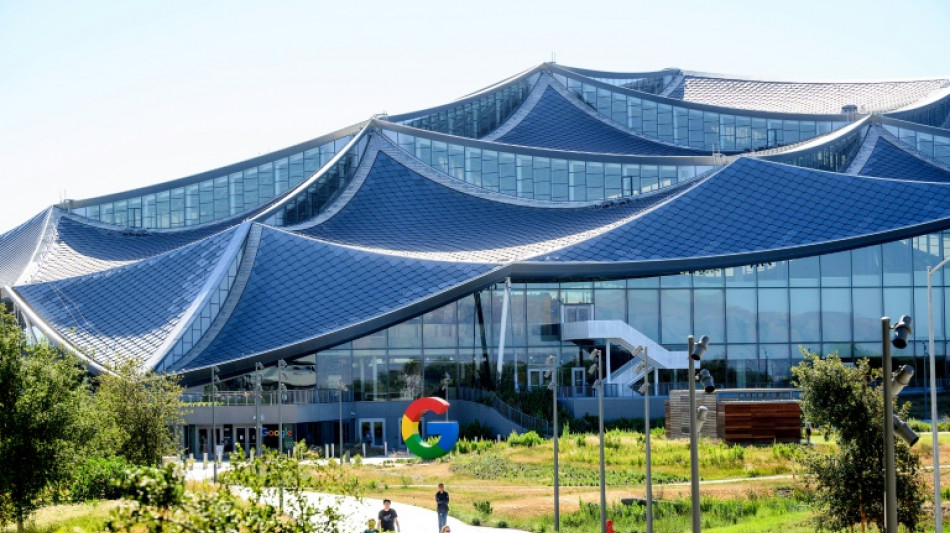
Roofs coated with canopy-like solar panels and indoor spaces awash in sunlight: Google has bet big on in-person work with its sprawling new Silicon Valley offices.
AFP visited Google's 1.1 million square foot (100,000 square metre) campus on Monday as the tech giant welcomes employees back after pandemic-era telecommuting.
"Luckily, a lot of the things we were already planning kind of set us up for success with Covid," said Michelle Kaufmann, Google director of development for built environments.
"Thank god, because otherwise we would have built these buildings and we would have to change," she added.
The campus spans 42 acres (17 hectares) of leased federal land next to NASA's Ames Research Center in Mountain View, close to the company's headquarters.
It includes an event center and small apartments that employees from out of town can use when visiting for work.
Ventilation systems in the buildings use 100 percent outside air, a plus against the spread of Covid-19.
- 'Not going empty' -
Ground floors feature cafes, fitness centers, meeting rooms, social spaces and playful touches such as multi-colored stationary bikes that people can pedal as they chat, with the option of plugging in to charge devices with power they generate.
Upper floors of the two story structures are home to desks, with furniture and fixtures easily reconfigured as teams want.
Work areas are divided into "neighborhoods" with homey touches and even "courtyards" with cozy furniture.
"The ground level is really like a market, so it's more the vibrant." Kaufmann said.
"Upstairs is more the quiet space where the teams really do a lot of their work," she added.
Bay View campus is planned to accommodate 4,500 workers, with move in to take place during the coming weeks.
Solar panels provide power, geothermal systems aid with heating and cooling and water collection and recycling systems result in surplus that is used to help restore wetlands on the property.
Google expects a norm going forward for people to typically work from the office about three days a week, with that rhythm changing depending on phases of projects and, of course, the tempo of the pandemic.
"I don't believe that any of our buildings are going to be empty, that is not a problem that we are worried about," Kaufmann said.
"We are more worried are we going to have enough space, just because the company is still growing," she added.
Google has more than 45,000 employees in the Silicon Valley area.
(V.Varonivska--DTZ)