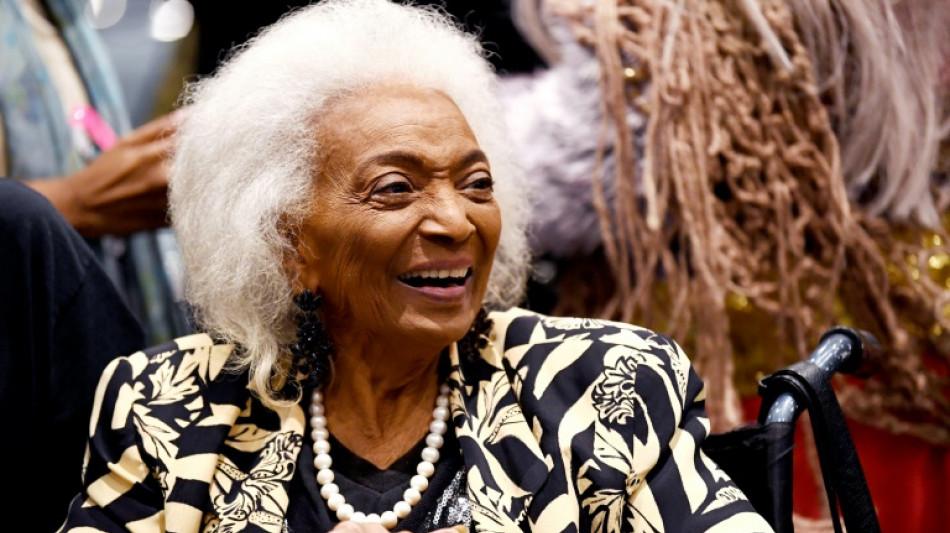
Nichelle Nichols, Uhura of 'Star Trek' fame, dies at 89 / Photo: © GETTY IMAGES NORTH AMERICA/AFP/File

Nichelle Nichols, a groundbreaking Black actress who played communications officer Nyota Uhura with cool authority on the popular 1960s series "Star Trek," has died at 89.
Her son, Kyle Johnson, announced the death on the official uhura.com website, saying, "Last night, my mother, Nichelle Nichols, succumbed to natural causes and passed away. Her light, however, like the ancient galaxies now being seen for the first time, will remain."
A family spokesman said Nichols died in Silver City, New Mexico, where she had been living with her son.
Tributes poured in quickly, including from a long list of devoted "Trekkies."
George Takei, who as helmsman Sulu shared the bridge with Lieutenant Uhura on the USS Enterprise, called her "trailblazing and incomparable," while prominent Georgia politician Stacey Abrams lauded her as a "champion, warrior and tremendous actor."
Nichols made history with one of the first interracial kisses on US television -- a 1968 embrace shared with the Enterprise's Captain Kirk, played by William Shatner (a kiss deemed worthy of a separate entry in Wikipedia).
Martin Luther King Jr. himself once praised Nichols, who broke ground with her powerful performance at a time when Black actors more often were cast as servants or criminals.
Nichols, who had trained in ballet and musical theater, at one point told "Star Trek" creator Gene Roddenberry that she wanted to quit the show to return to the theater.
But when she mentioned that to King, in a chance meeting recounted by the Hollywood Reporter: "All the smile came off his face and he said, 'You can't do that. Don't you understand, for the first time, we're seen as we should be seen? You don't have a Black role. You have an equal role.'"
She stayed.
While best known as Uhura, Nichols had a varied career, dancing with Sammy Davis Jr. in "Porgy and Bess," appearing on the NBC series "Heroes" and recording an album.
She also played Uhura -- a name taken from the Swahili for "freedom" -- in the first six "Star Trek" movies.
Later, Nichols worked as a recruiter for NASA -- which reached out to her after she had criticized its lack of diversity -- and successfully encouraged several talented African-Americans and women of all races to consider careers with the space agency.
(W.Uljanov--DTZ)