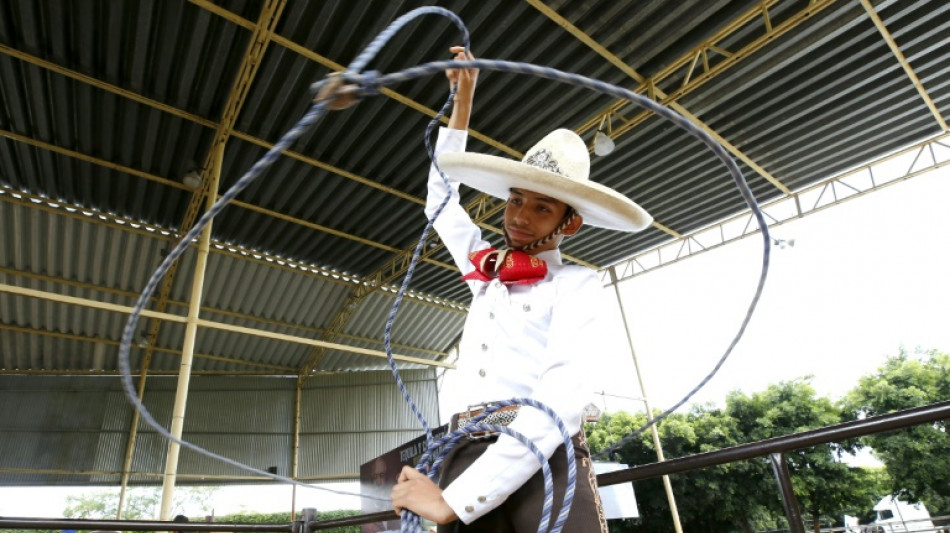
School trains new generation in Mexican cowboy traditions / Photo: © AFP

Wearing a wide-brimmed hat, silver-buttoned shirt and embroidered tie, teenager Victor Teran skillfully twirls a lasso at a Mexican school training younger generations in traditional cowboy skills.
Three years ago Teran's father gave him the choice of learning soccer or "charreria" -- cattle-ranching techniques that are recognized by UNESCO as intangible cultural heritage of humanity.
"I told him, 'let's go and do charreria right now!'" the 17-year-old said.
With the help of teachers at the school in Tlajomulco de Zuniga in the western state of Jalisco, Teran learned to ride a horse and to spin and throw a lasso so that it loops around the front legs of a horse.
The school, which opened in 2016, the same year that the tradition was inscribed by UNESCO, offers free classes to budding young "charros."
Novices and foreigners are welcome.
"Charreria has grown a lot at the national level," said school founder Victor Hugo de la Torre, who has 24 years as an instructor under his cowboy belt.
"Most of the students at the school don't come from a charro family, but they like it and join in," he added.
Today there are 100 regular students, of both sexes.
Beginner, intermediate and advanced groups of up to 15 students take part in three hours of training twice a week to hone their skills.
The first challenge is to learn to twirl a lasso and throw it around the neck of a docile bull.
When they have mastered that they progress to mounting a horse unaided using stirrups.
Then comes learning to ride the horse and eventually to lasso moving animals.
The girls also learn "escaramuzas" -- Spanish for "skirmishes" -- which involve performing tricky formations on galloping horses while riding sidesaddle.
"I started when I was four years old when my parents got me riding," said Alma de la Torre, 20, wearing traditional dress inspired by the garments of women who fought in the Mexican revolution.
Becoming a charro requires "a lot of dedication," but the financial rewards can be worth it, said school founder De la Torre.
Average salaries range from $1,500-4,000 a month, while those at the very top can take home around $7,500, he said -- a wage beyond the dreams of most Mexicans.
While the ideal age to start learning is six years old, many students begin as teenagers, said school head Rocio Rodriguez.
"Anyone can learn, of any nationality, so long as they want to," she said.
(M.Dylatov--DTZ)