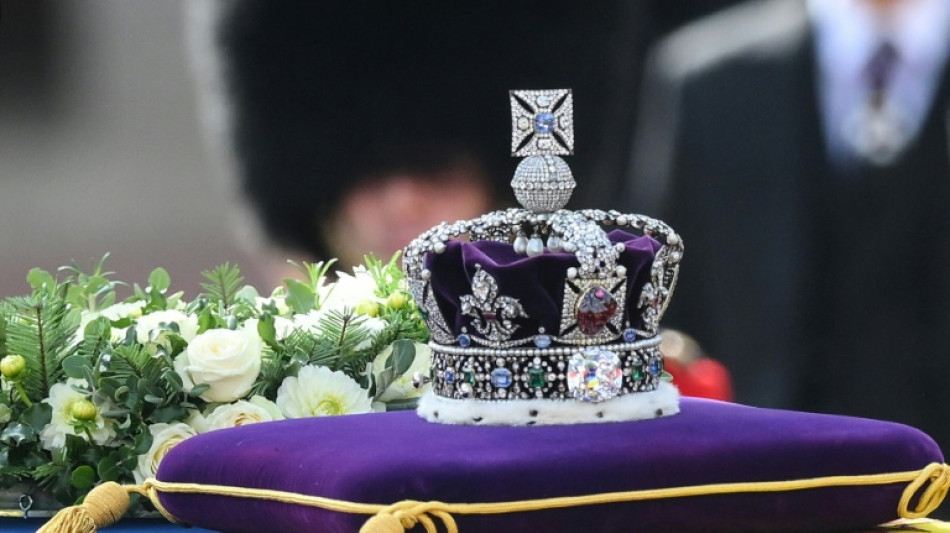
Imperial State Crown placed on Queen Elizabeth II's coffin / Photo: © POOL/AFP

Britain's Imperial State Crown, which rests atop Queen Elizabeth II's coffin as her casket lies in state, is a powerful symbol of royal wealth, majesty and sovereignty.
The crown, placed on a purple cushion, bears 2,868 diamonds, 269 pearls, 17 sapphires and 11 emeralds which sparkled as the coffin travelled from Buckingham Palace and lay in state in Westminster Hall.
Commissioned for her father king George VI's coronation in 1937, the crown was worn by the queen at her coronation in 1953 and features in a famous portrait of the event.
It was also worn by the monarch at the annual ceremony marking the opening of parliament and is stored along with the other priceless crown jewels in the Tower of London.
Another royal crown -- St Edward's -- was made in 1661 for the coronation of King Charles II and is made from solid gold.
It is used only in the moment of crowning and was long considered too heavy to wear, weighing around two kilogrammes (4.4 pounds) -- twice as much as the Imperial State Crown.
The queen once joked that even the Imperial State Crown was so heavy that if she looked down while wearing it, "it would break your neck."
- 'Quite important' -
"Fortunately, my father and I had the same sort of shaped head, but once you put it on it stays. It just remains, itself," she told the BBC in 2018.
"You can't look down to read the speech: you have to take the speech up," she said of her annual address to parliament.
"So there are some disadvantages to crowns but otherwise they're quite important things," she smiled.
Given its weight, she stopped wearing the Imperial State Crown to the state opening of parliament in her 90s. Instead, it was carried in on a cushion.
The main diamond at the front of the Imperial State Crown is called the Cullinan II.
It was cut from the Cullinan Diamond, the largest diamond ever mined when it was discovered in South Africa in 1905.
Other famous jewels include the Black Prince's Ruby -- cut from a stone called ruby spinel that resembles ruby -- and the Stuart Sapphire at the back of the crown.
The latter 104-carat gem has an uncertain history but is thought to date back to King Charles II who ascended to the throne in 1660.
(U.Stolizkaya--DTZ)