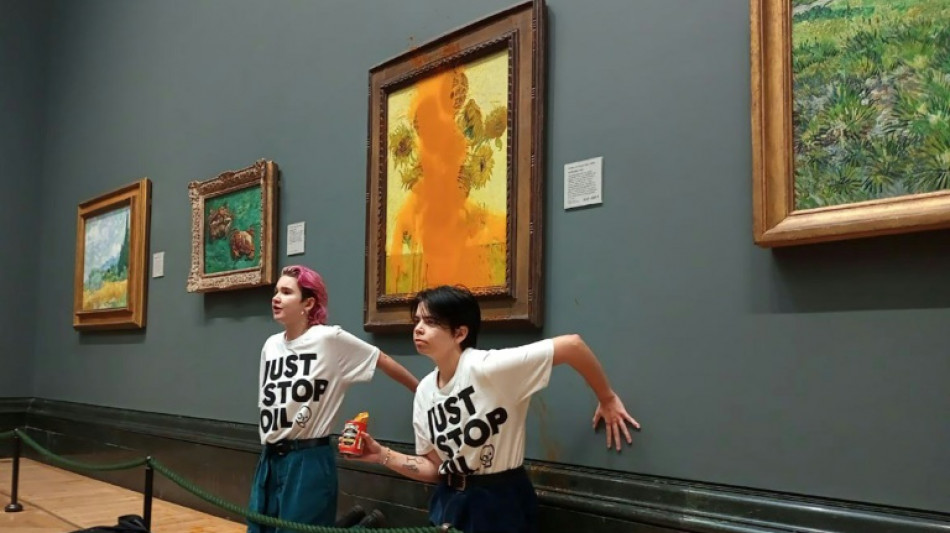
Climate activists throw soup over Van Gogh's 'Sunflowers' in London / Photo: © Just Stop Oil/AFP

Environmental protesters threw tomato soup over Vincent van Gogh's "Sunflowers" painting at the London's National Gallery on Friday, in the latest "direct-action" stunt targeting works of art.
The gallery said the protesters caused "minor damage to the frame but the painting is unharmed".
Protest group Just Stop Oil aims to end UK government approval for exploring, developing and producing fossil fuels, and has mounted a series of high-profile protests.
London's Metropolitan Police said its officers arrested two protesters from the group for criminal damage and aggravated trespass after they "threw a substance over a painting" at the gallery on Trafalgar Square and glued themselves to a wall just after 11 am (1000 GMT).
Police said they had unglued the protesters and taken them to a central London police station.
The National Gallery said the two protesters "appeared to glue themselves to the wall adjacent to Van Gogh's 'Sunflowers'" and threw a "red substance" at the painting. The room was cleared of visitors and police were called, it added.
A video posted on Twitter by the Guardian newspaper's environment correspondent Damien Gayle and retweeted by the eco-activism group shows two women wearing T-shirts bearing the slogan "Just Stop Oil" lobbing cans of soup at the iconic painting.
After glueing themselves to the wall, one of the activists shouts: "What is worth more, art or life?"
"Are you more concerned about the protection of a painting or the protection of our planet and people?" she asks.
In the video, someone can be heard yelling "oh my God" as the soup hits the canvas and another person shouts "Security!" while soup drips from the frame onto the floor.
Just Stop Oil said in a statement its activists threw two cans of Heinz Tomato soup over the painting to demand the UK government halt all new oil and gas projects.
It later tweeted that the protest's message was "Choose life over art".
"Human creativity and brilliance is on show in this gallery, yet our heritage is being destroyed by our government's failure to act on the climate and cost of living crisis," the group said.
The activist group said the painting has an estimated value of $84.2 million.
The National Gallery says on its website the signed painting from 1888 was acquired by the gallery in 1924.
Van Gogh created seven versions of "Sunflowers" in total and five are on public display in museums and galleries across the world.
One of those -- the Van Gogh Museum in Amsterdam -- said it was keeping "a close eye on developments" that might affect its own security measures.
Well-known Dutch 'art detective' Arthur Brand, dubbed the "Indiana Jones of the Art World" for recovering famous artworks, condemned the attack.
"There are hundreds of ways to achieve attention for the climate problems. This should not be one of them," he said.
- 'Cross a line' -
The attack came a week after British Home Secretary Suella Braverman issued a threat to direct-action climate protesters, who she said were using "guerrilla tactics" to bring "chaos and misery" to the public.
"Whether you're Just Stop Oil, Insulate Britain or Extinction Rebellion, you cross a line when you break the law -- and that's why we'll keep putting you behind bars," she said.
Just Stop Oil has previously targeted several other famous paintings with glue attacks.
In June, two activists glued their hands to the frame of van Gogh's painting "Peach Trees in Blossom" at the Courtauld Gallery in London.
In July, supporters glued their hands to the frame of British painter John Constable's "The Hay Wain" at the National Gallery.
They first taped over the canvas with a "reimagined version" of the bucolic scene, showing the landscape covered in pollution, dotted with wildfires and overflown by aircraft.
In the same month, they glued themselves to a full-scale copy of Leonardo Da Vinci's "The Last Supper" at the Royal Academy in London.
In recent days, Just Stop Oil has held multiple protests blocking major roads.
Met Police Commissioner Mark Rowley said of the protests that he was "frustrated so many officers are being taken away from tackling issues that matter most to communities".
burs-am/har/gil
(W.Novokshonov--DTZ)