Freud centenary exhibit reunites artist with closest friends / Photo: © AFP

British artists Lucian Freud and Francis Bacon were friends for decades before a bitter falling out.
Now a new exhibition explores the pair's friendship with two other influential painters with whom they shared models, rivalries and a belief in portraiture in 1950s and 60s London.
Freud's first wife Caroline Blackwood famously said of Bacon that he came over for dinner "nearly every night for more or less the whole of my marriage to Lucian".
"We also had lunch," she added.
But while their friendship is well documented, the lesser known relationship the pair had with two other artists -- Frank Auerbach and Michael Andrews -- was equally important, said exhibition curator Richard Calvocoressi.
The four friends and rivals sat for and painted one another and hung out together in central London's Soho district.
Freud and Auerbach also shared a common history, having both fled Nazi Germany as children.
"Friends and Relations", which opens on Thursday at central London's Gagosian gallery and runs until January 28, was inspired by a famous black and white photograph taken of the four artists in 1963 by John Deakin.
- 'Radical artists' -
The men are pictured along with the much younger painter Timothy Behrens in a Soho restaurant.
"I thought it would be interesting to look at him (Freud) in the context of these close friends," Calvocoressi told AFP.
The four painters "were seeing a lot of each other in the 1950s and 1960s. They, very unfashionably at the time, held out for figurative art... at a time when abstract art was all the fashion.
"I think they found the conventions of representational painting tired and in need of rejuvenating and refreshing and that's what they did, and over the course of half a century -- they stuck to the human figure as the core subject in their art," he said.
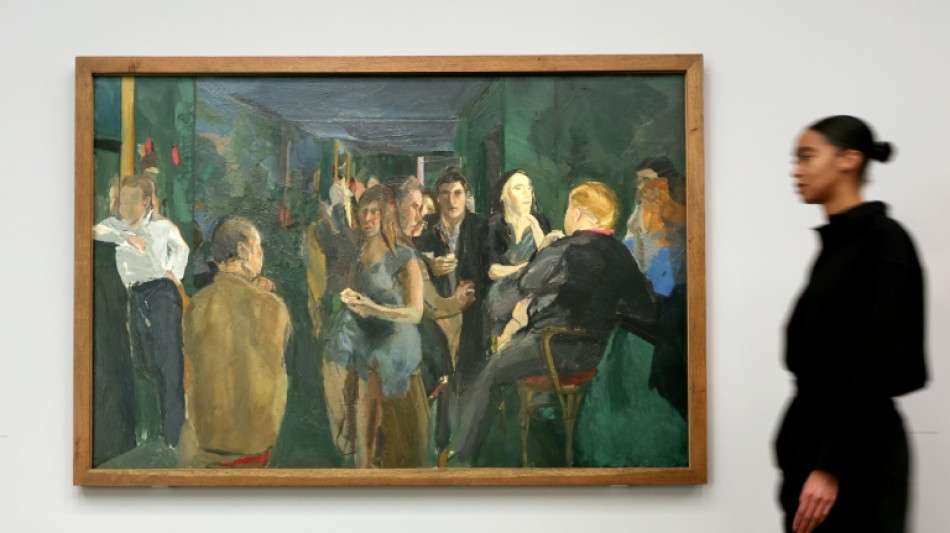
A highlight of the exhibition is the group portrait "The Colony Room I" by Andrews depicting Freud, Bacon and artist's model Henrietta Moraes among others at the storied drinking club that was a favourite haunt.
Calvocoressi said that Soho and the British capital, where each made their home, was another theme running through the exhibition, with works such as the rubbish-strewn view from Freud's studio and a painting of Primrose Hill by Auerbach.
The exhibition features more than 40 paintings gathered from private and public collections, including many of the artists' portraits of one another.
Calvocoressi said the quartet "sparked off each other" and were "the most radical" of their generation of artists.
- Nudes 'perfected' -
"They talked endlessly about art... they formed a sort of distinct group" at a time when people were turning to other artistic movements such as pop, conceptual and minimalist art, he said.
"I think after the last war... and the revelations of all that happened in Nazi occupied Europe and the death camps, a lot of painters lost faith in humanity and painting.
"How do you paint a human being again after he or she has committed something like that?"
But the four London painters "stuck to their interest in the human form", and Freud in particular "perfected the naked portrait more than the others", he said.
"Relations" featured in the exhibition include spouses, lovers, models, children and parents.
"Portrait of Man Walking Down Steps" is a tribute by Bacon to his lover George Dyer who killed himself in 1971.
"Naked Portrait on a Red Sofa" meanwhile shows Freud's fashion designer daughter Bella.
The work painted in 1989/91 when Bella was in her late twenties was described by his friend, the photographer Bruce Bernard, as one of his "most audacious and sensitive works".
Of the four artists, only Auerbach, now 91, is still alive. Bacon died in 1992, Andrews in 1995 and Freud in 2011.
Auerbach is still painting and during the pandemic, deprived of sitters, turned to self portraits.
(L.Møller--DTZ)