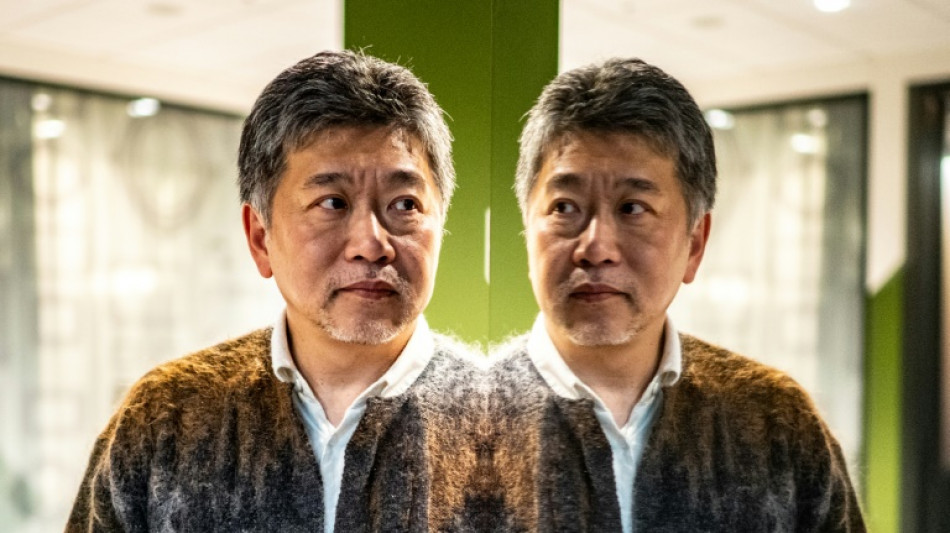
Japanese cinema 'must change' to help young directors, Kore-eda says / Photo: © AFP

Acclaimed director Hirokazu Kore-eda fears that Japan's underfunded, inward-looking cinema industry is putting off young talent, so he's taken matters into his own hands by mentoring up-and-coming filmmakers for a new Netflix series.
Kore-eda, whose 2018 film "Shoplifters" won the Palme d'Or at Cannes, told AFP that complacent attitudes and poor working conditions are holding Japan back in cinema and TV while its neighbour South Korea powers ahead internationally.
"Our filmmaking environment must change," he said in an interview, calling for an end to the low pay, long hours and insecurity faced by those trying to hone their skills.
"Throughout my career, I've been able to focus solely on improving my own filmmaking. But now, when I look around me, I see that young people are no longer choosing to work in film and television."
To help tackle the issue, the director of "Broker" and "Our Little Sister" collaborated with three younger proteges to make a new Netflix series set in tradition-steeped Kyoto.
The nine-episode manga adaptation, "The Makanai: Cooking for the Maiko House", tells the tale of a tight-knit community of kimono-clad apprentice entertainers known as maiko.
Kore-eda, 60, said he also learned many things from his mentees while working as showrunner for the series, to be released worldwide on January 12.
"It's more like -- I want to steal something from these three," he joked, complimenting the quality of their art and "knowledge of equipment that's far deeper than mine".
- 'Looking inward' -
While Japanese anime is booming on Netflix and other streaming services, the nation's live-action offerings have been overshadowed by South Korean megahits such as "Squid Game" and the Oscar-winning movie "Parasite".
To become a global cultural powerhouse, the South Korean government has spearheaded efforts to launch a blitz of pop-culture exports in the past two decades, Kore-eda said.
"All the while Japan has been looking inwards," with little incentive to market its films and TV shows overseas thanks to the flourishing domestic market. "That's one big reason why we see a gap," he added.
After the success of "Shoplifters", about a family of small-time crooks who take in a child they find on the street, the director branched out into languages other than Japanese.
He has previously said that making French film "The Truth", released in 2019, and the recent South Korean title "Broker" sharpened his perspective on what the industry lacks at home.
This year, Kore-eda and other directors argued that Japan needs an equivalent of France's state-run National Centre for Cinema to more robustly fund the industry and improve working conditions.
A 2019 Japanese government survey found over 60 percent of employees and 70 percent of freelancers involved in filmmaking in Japan were unhappy with their low pay, gruelling hours and the uncertain future of the industry.
- #MeToo campaigning -
Hiroshi Okuyama, one of the three directors who worked with Kore-eda on the new series, said he and his peers no longer see their vocation as a viable source of income on its own.
"Filmmakers of my generation, myself included, are resigned to the reality that we can no longer make a living solely by making movies," the 26-year-old told AFP, sitting alongside the two others, Megumi Tsuno and Takuma Sato.
Kore-eda is also an active campaigner against sexual harassment in the film world, and in March he and others stood in solidarity with actors who came forward with stories of being assaulted by a male director in Japan.
Those accusations morphed into a social media campaign resembling #MeToo, and in July, the Directors Guild of Japan issued a statement vowing to eradicate harassment -- described by Kore-eda as a "big step forward".
But he is calling for a system to protect victims who speak out, because harassment still tends to be "treated as a matter of a person's poor character, with little awareness yet that this is a more structural problem".
When he's not campaigning, Kore-eda is busy thinking about his next projects, saying he wants to focus on immigration, abandonment and even work that resembles an "epic poem".
All in all, "there are too many things I want to do."
(M.Dorokhin--DTZ)