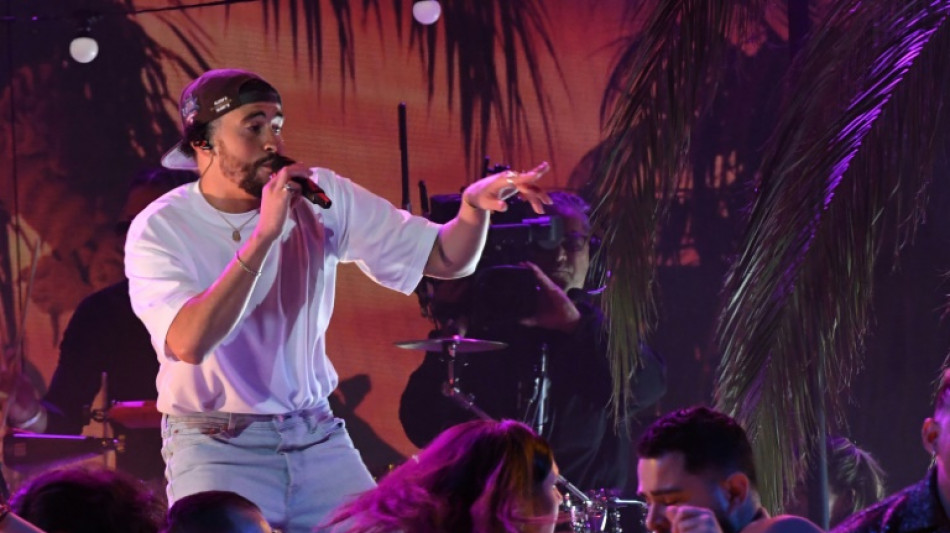
From reggaeton to Iran, five key moments on Grammys night / Photo: © AFP

Music's biggest stars turned out in force at the Grammys on Sunday in Los Angeles -- and a LOT happened.
Beyonce made history, but lost the night's biggest prize to Harry Styles. Bad Bunny opened the show with some serious reggaeton and First Lady Jill Biden showed up to honor an Iranian artist.
Here are five key moments from Grammys night:
- Bad Bunny, world's biggest artist -
Bad Bunny, music's most streamed artist, exploded into the Crypto.com Arena to open the night, performing a medley of hits off his blockbuster album "Un Verano Sin Ti."
Host Trevor Noah greeted him in Spanish as the Puerto Rican trailblazer introduced himself simply by his first name, "Benito." The room then erupted in color and rhythm as the audience was immersed in Latin sounds including bachata, merengue and mambo.
"I want to know if the Grammys are ready for the real party," exclaimed the 29-year-old who has fast become the face of reggaeton, the genre he has globalized.
Donning a white tee shirt and jeans, Bad Bunny left no one unmoved, with even Taylor Swift launching into a few dance steps.
"Now everyone wants to be Latino," he quipped. "But they're lacking flavor."
Bad Bunny went on to win the Grammy for Best Musica Urbana Album.
- Fifty years of hip-hop -
In probably the most electric moment of the night, a parade of stars from the world of hip-hop -- from Grandmaster Flash and Run DMC to Method Man, Queen Latifah, Missy Elliot and LL Cool J -- got the audience up on their feet to mark the upcoming 50th anniversary of the genre, seen as born in the Bronx in 1973.
The rapid-fire medley of hits across the decades -- Nelly offered a few bars of "Hot in Herre," Lil Uzi Vert closed the tribute with a bit of his "Just Wanna Rock" -- had Jay-Z cheering from his seat.
The Recording Academy has long been criticized for failing to honor hip-hop artists in the main Grammy categories, and for being behind the times in terms of acknowledging hip-hop's overall influence in music. The all-star performance certainly went some distance in putting the genre front and center, at last.
- Touching in memoriam -
The Grammys annual tribute to those the music industry has lost was even more emotional than usual, with Quavo of the hip-hop act Migos honoring his nephew Takeoff, who was murdered late last year in a shooting at the age of 28.
"Days ain't the same without you / I don't know if I'm the same without you," sang Quavo. "I wish I had a time machine / Just so you can take a ride with me / I miss just how you smile at me / Unc and Phew until infinity."
Kacey Musgraves opened the set paying homage to Loretta Lynn, the iconic country singer who died at 90, by covering Lynn's iconic "Coal Miner's Daughter."
And Mick Fleetwood was joined by Bonnie Raitt and Sheryl Crow in a touching performance of "Songbird" by Christine McVie, the late Fleetwood Mac artist who penned many of the beloved band's most famous songs.
- Special award for Iranian song -
In the night's most political moment, First Lady Jill Biden came to Los Angeles to present a special Grammy for Best Song for Social Change.
That award went to 25-year-old Iranian pop singer Shervin Hajipour for his "Baraye" -- an anthem for the protests that have rocked Iran since the September 16 death in custody of Mahsa Amini, a 22-year-old ethnic Kurd arrested for an alleged breach of strict dress rules for women.
Hajipour was detained after his song went viral and later freed on bail. He is not allowed to leave Iran.
Biden called "Baraye" a "powerful and poetic call for freedom and women's rights."
- Transgender singer Kim Petras makes history -
Kim Petras and Sam Smith took home the Grammy for best performance by a pop duo or group for their hit collaboration "Unholy," which made Petras the first openly transgender woman to win in the category.
"I just want to thank all the incredible transgender legends before me who kicked these doors open for me so I could be here tonight," Petras said after Smith, who is non-binary, urged her to accept the award.
"I grew up next to a highway in nowhere, Germany. And my mother believed me that I was a girl, and I wouldn't be here without her," she told the audience in a speech that elicited cheers from her peers.
Petras and Smith later delivered a blazing performance of the song -- a hellish, red latex-clad show that featured flames, devil horns, whips and the German artist Petras in a cage.
(A.Nikiforov--DTZ)