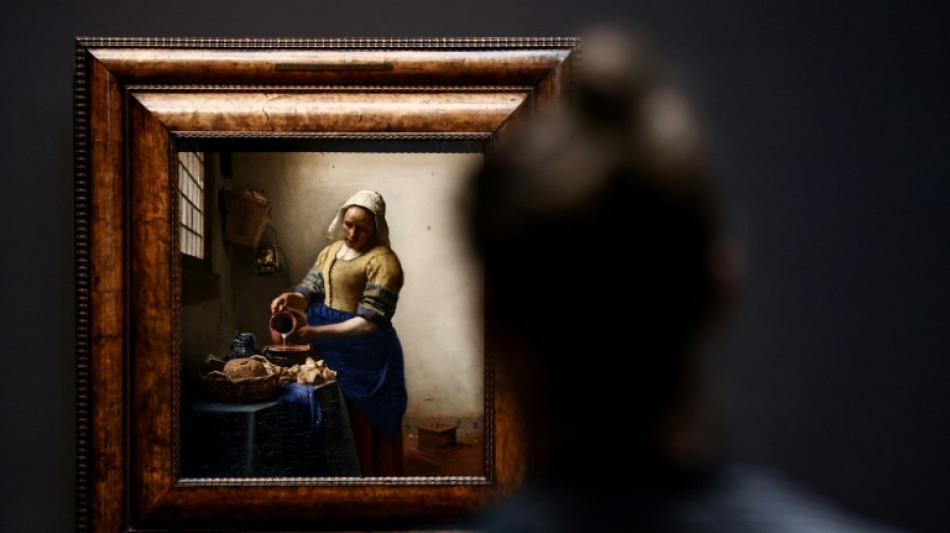
Vermeer in five masterpieces / Photo: © AFP

As the Rijksmuseum in Amsterdam unveils the largest ever retrospective of Dutch artist Johannes Vermeer, we look at five highlights from the show.
- 'The Milkmaid' (1658-59) -
One of Vermeer's most famous works, this simple domestic scene shows a woman in her kitchen absorbed in her task of pouring milk into a bowl, the light pouring in through a window.
Best known for his depictions of middle-class life, this is the artist's only study of a working-class woman.
Vermeer "endows this domestic worker with traits typically reserved for higher-class women -- virtue, diligence and a rich interior life", wrote the New York Times in 2009.
For years after his death, Vermeer was largely forgotten but "The Milkmaid", owned by the Rijksmuseum, was always heralded in art circles as a masterpiece.
- 'View of Delft' (1660-61) -
French writer Marcel Proust declared this luminous view of Vermeer's hometown, a rare exterior painting in his oeuvre, the "most beautiful painting in the world".
The painting of a quay and surrounding houses, which is owned by the Mauritshuis museum in The Hague, is one of the most famous cityscapes of the 17th century.
Near photographic in its precision, the artist composes a scene of balance and calm, a few people mingling, the canal without a ripple and a church rising in the distance.
- 'Woman Holding a Balance' (1662-64) -
A quiet moment of contemplation dominates this painting of a woman standing at a table scattered with jewellery, delicately holding a set of dainty scales.
At first glance, the work, loaned for the exhibition by the National Gallery of Art (NGA), Washington, looks like another of Vermeer's tranquil domestic scenes.
But a picture of the Last Judgement hanging on the wall gives it distinctly religious overtones. The artist seems to be warning the woman to weigh up the eternal consequences of her actions.
- 'Girl with a Pearl Earring' (1664-67) -
Dubbed the "Mona Lisa of the North" for the inscrutable expression of its subject, which recalls Leonardo Da Vinci's famous portrait, this painting attained global fame after inspiring a best-selling novel that was turned into a Hollywood film.
The small canvas shows a young woman set on a dark background, her head turned towards the viewer and a pearl earring glinting from beneath her blue and cream turban.
Johannes Vermeer was a master of light. As the NGA explains, "the soft contour of the girl's face creates a warmth that permeates the image".
- 'The Lacemaker' (1666-68) -
Another of Vermeer's masterpieces, this painting shows a woman bending over a piece of lace, bathed in light and deeply concentrated on her meticulous work.
At 24 by 21 centimetres (10 by eight inches), smaller than an A4 page, this is the most diminutive of Vermeer's paintings. It usually hangs in The Louvre in Paris.
It is also among his most beloved works, inspiring a French film of the same title, starring Isabelle Huppert.
(W.Novokshonov--DTZ)