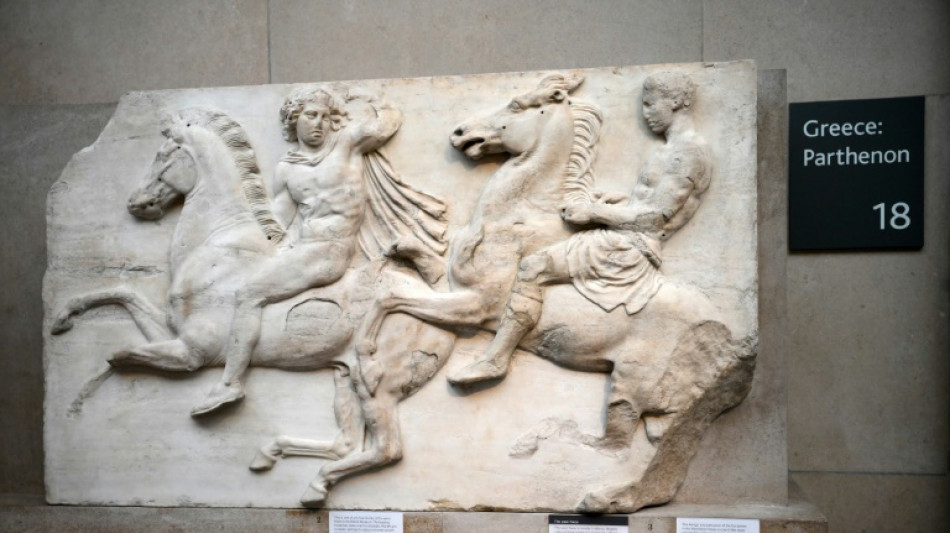
Greece approves disputed museum law seen as antiquity 'export' plan / Photo: © AFP

Greece's parliament on Monday approved a new law enabling the exhibition of rare antiquities outside the country, with archaeologists warning it could lead to the long-term "export" of rare items.
The move comes as the Greek government is engaged in talks with the British Museum on the possible return of the Parthenon Marbles after decades of wrangling between Athens and London.
The Financial Times last week reported that the famed prehistoric frescoes of Santorini "have been mentioned in Athens" as potential candidates for a loan swap.
The new law concerns five of the country's top state museums -- the National Archaeological Museum and the Byzantine and Christian Museum in Athens, the Archaeological Museum and Museum of Byzantine Culture in Thessaloniki, and the Archaeological Museum of Heraklion, Crete.
It enables the five museums -- which hold some of the country's most coveted ancient artifacts -- to create satellite branches outside Greece.
Culture Minister Lina Mendoni has said the changes give the museums more freedom to plan exhibits and raise sponsorship.
The association of Greek archaeologists has said it will block the law in court.
"Important antiquities could be sent abroad for 50, a hundred years or more," the association warned in a statement.
Greece's culture ministry has been trying for years to broker deals for the repatriation of antiquities without resorting to legal action.
Its chief goal remains the return of the Parthenon Marbles, held by the British Museum since the 19th century.
Mendoni on Monday said Athens is proposing "intertemporal exhibitions" of Greek artifacts in Britain for the "return and reunification" of the Parthenon Marbles.
Last year, the culture ministry brokered a deal to acquire 161 Bronze Age antiquities formerly in the collection of US billionaire and philanthropist Leonard Stern.
The agreement involves the artifacts gradually returning to Greece over the next 25 years after display at New York's Metropolitan Museum of Art.
The deal has sparked controversy among experts over the provenance of the antiquities.
The association of Greek archaeologists said Stern was a "proven recipient of smuggled archaeological discoveries" and that the agreement set a poor precedent to let wealthy collectors off the hook.
The archaeologists said Stern had previously owned a Bronze Age marble idol from Sardinia that was later seized in 2018 from billionaire collector Michael Steinhardt as illegally trafficked.
(W.Budayev--DTZ)