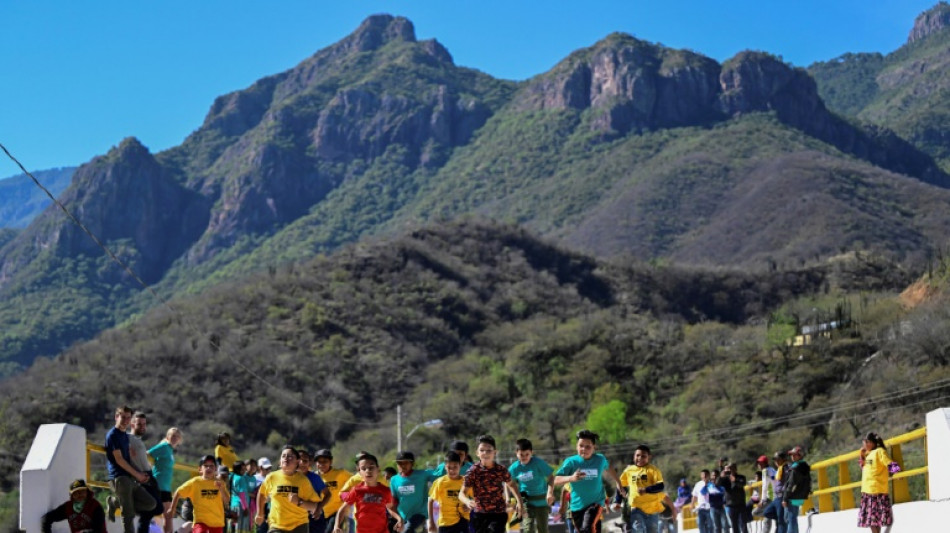
Mexico ultramarathon pits outsiders, legendary Indigenous runners / Photo: © AFP/File

Hundreds of amateur athletes set off at dawn Sunday for an ultramarathon through a sun-bleached canyon in northwestern Mexico, hoping to take their measure against legendary Indigenous runners in one of the world's most challenging distance events.
The 20th Caballo Blanco Ultramarathon started in the village of Urique in Chihuahua state, with races over distances of 80, 40 or 21 kilometers (50, 25 or 13 miles) through the rugged canyons of the Sierra Tarahumara.
The event has a festive ambiance, but it gives runners from elsewhere in Mexico and from other countries -- mainly the United States -- a chance to compete against the world-famous distance runners of the Indigenous Raramuri or Tarahumara people.
Living along the edges of Mexico's deepest canyon -- it reaches down 1,800 meters (5,900 feet) -- they have developed extraordinary cardiovascular systems, making them "the modern Spartans," as one cardiologist described them.
"It's much more than a race. Its spirit is all about sharing, about exchanges between cultures," said Fabio Meraz, a tourism official in the canyon village of Urique.
Festivities began there on Saturday, with children's races under a blazing sun.
The Raramuris ("lightfooted ones," in their language) often run in simple sandals, known as huaraches, made of discarded car tires.
The women run in brightly colored dresses, while the men wear loose-fitting white shorts.
Their endurance is legendary, and they often seem to fly effortlessly past runners shod in far more sophisticated shoes.
"I'm used to these huaraches," said one Raramuri participant, Irma Chavez. She said her feet aren't accustomed to more expensive shoes.
The ultramarathon has a social function, as intended by its Mexican and American sponsors. Participants from neighboring villages head home afterward with food vouchers -- much appreciated at a time when severe drought has hurt harvests.
"The families sometimes can't feed themselves with what they grow," Chavez said.
Police and army troops were positioned Sunday to keep a discreet watch over the race. Last June, two Jesuit priests and a tour guide were murdered nearby by a suspected drug trafficker who has never been caught.
The Caballo Blanco race owes its name to its founder, Micah True, an American ultrarunner who lived for years in the area in an adobe hut.
Locals nicknamed him "El Caballo Blanco," the White Horse, after seeing the pale-looking man running hour after hour on steep canyon trails.
True founded the race in 2003 to help the Tarahumara people preserve their culture. He died in 2012, aged 58, during a run in New Mexico.
Michael Miller, a friend of his, said True had "a sort of connection with this people and this land: to live simply, to share, to be good."
(L.Møller--DTZ)