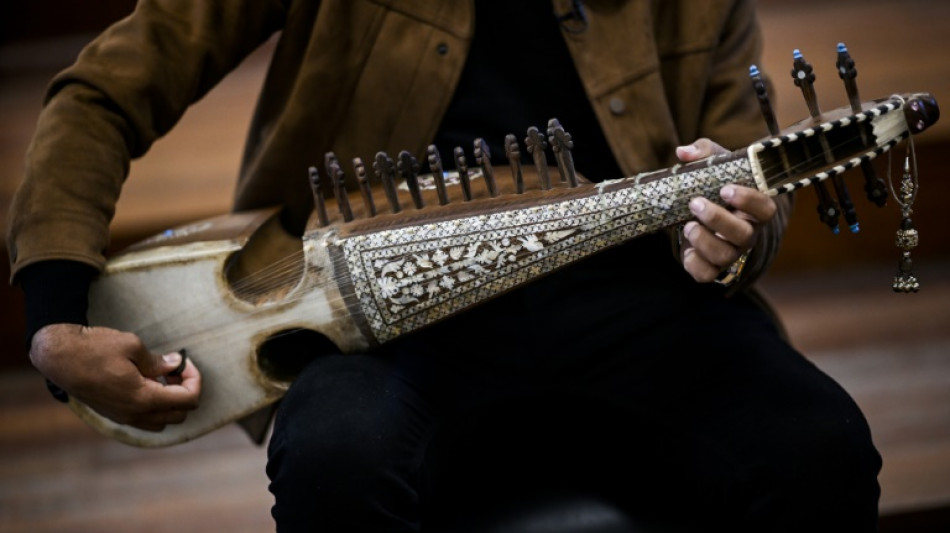
Afghan musicians in Portugal tell of 'cultural genocide' / Photo: © AFP

"We are here to save our music," proclaims Ramiz, a young Afghan musician who has been welcomed in Portugal, along with other students from the national music school he left as he fled the Taliban's cultural crackdown.
"We hope that one day we can go back to our country," the 19-year-old told AFP, holding his rubab, a traditional stringed instrument made of wood and inlaid with mother-of-pearl.
Ramiz is one of 58 students from the National Music Institute of Afghanistan (Anim), aged between 13 and 21, who have settled in the northern Portuguese cities of Braga and Guimaraes.
He landed in Lisbon, along with his classmates, several teachers and some of their families in December 2021, months after the Taliban took power.
The 273 refugees fled Afghanistan for fear of reprisals from the ruling Taliban, who have banned non-religious music.
"When Taliban reached the gates of Kabul, it was clear that we should get out," recalled Anim director Ahmad Sarmast, who did everything possible to evacuate the students and staff of the music institute.
"Afghanistan is a silent nation," the 61-year-old said.
"When a country's music is banned, an entire nation is silenced," added Sarmast, who lost some of his hearing in an attack by the Taliban in 2014 when they were rebel fighters.
"It's nothing short of a cultural and musical genocide," added the Afghan music specialist, who has made it his mission to safeguard his country's musical heritage and to recreate in Portugal the music school he founded in Afghanistan in 2010.
- 'Each performance is a protest' -
While waiting to find a place where it can be reborn, his exiled students have been welcomed at the Braga Music Conservatory, where they continue to play music as an act of resistance.
"Each performance of our school is a protest against what is happening in Afghanistan," Sarmast said.
One of those acts of musical protest came earlier this month in a concert with celebrated Japanese-born violinist Midori Goto.
The Taliban seized power in Afghanistan in August 2021, promising a softer version of their brutal 1996-2001 rule that was infamous for human rights abuses.
But they have squeezed women out of almost all areas of public life, recently banning them from secondary and higher education, public sector work and from visiting parks and baths.
Nineteen-year-old percussionist Shogufa, working in another part of the Braga conservatory with a fellow student, is trying to enjoy the freedom that her new life in Portugal offers.
In her spare time, the Beethoven fan likes to compose music, cook, go out for a hamburger or play sports with her friends at a local gym.
While women are not allowed to study in Afghanistan, Shogufa welcomes the opportunity to do so every day in Portugal.
She remains traumatised by the memory of musical instruments destroyed and burnt by the Taliban in Kabul.
"My huge dream is that one day I'll return back to Afghanistan," she said.
"I do believe that everything will be fine, because the Taliban... is not forever."
- 'Our music is not dead' -
Ramiz, taking a break from his rubab practice, is also optimistic and hopes one day to return to Afghanistan "and show our music is not dead".
But his mood darkens when he thinks about his family back home.
He hopes they will soon be able to join him in Portugal as "the life is too dangerous for them".
He speaks to his mother every day. "One night if she didn't listen to my voice, she won't sleep," added the young man, whose father and two brothers are also musicians.
Shogufa, who spent over seven months in a precarious condition in a former military hospital in Lisbon before making her way to Braga, has similar concerns for those she left behind, including her six brothers and sisters.
"All of them just stay at home... have no plans for the future."
(V.Sørensen--DTZ)