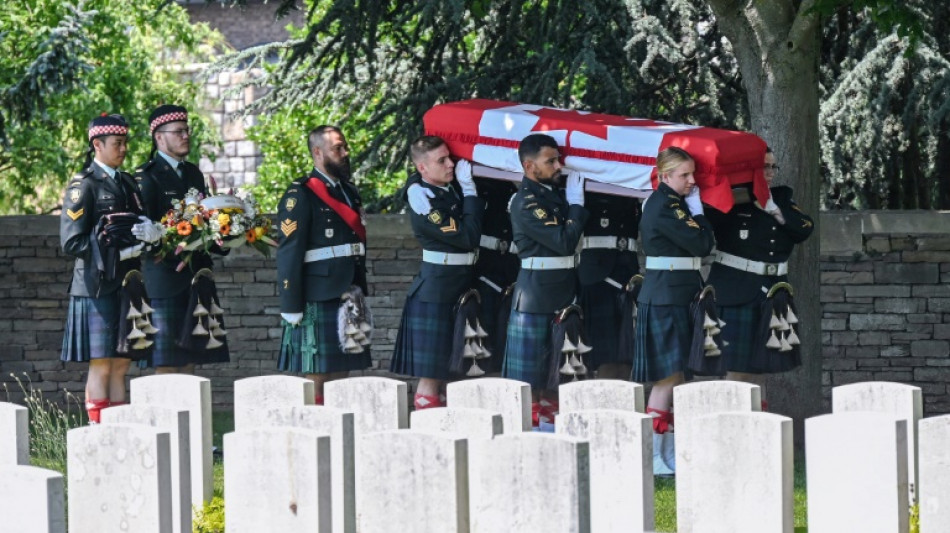
The painstaking task of identifying WWI dead / Photo: © AFP

At least 600,000 soldiers who died in France during the First World War are still officially missing, their resting places unknown and unmarked.
While the passage of time renders the task of recovering the lost war dead increasingly complex, it is still possible to identify a few of the fallen.
The first step to is to determine whether discovered remains are really those of a soldier from WWI.
Researchers use the state of the remains and scraps of uniform or equipment to check that the skeleton doesn't date from an earlier period or is evidence of a crime scene.
Then they try to ascertain the soldier's nationality.
"The best sources of proof are metal-reinforced leather boots, which preserve well and are different depending on the country," said Stephan Naji, head of the recovery unit at Commonwealth War Graves Commission (CWGC).
His team in the Calais region of northern France is regularly contacted when remains are discovered.
- Buttons, boots and badges -
Soldiers who are uncontestably French or German are handed over to France's War Veteran's Office (ONAC) or Germany's VDK war graves agency.
"If there's a military plaque with a name of it and proof of next of kin, the soldier's descendants can repatriate him to his family home or they can let the state bury him in a national cemetery," said ONAC's Stephane Jocquel.
DNA tests are seldom carried out on the remains of French combatants.
One of the CWGC's missions is to help the authorities identify as many as possible of the 100,000 soldiers from the former British Empire who are still missing.
Buttons and insignia from uniforms are key clues, as are regiment badges as well as water bottles or whistles bearing the name of the soldier's unit.
But all the tell-tale signs need to tally. Some soldiers swapped badges as a sign of comradeship or recovered equipment from fallen brothers in arms.
Australian boots, for example, were particularly prized for their quality.
- 'Known unto God' -
Investigators also clean personal items, like razors, forks and watches, for fine details like the owner's engraved initials or a hallmark indicating the date and place the object was made.
If they can confirm the soldier's nationality, they pass on the information to the country's authorities, who cross check it with their lists of missing combatants.
Some countries, including Australia, Britain and Canada, carry out genealogical research to try to trace descendants, including DNA tests if any are found.
The search can take several years and is successful in only about two to three percent of cases, according to Alain Jacques, head of the archaeology service in Arras, northern France.
If a soldier is successfully identified, his remains are buried with military honours at the nearest Commonwealth cemetery, in the presence of descendants who wish to attend.
When the soldier cannot be identified, he is reburied with honours under a gravestone bearing the words "Known unto God".
The epitaph was chosen by British poet Rudyard Kipling, who spent years fruitlessly searching for his own son after he went missing, aged 18, in what would be called the war to end all wars.
(V.Varonivska--DTZ)