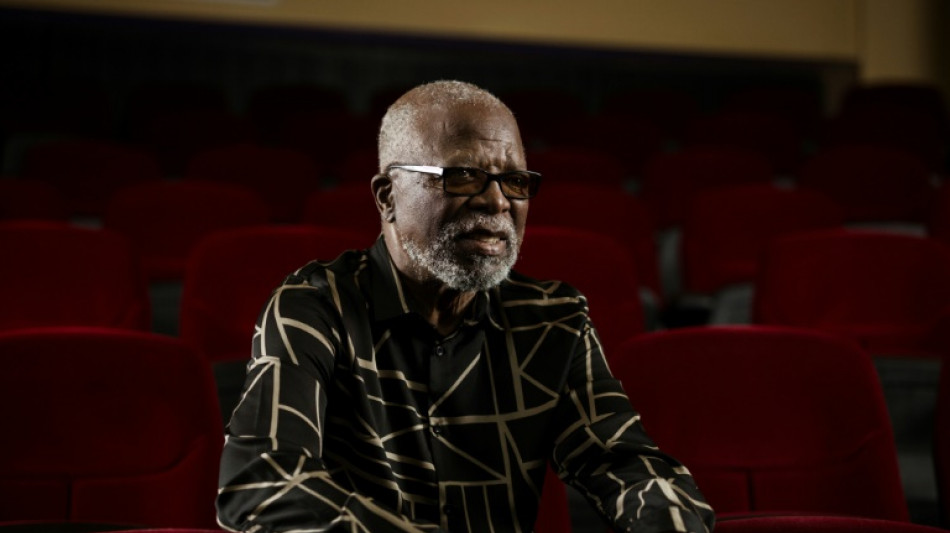
For theatre legend John Kani, art must 'speak truth to power' / Photo: © AFP

South African stage legend John Kani shuffled between rows of red chairs in the 450-seat theatre named after him, searching for one in particular.
"I think it's this one," he exclaimed, pointing at 15E near the stairs leading to the stage. "This used to be Nelson Mandela's seat!"
The actor laughed as he recalled how South Africa's first democratically elected president once interrupted the opening moments of one of his plays.
"He said, 'Excuse me, could you start over? My hearing aid is giving me problems,'" Kani said in a perfect imitation of Mandela's unmistakable accent.
At 82 years old and after a six-decade career as a performer and playwright, the South African star had several stories to recount in a recent interview with AFP.
Roles in blockbusters like "Black Panther" (2018) and Disney’s 2019 "The Lion King" have earned Kani international recognition.
He has been honoured with an Order of the British Empire and Obie and Tony awards, and was in August selected to join the prestigious Academy of Motion Picture Arts and Sciences, the Oscars’ voting body.
But the acclaim does not overshadow the hardships of his early career, when he was persecuted by the white-minority apartheid regime for criticising its racist policies.
The year he started in theatre, 1965, was "a time where there was almost no hope", Kani recalled.
"Any form of resistance was assumed to be crushed by the apartheid government. If you were not dead, you were on Robben Island prison, sentenced to life... or left the country and became a refugee."
- 'So much hell' -
The young Kani was eager to join the underground movement and "come back with my AK-47".
But friendships with a few white artists -– including acclaimed playwright Athol Fugard -– steered him towards writing "protest theatre... that protests the status quo, that keeps the conscience of freedom and that flame burning all the time."
Plays from the 1970s like "Sizwe Banzi Is Dead" and "The Island" exposed the realities of apartheid and were performed to racially mixed audiences, almost costing him his life.
"I stand here with 11 stab wounds. I survived an assassination. I spent days in solitary confinement," said Kani, who lost an eye to police beatings and now uses a prosthetic one.
More than 30 years into democracy, some of South Africa's youth "do not understand the cost", he said.
He recounted trying to teach his granddaughter about life under apartheid by telling her that as a black man he had been barred from a certain whites-only eatery that is still in business in central Johannesburg.
The 11-year-old missed the point. "She said: 'Why would you want to eat here? The food is bad'," he laughed.
"I've been through so much hell," Kani said. "And I think every moment, every scar on my body, every memory that haunts me was worth it. Because now... we are citizens of the global humanity."
He fears, however, a return of oppression. "There is a current... of lack of leadership in the world, populism, the rise of conservatism, dictatorships," he said.
His latest play "Kunene and the King" (2019) explores racial tensions in post-apartheid South Africa and recently made its US premiere at Washington's The Shakespeare Theatre.
"When that ICE (Immigration and Customs Enforcement) truck comes with the soldiers looking for people who are undocumented, that was apartheid South Africa," he said, referring to the US administration's crackdown on immigration.
"That's what I went through all my life. I was arrested 12 metres (40 feet) from my father's gate because I'd forgotten my pass book."
- Truth to power -
In the context of global uncertainty, art "will always speak truth to power," the actor said.
"Art will always reflect society like a mirror. When things are good, we celebrate in song. When things are bad, we celebrate in poetry, in anger, and we march."
His admission into the Oscars' Academy will be another opportunity to elevate African voices, he said.
“One hopes that by sitting there, we will impress upon them to look more into Africa. Africa needs incubation. Africa needs assistance in development," Kani said.
"But most importantly, Africa needs a budget.”
He would like one day to be able to tell his great-grandchildren a story about the demise of a monster that once terrified the world.
"That monster was called Injustice. But the people of the world got together... and we defeated it.”
(M.Dylatov--DTZ)