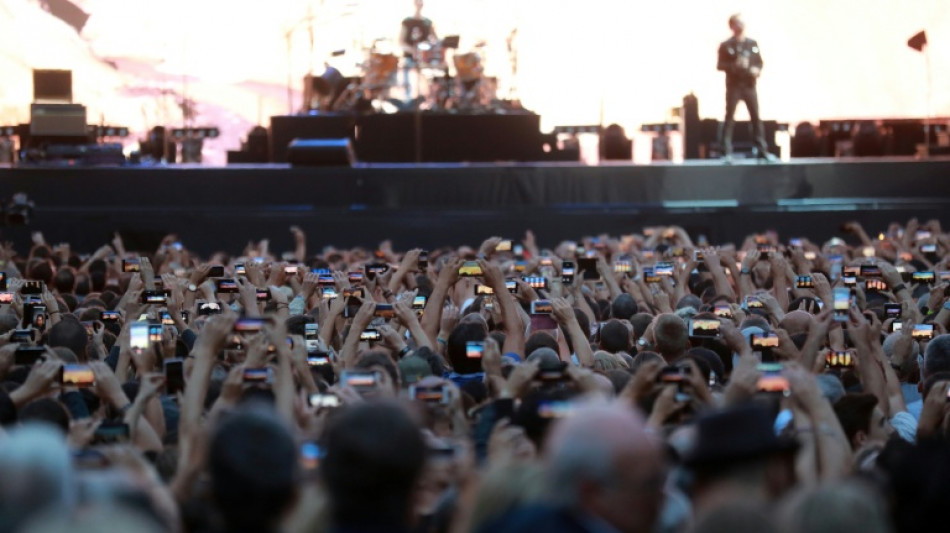
Top music body says AI firms guilty of 'wilful' copyright theft / Photo: © AFP/File

AI companies have sucked up the world's entire music catalogue and are guilty of "wilful, commercial-scale copyright infringement", a major music industry group told AFP.
"The world's largest tech companies as well as AI-specific companies, such as OpenAI, Suno, and Udio, Mistral, etc. are engaged in the largest copyright infringement exercise that has been seen," John Phelan, director general of the International Confederation of Music Publishers (ICMP), told AFP.
For nearly two years, the Brussels-based body, which brings together major record labels and other music industry professionals, investigated how generative artificial intelligence (AI) companies used material to enrich their services.
The ICMP is one of a number of industry bodies spanning the news media and publishing to target the booming artificial intelligence sector over its use of content without paying royalties.
AI music generators such as Suno and Udio can produce tracks with voices, melodies and musical styles that echo those of original artists such as the Beatles, Mariah Carey, Depeche Mode, or the Beach Boys.
The Recording Industry Association of America, a US trade group, filed a lawsuit in June 2024 against both companies.
"What is legal or illegal is how the technologies are used. That means the corporate decisions made by the chief executives of companies matter immensely and should comply with the law," Phelan told AFP.
"What we see is they are engaged in wilful, commercial-scale copyright infringement."
One exception was Eleven Music, an AI-generated music service provider, which signed a deal with the Kobalt record label in August, Phelan said.
Contacted by AFP, OpenAI declined to comment. Google, Mistral, Suno and Udio did not respond.
Tech giants often invoke "fair use", a copyright exception that allows, under certain circumstances, the use of a work without permission.
- 'Threat' -
Research by the ICMP, first published in music outlet Billboard on September 9, claimed that AI companies had engaged in widespread "scraping", a practice that uses programmes known as "crawlers" which explore the internet for content.
"We believe they are doing so from licensed services such as YouTube (owned by Google) and other digital sources," including music platforms, the group added.
Lyrics can be harvested to feed some models, which then use them for inspiration or reproduce them without permission, according to the ICMP.
In response, rights holders are calling for tougher regulation, notably through the European Union's Artificial Intelligence Act, to ensure transparency about the data used.
"It is essential to understand the scale of the threat facing authors, composers and publishers," warned Juliette Metz, president of the French music publishers' association and also an ICMP member.
"There can be no use of copyright-protected music without a licence," she said.
In the United States, AI start-up Anthropic, creator of Claude, announced on September 6 that it had agreed to pay at least $1.5 billion into a compensation fund for authors, rights holders and publishers who sued the firm for illegally downloading millions of books.
The three US-based music majors -- Universal, Warner and Sony -- have entered into negotiations with Suno and Udio, aiming for a licensing deal.
Music generated entirely by AI is already seeping onto streaming platforms.
"Velvet Sundown", a 1970s-style fake rock band, as well as country music creations "Aventhis" and "The Devil Inside" have racked up millions of plays on streaming giant Spotify.
AI-generated music accounts for 28 percent of content uploaded daily on Deezer, the French music platform, which has reported "a surge" over the past year in uploads.
It has an AI-music detection tool that is able to identify songs generated using models such as Suno and Udio.
A major study in December last year by the International Confederation of Societies of Authors and Composers (CISAC), which represents more than five million creators worldwide, warned about the danger of AI-generated music.
It forecast that artists could see their incomes shrink by more than 20 percent in the next four years as the market for AI-composed music grows.
(Y.Ignatiev--DTZ)