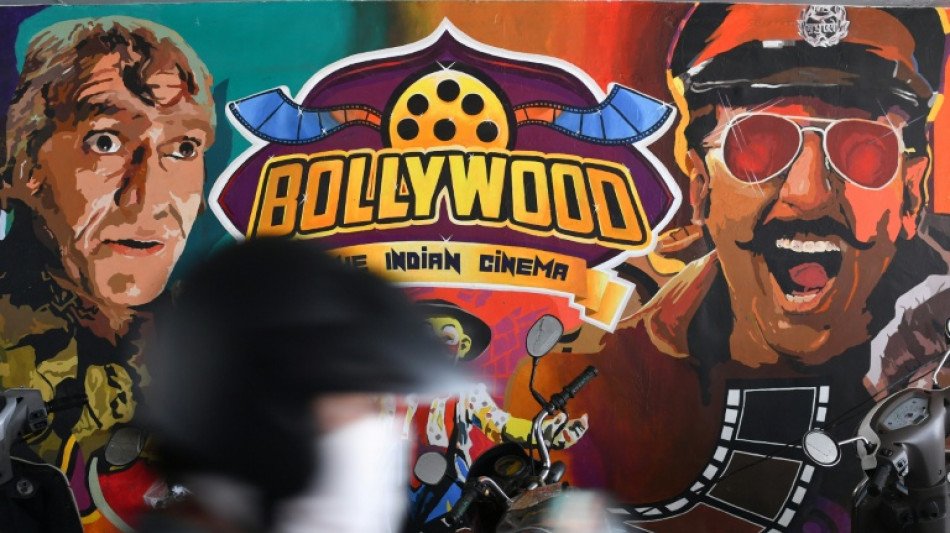
India's Bollywood counts costs as star fees squeeze profits / Photo: © AFP/File

From fleets of private trailers to personal chefs and sprawling entourages, Bollywood stars' "obnoxious" demands are driving up production costs and putting a strain on the Indian film industry's finances, insiders say.
Bollywood has long been unpredictable at the box office and the pandemic compounded problems, but producers argue that today's losses stem less from creative failure and more from top artists' runaway expenses.
"It is not so much about production cost -- it is more about star fees," says producer Ramesh Taurani, best known for the successful Race action franchise.
Actors, filmmakers say, increasingly arrive on set with a dozen-strong entourage -- including makeup artists, hairdressers, stylists, gym trainers and assistants -- all billed to production.
Stars are paid hefty fees of up to $22.18 million per film but additional requests for first-class travel, five-star hotels, multiple private trailers and work-shy hours have become routine.
"Expansive support teams, premium travel and luxury accommodations often inflate budgets without proportionate creative impact," said veteran producer Mukesh Bhatt. "The kind of demands stars make is obnoxious."
Distributor and trade analyst Raj Bansal added: "One actor usually comes with 10 to 15 staff members.
"Earlier, actors wouldn't mind sharing one vanity van. Then they decided to give one vanity van each to a big star -- and demand went on increasing."
A single trailer hired for the duration of a film shoot can cost as much $18,000. For some actors, insiders say, demanding more has become a status symbol.
- 'Self-respect' -
Bollywood has always been considered high-risk, producing more flops than hits, but producers say the balance has tipped sharply as star-driven costs spiral beyond what box office returns can sustain.
The fragile model was shaken after the pandemic, when streaming platforms bought films at inflated prices.
When those deals dried up, producers faced a painful course correction as income plunged but actors' demands stayed elevated. And that problem continues today.
Competition has also intensified.
"Audience behaviour has matured, streaming platforms have broadened horizons and regional cinema has elevated creative standards," says Bhatt.
"Yet, alongside this progress, rising production costs -- particularly talent-driven budgets -- have introduced a significant strain. It is not the films that falter, but the economics that lose balance."
Actor-filmmaker Aamir Khan slammed stars for burdening producers with these costs.
"You earn in crores (tens of millions of rupees)," Khan said, in a September interview with the YouTube show Game Changers. "Where's your self-respect?"
- 'Power of storytelling' -
Industry insiders say actors' demands also have a cascading effect, as stars seek to exceed each other's perks.
"A measured approach will allow us to redirect resources toward what truly defines cinema -- the power of storytelling," said Bhatt.
Producers have pushed for partnership-style compensation models.
"When a film thrives, every contributor should benefit," Bhatt said. "When it struggles, the weight should not rest solely on the producer, who shoulders risk from the very beginning."
The 2024 science fiction action film Bade Miyan Chote Miyan ("Big Mister, Little Mister"), starring Akshay Kumar and Tiger Shroff, reportedly cost about $42 million. After poor ticket sales, producers were reported to have mortgaged property to cover debts.
There have been exceptions.
Actor Kartik Aaryan waived his fee for the 2023 action-comedy Shehzada, which tanked at the box office.
"If your star value and the entire project's value gives profit to the entire team, I think then the math adds up," Aaryan said. "If it doesn't, then you should take a cut."
Some producers argue that the industry must confront its own excesses.
"If the star fee and entourage is affecting your budget, then don't take stars," says actor-writer-producer Viveck Vaswani.
"I have made 40 films with 40 newcomers and have prospered. I took SRK (Shah Rukh Khan) when nobody wanted him. I cast Raveena Tandon when nobody knew her."
Vaswani, a longtime friend of Khan, notes that "SRK has no entourage cost, he pays his own", as does Akshay Kumar.
"Lots of them do that, they don't burden the producers," he said. "If you think your star is stronger than your script, you are wrong."
(P.Vasilyevsky--DTZ)