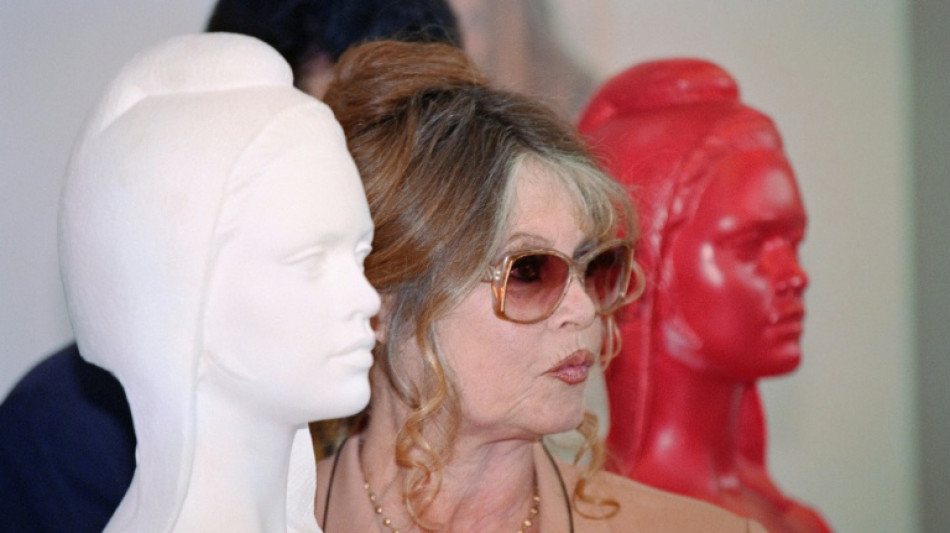
Bardot: from defending sheep to flirting with the far right / Photo: © AFP/File

Film legend Brigitte Bardot in her later decades raised eyebrows calling far-right leader Marine Le Pen a modern "Joan of Arc", but she always maintained she was merely doing what was best for animals.
Bardot, who died on Sunday aged 91, argued she was unfairly labelled as a supporter of the anti-immigration far right after she made explosive remarks in the late 1990s about Muslims slaughtering sheep.
"I never asked anyone to be racist and I don't think I fuel any racial hatred," she wrote in her 2018 book "Larmes de Combat", translated into English under the title "Tears of Battle".
But the Paris-born star of around 50 films, who walked away from cinema to defend animal rights, was repeatedly convicted for hate speech -- mostly against members of the Islamic faith after migration from France's former colonies.
And she actively backed far-right presidential contender Marine Le Pen when she ran in 2012 and 2017.
"I wish for her to save France. She's the Joan of Arc of the 21st century," she told Paris Match in 2014, referring to the legendary teenager who repelled the English in the Hundred Years War in the 15th century.
"She's the only woman... who has balls," she later added of Le Pen, who also vied for president in 2022.
- 'We'll be slaughtered too' -
Le Pen may be barred from a fourth run for the Elysee in 2027 due to a graft conviction, but her National Rally party feels its best chance ever to win the presidency in the upcoming polls, with Emmanuel Macron stepping down after two consecutive terms.
Le Pen on Sunday mourned Bardot, calling her "incredibly French: free, untameable, whole", while her lieutenant Jordan Bardella -- who could run instead of Le Pen -- described her as an "ardent patriot", adding French people had lost "the Marianne they so loved".
France's republic is traditionally represented by a female figure called Marianne, and Bardot in the 1960s posed for such a statue by artist Alain Aslan.
Macron also alluded to "the face that became Marianne" in his tribute to a woman he called a "legend" of the 20th century.
But he made no mention of her comments leading to convictions for hate speech.
In 1997, Bardot argued against the ritual killing of sheep for the celebration of Eid al-Adha, saying the practice would "stain the soil of France".
"They're slitting the throats of women and children, our monks, our civil servants, our tourists, and our sheep. One day we'll be slaughtered too," she wrote, appearing to conflate violent Islamists with ordinary Muslims, and warning against "a Muslim France with a North African Marianne".
In 1996, Islamist insurgents killed French monks in France's former colony Algeria during the civil war.
Bardot declared herself "against the Islamisation of France" in a 2003 book, arguing "our ancestors, our grandfathers, our fathers have for centuries given their lives to push out successive invaders".
But in 2018 the former actor told Le Monde newspaper her concerns surrounding Eid al-Adha had been misunderstood, and she was "simply requesting the animals be stunned" to avoid suffering.
- 'Wild hopes' in the far right -
In her final book, "Mon BBcedaire" ("My BB Alphabet"), she said right-wing politicians were "the only urgent remedy to France's agony".
The animal activist, who has criticised the #Metoo movement, also made derogatory comments about gay and transgender people.
Her fourth husband, Bernard d'Ormale, was an advisor of late French far-right leader Jean-Marie Le Pen, whose daughter Marine took over the party.
In 1996, Bardot described Jean-Marie Le Pen as a "charming" man also worried about the "terrifying rise of immigration".
He later invoked Bardot to argue Muslim women should not be allowed to wear burkinis in public.
"French beaches are those of Bardot and Vadim," he said, in an apparent reference to Roger Vadim's 1956 film "And God created Woman", featuring the actor dancing with her skirt slit up to her waist.
Often a guest at the Elysee palace, Bardot said French presidents -- including Macron -- did not do enough to protect animal rights.
"I had wild hopes when the National Front (now called the National Rally) put forward concrete proposals to reduce animal suffering," she told Le Monde.
But she claimed she also reached out to hard-left leader Jean-Luc Melenchon, "congratulating him for being a vegetarian", and said that if a communist took up her proposals, she would vote for them.
(L.Barsayjeva--DTZ)