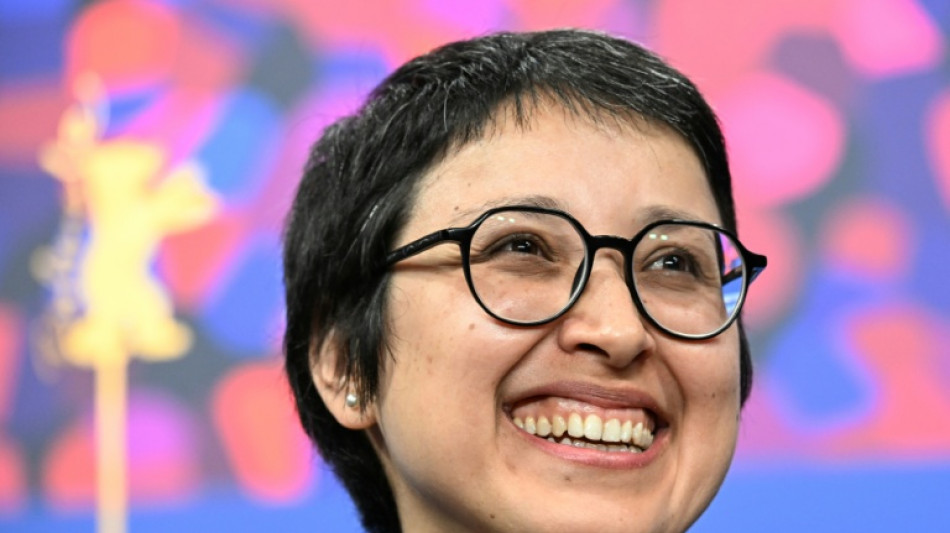
'Naive optimist' opens Berlin Film Festival with Afghan romantic comedy / Photo: © AFP

Are there any good men in Afghanistan? The opening film at this year's Berlin Film Festival poses the question against the backdrop of the Taliban authorities returning to power.
Naru, the protagonist of "No Good Men" -- played by director Shahrbanoo Sadat -- rethinks her jaded views on the opposite sex as a result of a burgeoning friendship with a male co-worker.
For Sadat, being chosen to open this year's festival was an exciting chance to spotlight a story about Afghanistan told by Afghans themselves.
"For a very, very long time Afghan stories have been told by international filmmakers and therefore (there has) been always a kind of misrepresentation," she told AFP.
"We are trying to figure out... what does it mean to make an Afghan protagonist?"
The film vividly depicts Naru navigating the chaos of the withdrawal of US-led forces in 2021 and the crush at Kabul airport swarmed by desperate Afghans trying to flee their country.
Those scenes drew directly on Sadat's own experience of having to flee when Taliban fighters reached the capital.
"I was at the airport with my family for 72 hours when things started," said Sadat, who now lives in Hamburg.
"When we wanted to do this airport scene, because I was there, it was one of the most difficult scenes," she recalled.
- Phallic cactus -
The film doesn't only dwell on the violence and upheaval that Afghans have gone through in recent decades.
The effervescent Sadat, who was born in Iran and spent her childhood in Tehran before moving to Afghanistan with her parents, describes herself as a "naive optimist" in many ways and her lightness of touch is visible throughout "No Good Men".
A suspiciously phallic cactus at the end of the closing credits is typical of the spiky humour that Sadat uses to skewer patriarchal attitudes, not to mention the sex toy Naru gets from a colleague to celebrate her separation from her philandering husband.
The film portrays the space that Afghan women were carving out for themselves before 2021, both personally and professionally.
It has an element of idealism in its portrayal of Afghan journalists and is dedicated to seven members of staff from the popular Tolo TV station killed in a 2016 attack orchestrated by Taliban fighters.
However, Sadat said she also felt the need to push back against a tendency to "romanticise the era of democracy".
"I do not deny that the Taliban are the biggest problem of Afghanistan today, but on the other hand... nothing was flowers and roses in the era of democracy," she said, citing the widespread corruption that plagued the country in that era.
- Expecting Afghans to watch -
Given the difficulty of filming in Afghanistan, the film was shot in several locations in northern Germany, interspersed with archive footage from Kabul.
In her acknowledgements Sadat thanks Germany's Afghan community and says that in some senses it was her "good luck" to work in a country with "one of the biggest Afghan communities" in the diaspora.
Sadat was hands-on in the casting process, trawling through lists of the mosques, cafes and restaurants frequented by the more than 460,000 Afghans in Germany.
She got "thousands of requests" from Afghans across the country to participate in the film, with those who did take part eventually forming a "little film community", some of whom will be coming to Thursday's premiere.
The return of a Taliban government in 2021 brought with it tight restrictions on films, music and other entertainment under their strict interpretation of Islamic law.
So is there any hope for the film reaching an audience inside Afghanistan?
"Probably... they're going to watch the film before the film comes in cinemas" elsewhere, Sadat said, explaining that she expects internet pirates to get their hands on it.
"It always happened to my previous films that they... either end up on YouTube or it's going to be chopped and will be on TikTok."
Sadat says that try as the Taliban authorities might, they can't keep out the modern age where "everyone has... a phone and everyone is connected to internet".
"Even if they (Afghans) don't experience the film in a cinematic way, on a big screen... they're going to watch the film."
And as for whether Sadat thinks there are any good men?
"I do believe there are good men, but I also believe that we need more good men in the world, but also in Afghanistan," she told reporters at a press conference.
(W.Novokshonov--DTZ)