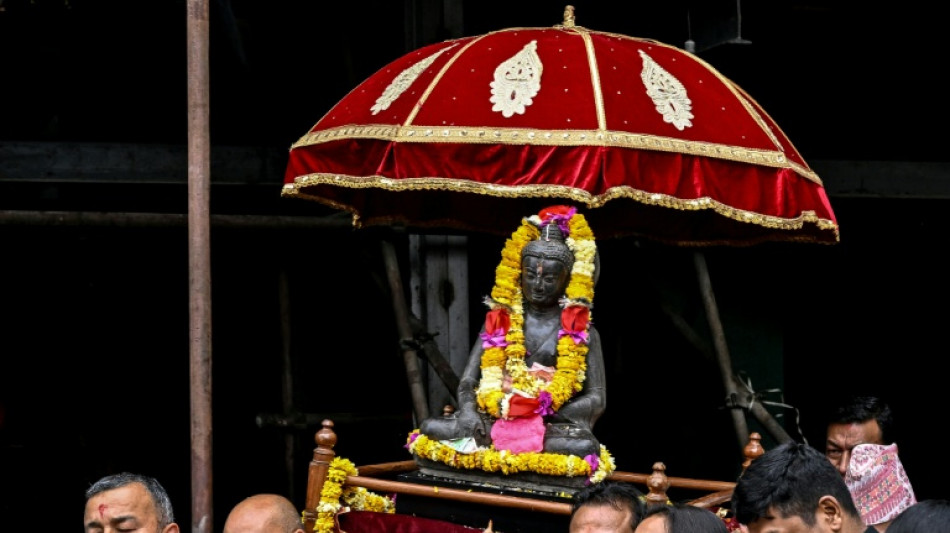
Nepal temple celebrates return of stolen Buddha statue / Photo: © AFP

A centuries-old Buddha statue stolen from a Nepali temple was reinstalled in its original location on Friday, one of several artefacts returned from foreign museums and collectors in recent years.
The statue, dating to the 13th century, was carried in a palanquin back to its pagoda-style temple in the capital Kathmandu to the sound of traditional music.
"I feel so happy, we all do. Our god is coming back," temple-goer Sunkesari Shakya, 67, told AFP, recalling the day the statue was stolen, wreaking "havoc" in the community.
In a ceremony attended by a visiting US envoy, the statue returned from New York in 2022 was placed back on its original stone plinth.
The event coincided with the festival of Buddha Jayanti, marking the birth of the founder of Buddhism.
A replica that locals had been worshipping instead was moved to another area of the temple.
The statue was taken from the temple in the 1980s and later emerged at Tibet House US, a New York cultural centre, where it was gifted by an unknown monk, according to Nepal's Department of Archeology.
Sergio Gor, Washington's special envoy to South and Central Asia, told AFP that "one of the things we are focusing on is to be able to bring back some of these incredible artefacts that decades past got into the wrong hands."
"We are trying to right a wrong from the past," said Gor, who was on a three-day visit to Nepal.
Many in the Himalayan nation of 30 million people are deeply religious, and the country's Hindu and Buddhist temples as well as heritage sites are an integral part of everyday life.
But many sites are bereft of centuries-old sculptures, paintings, ornamental windows and even doors, which were often stolen after the country opened up to the outside world in the 1950s.
Many pieces were taken with the help of corrupt officials to feed art markets in the United States, Europe and elsewhere, although their export remains illegal.
About 200 artefacts have been returned back to Nepal, according to the archeology department, including wood and stone carvings, paintings, scriptures and idols of gods and goddesses.
At least 41 artefacts have been placed back in their original location.
"This is very important. Our statues are not just objects of art but part of a living heritage," conservation expert Rabindra Puri told AFP.
Puri said there was growing momentum to return stolen artefacts. Over 400 are officially listed as missing, but experts estimate the actual number is in thousands.
Authorities are specifically seeking to return more artefacts from the United States, France, Germany and Britain.
(L.Møller--DTZ)