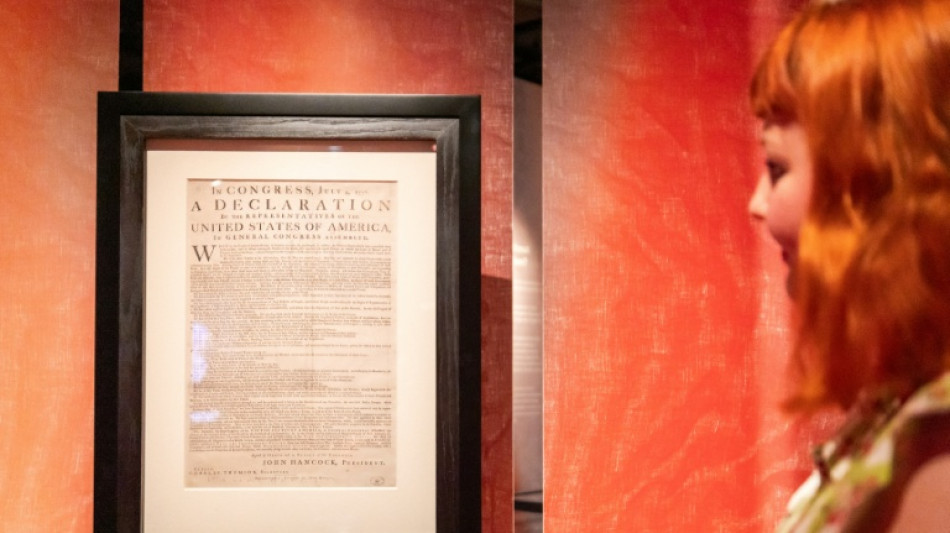
'Boston Tea Party' compensation claim to be displayed at UK exhibit / Photo: © AFP

A compensation claim for 340 chests of tea thrown into Boston harbour in what is known as the "Boston Tea Party" is among the highlights of a UK exhibition exploring the birth of the United States.
The letter from the owner of the cargo, the East India Company, to the British government gives a breakdown of the tea destroyed on December 16, 1773 by American colonists.
It demands reimbursement to the tune of £9,659 -- the equivalent today of around £1.2 million ($1.6 million) -- after what it calls "a lawless rabble went on board" and threw the tea into the water.
It's just one of the original documents including original maps, correspondence and first-hand accounts, to feature in the exhibition at the UK's National Archives in southwest London which opens on Wednesday.
The exhibition comes as the US gears up for the 250th anniversary of the nation's July 4, 1776, Declaration of Independence.
Other highlights include a handwritten letter from 1781 signed by George Washington, a founding father and the first US president, accepting the British surrender in what became the decisive battle at the end of the American Revolutionary War.
"This is the moment the British realised they would have to give up the Thirteen Colonies that would become the United States of America, the moment that Britain finally accepts the reality of the declaration of independence drafted five years earlier," said curator Sean Cunningham.
Also on display will be a rare first printing of the 1776 Declaration of Independence by Philadelphia publisher John Dunlap.
Adopted on July 4, 1776, the declaration states that 13 American colonies then at war with Britain would regard themselves as independent sovereign states no longer under British rule.
July 4 is celebrated as Independence Day in the United States.
Other exhibits include the Olive Branch Petition to King George III signed by many of the men who would become the nation's founding fathers in a last ditch attempt to avoid war a year earlier.
Cunningham said the exhibition -- Revolution 250 -- also brought forward voices often absent from traditional accounts, including indigenous peoples, black loyalists and enslaved individuals.
Lesser-known documents illuminating other perspectives include the Dunmore Proclamation of 1775 which offered freedom to enslaved people who joined British forces, revealing how intertwined the war was with slavery.
"Together, these records offer a more complex and enlightening account of the Revolution, showing how its consequences were felt far beyond the Thirteen Colonies," Cunningham added.
(N.Loginovsky--DTZ)