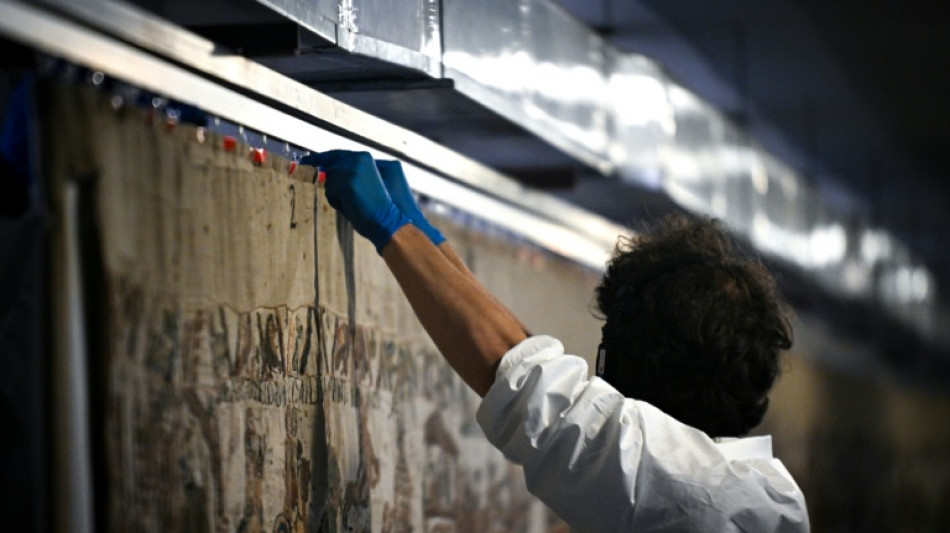
Bayeux Tapestry begins epic journey from France to London / Photo: © POOL/AFP/File

The medieval Bayeux Tapestry began a hugely complicated journey on Thursday that will see it leave France for the first time in more than 900 years for an exhibition in the British capital.
The fragile 11th-century artefact has left its home in Bayeux in a high-tech container designed to eliminate vibrations and maintain a steady temperature and humidity, a source close to the matter told AFP.
It was expected to cross the Channel between France and the UK via the undersea railway link in a climate-controlled truck under police protection.
The 68-metre (224-foot) embroidered tapestry is being loaned to the British Museum as a diplomatic gesture intended to underscore Franco-British friendship.
- William the Conqueror -
Of uncertain provenance and nearly destroyed on several occasions, the masterpiece tells the story of the Norman invader William the Conqueror who crossed the Channel and defeated the English king Harold in the 1066 Battle of Hastings.
Starting from September 10, visitors at the British Museum will be able to view the UNESCO-listed artwork in an exhibition that runs until July 2027.
Some experts had voiced concerns that the complicated transfer -- funded by the UK for an undisclosed amount -- risked causing irreversible damage to a work already weakened by 30 tears and nearly 10,000 holes.
A 2021 study by restoration experts warned of the "additional risks" that a trip lasting more than two hours would pose to the tapestry.
But when French President Emmanuel Macron announced the loan almost exactly a year ago, he brushed aside the warnings to celebrate Franco-British relations, 10 years after the bitter Brexit referendum.
Since then, several technical studies and two test trips with a full-scale reproduction of the tapestry have been undertaken to meet the logistical challenge of transporting a work as delicate as lace.
Pointing out that the tapestry is unfinished, Macron wrote: "It is our job to write the next chapter, in a spirit of respect, trust and renewed alliance," in an article in The Times newspaper.
"Let us go on building the future of this link between the two sides of the Channel, this Entente Cordiale that has become an Entente Amicale."
- High demand -
The tapestry will be laid flat for viewing in a specially made, raised glass case.
The British Museum sold a record 100,000 tickets for the exhibition, costing between £25-33 for adults, on the day they went on sale earlier this month.
After the first tranche sold out so quickly, more tickets will go on sale later in the year.
Last September, conservators completed a tricky operation to move the tapestry from its museum in northwestern Normandy, which it had not left since 1983, to a secret storage location.
Plans to loan it to London had been considered twice before, but both were aborted: in 1953 for the coronation of Queen Elizabeth II and in 1966 for the 900th anniversary of the Battle of Hastings.
- 'Safe and sound' -
"Nothing, absolutely nothing, has been left to chance, particularly when it comes to the movement of this work," French Culture Minister Catherine Pegard said in June, calling some "insinuations of incompetence" particularly "unfair".
The British Treasury has agreed to provide insurance coverage estimated at £800 million (over 900 million euros) in the event of major damage to the tapestry.
"The risks are extremely low," Philippe Belaval, who was tasked by Macron's office with overseeing the operation, told AFP in April.
Peter Ricketts, his British counterpart, insisted the one-of-a-kind work will be returned to France "safe and sound".
The eye-watering insurance cover "just shows how serious we are about ensuring that it goes back in good condition," Ricketts told AFP earlier this week.
The origins of the tapestry remain shrouded in mystery, with many scholars believing it was made by artisans in or around Canterbury in southern England.
It was probably commissioned by Bishop Odo of Bayeux -- William's half-brother -- in 1077 to decorate the new cathedral in his hometown, Bayeux, according to the tapestry's home museum.
French museums will in exchange be loaned ancient treasures mainly from the Anglo-Saxon Sutton Hoo site, one of England's most important archaeological locations.
On its return to France in late 2027, the tapestry will be reinstalled at its museum in Bayeux, which is currently closed for renovations, before undergoing a delicate and long-delayed restoration.
The restoration is expected to begin in 2028 and could take place inside the museum and "in the presence of the public" to avoid having to remove the tapestry again, Belaval said.
(M.Travkina--DTZ)