A once wary Hollywood slowly warms to AI / Photo: © GETTY IMAGES NORTH AMERICA/AFP

Once wary of artificial intelligence, Hollywood is now striking up partnerships with AI start-ups and weaving the technology into productions more and more openly -- all while insisting the creative process itself will remain untouched.
"Everybody is still wrapping their head around it," said Mike Mosallam, COO of production company Shadowbox Studios, in an interview with Variety as recently 2025.
Rattled by the technology, Hollywood initially went on the defensive.
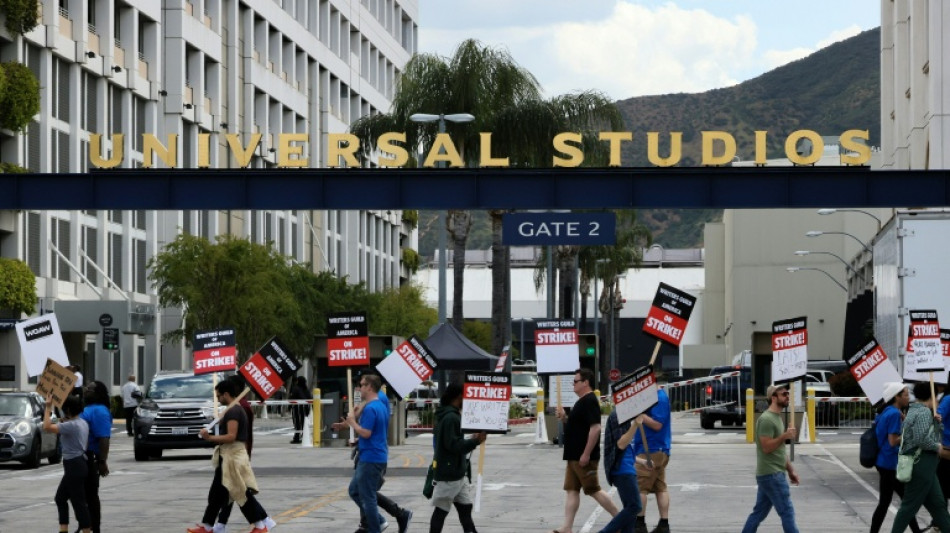
Studios worried about their intellectual property being misused, and actors feared becoming little more than raw material for AI systems -- and made it a central plank of their strike action in 2023.
Those who did experiment ran into the technology's early limitations -- six-fingered hands, mouths that didn't move right.
But a floodgate opened in early March, when Netflix bought a small, little-known company -- fewer than 20 employees -- for a hefty $587 million.
Co-founded in 2022 by producer, director and actor Ben Affleck, InterPositive is an AI platform designed to assist film and TV production.
In early June, studio Lionsgate took a stake in Runway, one of the leading names in AI-generated video, and the two will now develop creative projects together.
Days later, Google made a similar move, investing in independent studio A24.
Recent ad campaigns and short films have shown that AI video -- even when it includes human characters -- has crossed a real threshold.
As Runway put it in May: "In many cases, if the story is strong enough, the technology is now good enough to become invisible."
According to Jamie Umpherson, Runway's chief creative officer, people are learning to use the tools better as the technology improves on a "scale that was unimaginable a couple of years ago."
"There's more familiarity than there was even a year ago," he said, adding that this is freeing up creative teams to focus more on story and style.
Netflix co-CEO Ted Sarandos struck a similar note when presenting the company's results in mid-July: "We're making higher quality output more quickly and efficiently than we could have using traditional methods."
He said GenAI workflows have now been used on roughly 300 Netflix titles, mostly in post-production, adding: "We're leveraging GenAI for really complicated shots and sequences."
- 'Hybrid' -
Still, the streaming giant seems to be focusing mainly on the edges of production -- from visualizing a concept early on to color-grading footage after filming wraps.
Independent director and producer Jon Erwin insists the core of the craft isn't going anywhere.
"Actors drive all the performances, and we use these tools to amplify the sets and the scope of the shows," he said.
"But we preserve the core of the filmmaking process, which is the relationship between the actor, the director and the camera. These tools do not replace that."
In April, his production company Wonder Project launched a joint venture called Innovative Dreams with Luma, a rival to Runway.
Together they have developed a new process that lets actors be filmed naturally -- no green screen, no motion-capture suit -- and then surrounds them with a hyper-realistic AI-generated world.
Erwin calls it "hybrid" or "nonlinear" filmmaking.
The process is fast enough that the AI-generated backdrop can be added just minutes after a scene is shot, giving filmmakers an almost-instant preview -- and the chance to shoot additional takes right away if needed.
The first feature film built on this approach, "Young Washington," has already grossed more than $40 million at the box office -- double its production budget -- starring Oscar winner Ben Kingsley alongside two Golden Globe winners.
Technicians, actors and camera operators still have a place in this new ecosystem, though how many of them will be needed remains an open question.
Actor Matt Damon voiced concern about this, referring to Christopher Nolan's "The Odyssey," shot across three continents: "I don't think people are going to be given the resources to shoot movies that way for much longer."
So far, Hollywood's traditional powerhouses -- Paramount, Universal, Sony, Walt Disney and Warner Bros -- have officially stayed on the sidelines of the AI shift.
But Tanya Porquez, CEO of Generated Group -- which has just launched a database of AI-generated video creations -- thinks that won't last.
"Studios will have to get on board. Not because they necessarily want to, but I think it's just the wave."
(W.Uljanov--DTZ)