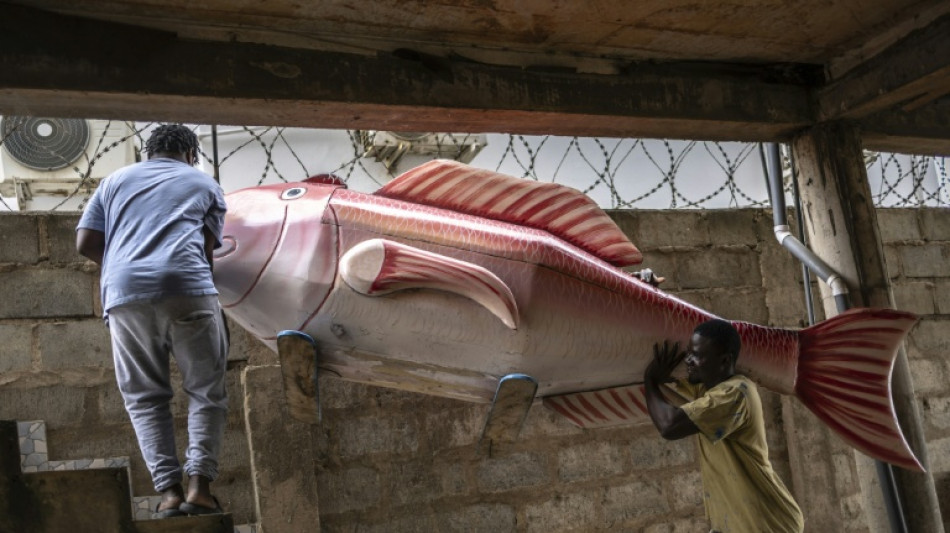
In Ghana, larger-than-life coffins tell the stories of the dead / Photo: © AFP

Frederick Teiko Ofori spent a large portion of his life with a guitar in his hands, so when the Ghanaian musician died in a road accident, his family decided that the instrument should accompany him on his final journey.
His coffin was built in the shape of an enormous guitar.
The coffin stood out at his funeral on Saturday in Adjen Kotoku Amoama, on the outskirts of Accra, among bright red flowers, a portrait of the 40-year-old and the mourners gathered under canopies to shade themselves from the sun.
Yet it was also par for the course in a country where celebrations of life often include such intricately crafted tributes to the deceased.
In Ghana, particularly among Ga communities around the capital, "figurative" or "fantasy" coffins, as they're known, offer fantastical, yet intimate, send-offs.
Fishermen are buried in massive, human-sized fish or canoes, farmers in cocoa pods, drivers in cars and religious figures in Bibles.
Ofori left behind a wife, a young family including a child born just a week before the funeral, and a musical legacy abruptly cut short.
But even in death, the guitar remained part of his identity.
The huge wooden instrument carrying his body was made by Daniel Oblie Mensah, known by the cheery nickname "Hello", a veteran coffinmaker who has spent more than three decades turning people's professions, passions and status into their final resting places.
"Anytime someone commissions me to do a coffin in the profession of the deceased, it excites me," Mensah, 54, told AFP.
"It helps me truly honour the deceased and the family."
The modern tradition of sculptural coffins emerged among Ga craftsmen around Accra in the middle of the 20th century, partly inspired by the elaborately shaped palanquins used by local chiefs.
Today, the objects occupy an unusual niche of contemporary art, quickly disappearing underground despite painstaking, finely tuned craftsmanship.
Some end up displayed in museums, however, including a guitar-shaped coffin by Ghanaian artist Paa Joe, on loan to New York's Metropolitan Museum of Art.
- A teacher's final pen -
Samuel Commey Tetteh lay dressed in white before his funeral began, visitors greeting elders at the family home before approaching the body of the man known throughout the community as "Teacher".
Tetteh, born in 1943, had taught in Paanor, in Ga South, outside the capital, for more than half a century, his family said.
The quiet of the early morning eventually gave way to pounding music as mourners filed in. Then came Tetteh's coffin -- a giant pen.
Again, it was Mensah's work. It took about two weeks.
A sheep was slaughtered and its blood applied to the coffin, the solemnity of the funeral rites taking precedence over the fun of the coffin.
And then, the pen was buried, Mensah's work disappearing into the ground.
At workshops around Accra, dozens of other lives wait to be translated into wood.
Some customers arrive carrying a photograph of exactly what they want. Others simply describe the life of the deceased.
Then the craftsmen let their imaginations run riot.
One of the most difficult designs that carpenter Lawrence Okoe Anang remembers was a crocodile, commissioned more than a decade ago for a priest in Ghana's Volta Region.
His father made the coffin, while the younger Anang, then still learning the trade he started training for at age 10, helped around the workshop.
- Worldwide interest -
Coffins typically fetch around 10,000 Ghanaian cedis ($900), said the 26-year-old, who now runs the workshop with his younger brother.
Pieces intended for exhibitions cost more, because craftsmen use more durable materials, intended to last decades under the museum lights.
The industry remains heavily dependent on skills passed down through families, though it has changed considerably since earlier generations worked with hand tools.
Modern equipment has sped up production, wood supplies have become more reliable, and overseas commissions for museums and collectors have helped grow the trade.
The ability to turn ordinary timber into a fish, aeroplane, Bible, pen or guitar raises questions over what to call the people who make them.
Anang considers himself a carpenter, coffin maker and artist, rolled into one.
At Ofori's funeral, however, those kind of playful questions seemed distant.
Around his grave stood the people the musician had left behind.
They gathered around the guitar.
Then, it was lowered out of sight.
(P.Tomczyk--DTZ)