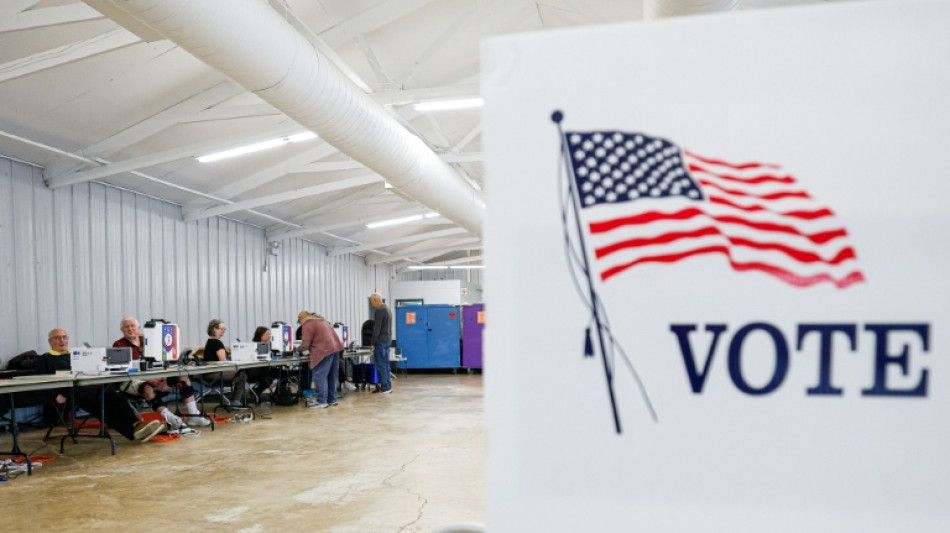
'Pseudo-journalism': Partisan 'news' sites target US midterms / Photo: © AFP

It bills itself as an "independent journalism" outfit, but the innocuous-sounding North Carolinian is among hundreds of partisan sites that researchers say masquerade as local news outlets in battleground states ahead of the US midterm elections.
The so-called "pink slime" sites -- many secretly backed by partisan groups on both sides of the political aisle -- appear to be fueling an explosion of polarizing or false narratives ahead of the November 3 elections.
Their backers are splurging hundreds of thousands of dollars on advertising their articles on social media, expanding their otherwise limited readership while authentic media outlets grapple with financial woes, layoffs, and record low public trust.
The Senate Leadership Fund (SLF), a political action committee that describes itself as "solely dedicated to protecting and expanding the Republican Senate majority," apparently launched the North Carolinian in July, according to disinformation watchdog NewsGuard.
The North Carolinian said the site was "paid for by SLF" and was "not authorized by any candidate or candidate's committee."
But the site appears focused on opposing Democrat Roy Cooper's campaign for US Senate and boosting his Republican opponent in the southern state, Michael Whatley. It carries headlines with phrases such as, "Roy Cooper's disastrous crime record" and "Whatley highlights Democrat Cooper's dangerous soft-on-crime record."
SLF spent between $34,700 and $46,715 promoting the site's articles on Meta platforms through late August, garnering at least 3.6 million views, according to NewsGuard.
SLF did not respond to AFP's request for comment.
- 'Undermining trust' -
"Pink slime" outlets -- some suspected of using AI tools to produce their articles -- have proliferated in recent years, outnumbering American newspaper sites, in a trend that experts say is eroding trust in traditional media.
NewsGuard has identified 21 pink slime outlets that launched this year, bringing the total number of such sites to 1,179. By comparison, only 937 daily newspapers were operating, according to Northwestern University's Local News Initiative.
"These pink slime sites can be confounding to news consumers who may not be aware of their agendas and confuse them with authentic independent news websites in their area, thereby undermining trust between journalists and their readers of all political persuasions," said NewsGuard's Sam Howard.
NewsGuard said two pink slime networks -- One Nation on the right, and the American Independent on the left -- collectively spent at least $801,500 on advertising in the first eight months of this year to promote their articles on Facebook and Instagram.
Their growing online reach could potentially affect the responses of AI chatbots, which are now popularly used for online searches, researchers say.
One Nation, an affiliate of SLF, has launched six sites posing as independent news portals in states with key Senate races -- Georgia, Alaska, Maine, Iowa, Ohio, and New Hampshire -- according to the independent newsletter Popular Information.
One Nation is "producing propaganda masquerading as journalism," the newsletter said.
The American Independent and One Nation did not respond to an AFP request for comment.
- 'Tricked' -
The sites are dubbed "pink slime" after the fluorescent pink meat paste used as an additive by food manufacturers.
In the age of cheap, widely available AI tools, producing and circulating their content -- described as "pseudo-journalism" by the Columbia Journalism Review -- has never been easier.
Last year, a study supported by Yale University's Institution for Social and Policy Studies warned of their growing influence, saying many users often prefer such sites over traditional media adhering to ethical practices.
"These sites seem to take money from campaigns or political operatives and write pieces that are biased or have some sort of angle, with this veneer of a legitimate news site," said Kevin DeLuca, an assistant professor of political science at the university.
"Such sites have the potential for making people believe things that are not true without understanding where the information is coming from."
The rise of pink slime comes amid a rapid decline of local newspapers, many of which have either shut down or suffered extensive layoffs due to economic headwinds.
Last year, Northwestern University identified over 212 counties out of some 3,000 in the United States as "news deserts," having no locally-based news sources such as newspapers and public radio.
(I.Beryonev--DTZ)