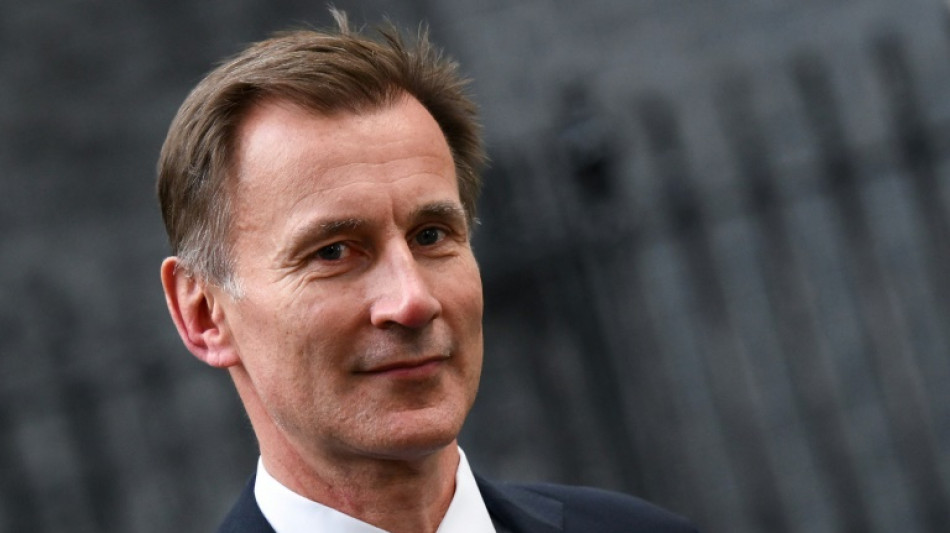
UK unveils cost-of-living budget as strikes rage / Photo: © AFP

Britain's government on Wednesday vowed a hefty £94 billion ($114 billion) in cost-of-living support for this year and next, as it forecast the UK to stay out of recession and inflation to slow sharply.
Unveiling an annual budget set against a backdrop of mass strikes, finance minister Jeremy Hunt said he was "protecting struggling families" as he outlined more support especially for energy bills and childcare.
Coinciding with the budget, teachers, junior doctors, civil servants, BBC journalists and drivers on London's Underground network staged the latest walkouts, demanding higher wages in line with soaring prices.
"High inflation is the root cause of the strikes we have seen in recent months," Chancellor of the Exchequer Hunt told parliament.
"We will continue to work hard to settle those disputes but only in a way that does not fuel inflation," he added.
- No recession -
UK inflation remains above 10 percent but should cool to 2.9 percent by year-end, Hunt said.
"The UK will not... enter a technical recession this year," he added, after the economy narrowly avoided two successive quarters of contraction in 2022.
The government said it would extend a subsidy on energy bills for a further three months, after Russia's invasion of Ukraine sent them soaring.
Prime Minister Rishi Sunak's Conservative administration also announced increased childcare funding and other actions aimed at encouraging parents, the over-50s and others back into the jobs market.
Hunt unveiled a major expansion of the government's free childcare scheme, in a bid to tackle some of Europe's highest childcare costs and encourage parents back to work.
It is looking to fill 1.1 million staff vacancies -- in part caused by a lack of EU workers following Brexit, and by a record number of people classed as long-term sick since the Covid pandemic.
The chancellor also confirmed workers could put more tax-free money into private pensions, in an attempt to discourage early retirement.
However, opposition Labour leader Keir Starmer argued this was a "permanent tax cut... for the richest one percent" as many did not have enough income to benefit.
Faced with the geopolitical tensions over Ukraine, Hunt confirmed UK defence spending would increase by £11 billion over the next five years.
He also outlined a 20-year plan to capture carbon and commit to nuclear energy, as the government seeks to strengthen energy supplies and establish a "net zero" economy by 2050.
- 'No rabbit, no hat' -
However, the chancellor kept a tight leash on spending after debt jumped as a result of the pandemic.
Hunt only took office in October -- reversing unfunded tax cuts that were imposed by Sunak's short-lived predecessor Liz Truss, whose free-market policies sent markets into a panic.
"It's common for the chancellor to 'pull a rabbit out of their hat' during budgets," remarked Stuart Fox, politics lecturer at the University of Exeter.
"As far as Jeremy Hunt is concerned, however, there's not enough money to pay for the rabbit -- or the hat -- because of spiralling inflation, sluggish growth and the disastrous impact of Liz Truss' premiership on the public finances."
Paul Johnson, director of the Institute for Fiscal Studies (IFS) think-tank, added that Sunak had made a "political choice" regarding public-sector pay.
"There was no funding to be found to improve the pay offer to striking public-sector workers, where £6 billion might have been enough to make an inflation-matching pay offer possible," Johnson commented.
"That's a political choice. Money for motorists," he said, referring to Hunt's announcement of a freeze on fuel duty, "but not for nurses, doctors and teachers".
(M.Dorokhin--DTZ)