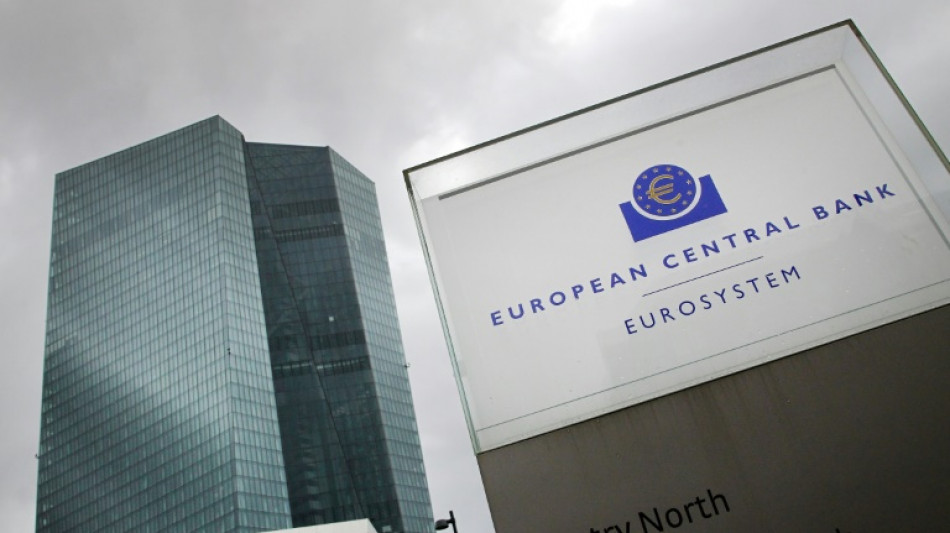
Market turmoil tests ECB rate hike appetite / Photo: © AFP/File

European Central Bank governors will meet Thursday, with fears over a widening banking crisis testing their resolve to raise interest rates again by a hefty half percentage point.
Investors say the ECB should reconsider its plans following the collapse of Silicon Valley Bank and Signature, the sector's biggest failures since the 2008 financial crisis.
Fears of contagion have spread to Europe, with stock markets tumbling and Credit Suisse shares hitting a record low on Wednesday, while other lenders also saw dramatic drops.
"The sell-off may have implications for the ECB's policy decision," said Capital Economics analyst Andrew Kenningham.
The banking crisis poses a conundrum for central bankers seeking to tame inflation while preventing an exacerbation of the market turmoil.
SVB's demise was precipitated by the US Federal Reserve's own rate-hike campaign, which brought down the value of bonds with lower returns that the California bank held, causing it to lose $1.8 billion.
"It seems investors have been rattled by worries that the ECB may still opt for a big rate increase, despite the problems hard and fast monetary policy tightening has had on bond prices," said Susannah Streeter, head of money and markets at wealth management firm Hargreaves Lansdown.
"The worry is that banks sitting on large unrealised losses in their bond portfolios might not have sufficient buffers if there is a fast withdrawal of deposits," she said.
But Kenningham said the ECB will likely press on with its pre-announced plan to raise the deposit rate from 2.5 to 3.0 percent.
Others, however, have revised their expectations for Thursday, with ING analysts noting that "what was seen as a solid 50 basis points hike from the ECB has today been cut to a 35 basis points hike".
- 'Persistent inflationary pressures' -
Ahead of the market upheaval, ECB president Christine Lagarde had said the bank's 26-member governing council will "very, very likely" raise interest rates by another 50 basis points.
It would be the sixth successive increase for the 20-nation currency club, leaving the ECB's three main rates 3.5 percentage points higher since July.
While the monetary hawks will still argue that there is no threat of contagion from SVB for the eurozone, it is clear that the bank's failure would bolster doves' case that interest rate hikes are not as painless as they are made out to be, said Axa chief economist Gilles Moec.
Frederik Ducrozet of Pictet Wealth Management noted that central banks are now "likely to be more cautious as they monitor the tightening in credit conditions".
"However, one major difference with previous banking crisis episodes is a more resilient macro backdrop including persistent inflationary pressures," he said.
The ECB has hiked rates at a historically fast pace to cool consumer prices after energy and food costs shot up in the wake of Russia's war in Ukraine.
Declining energy prices in recent months have helped slow inflation to 8.5 percent in February.
But excluding volatile energy and food costs, core inflation hit a fresh record high of 5.6 percent, bolstering the argument for further interest rate rises.
- 'Heated discussion' -
The ECB is set to release a new set of economic forecasts on Thursday that will help guide its decisions.
Back in December, the bank expected inflation to soften to 3.4 percent in 2024 and 2.3 percent in 2025.
The ECB does not expect a recession in 2023, and any upward revisions to economic growth forecasts would make it easier for policymakers to back more monetary tightening.
ING bank economist Carsten Brzeski predicted a "heated discussion" between dovish policymakers wanting to slow down rate hikes and hawks pushing to stay the course as inflation remains well above the ECB's two-percent goal.
What is clear is that all eyes will also be on hints about future rate meetings.
"The March hike will be less important than what is signalled for May and beyond," Deutsche Bank economists said.
(M.Dorokhin--DTZ)