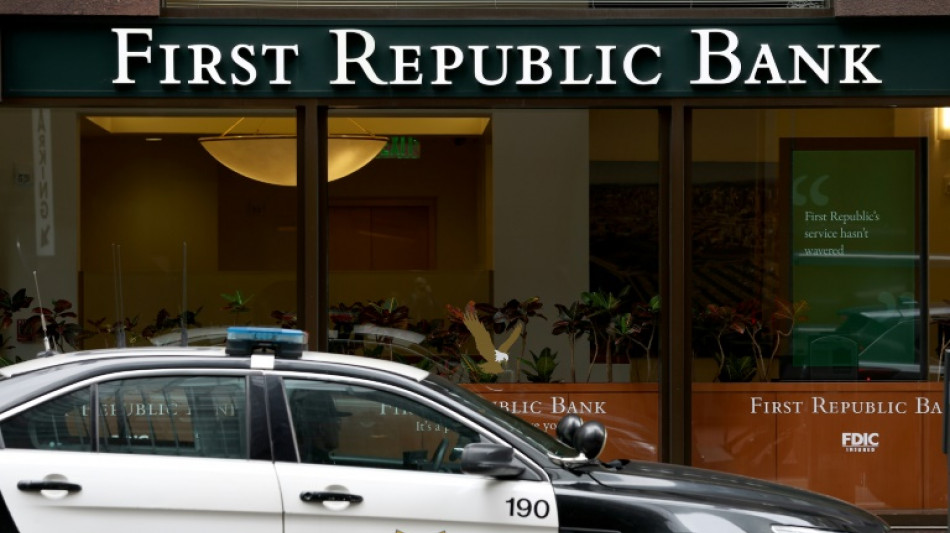
Wall Street giants move to rescue First Republic Bank / Photo: © GETTY IMAGES NORTH AMERICA/AFP/File

America's largest banks moved Thursday to shore up First Republic, easing fears that the regional lender could be the next domino to fall after two collapses including Silicon Valley Bank (SVB).
Shares of the crippled Californian bank pared earlier losses to trade higher on Wall Street Thursday, following reports it could receive an infusion of funds from some of the country's most prominent financial institutions.
A group of 11 US private banks, including Bank of America, Citigroup and JPMorgan Chase, have since announced they would deposit $30 billion into First Republic.
"This show of support by a group of large banks is most welcome, and demonstrates the resilience of the banking system," said leaders of the Treasury Department, US Federal Reserve, Federal Deposit Insurance Corporation and Office of the Comptroller of the Currency in a joint statement.
Founded in 1985, First Republic is the 14th largest US bank by assets, with $212 billion at the end of 2022.
Headquartered in San Francisco, First Republic is also present on the East Coast, including in New York and Florida, as well as in western states such as Washington and Wyoming.
But the majority of the bank's "affluent" client base is concentrated in coastal urban areas, Morningstar analyst Eric Compton wrote in a recent note to clients.
The bank is known for private banking and wealth management. As a result of its clientele, it has a large percentage of uninsured deposits that has kept it under scrutiny after the failures of SVB, Signature and Silvergate.
- 'Elevated' risk of outflows -
Although First Republic's customers come from a wide range of sectors, there have been concerns that many of them might look to flee to the relative safety of big, well-capitalized Wall Street banks in light of the ongoing turbulence in financial markets.
According to S&P Global Ratings, 68 percent of the bank's accounts hold deposits of more than $250,000, the level automatically guaranteed by US regulators.
"We believe the risk of deposit outflows is elevated at First Republic Bank despite the actions of federal banking regulators and the bank actively increasing its borrowing availability to mitigate risk associated with the bank failures over the last week," S&P said Wednesday as it moved to downgrade First Republic.
By Thursday morning, First Republic's share price had cratered by more than 75 percent week-on-week, adding to the worries about its long-term viability.
The free-fall came to an abrupt end after reports that some of Wall Street's biggest names were mulling a move to rescue the beleaguered bank.
All three major indexes were also trading higher, led by the Nasdaq which traded up more than 2.4 percent at 3:15pm to 11,711.05.
(I.Beryonev--DTZ)