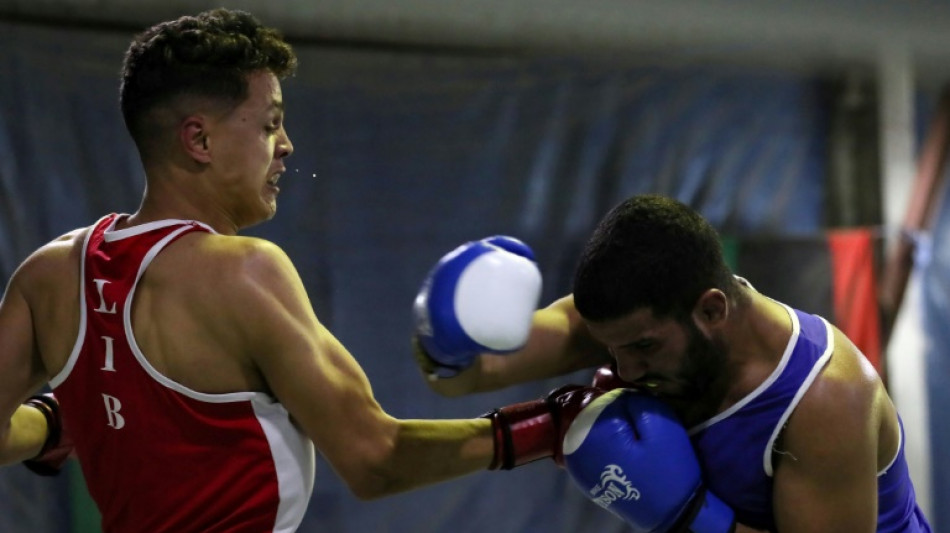
Libya's boxers recover from Kadhafi-era knockout / Photo: © AFP

Omar Zlitni holds a decades-old, black-and-white photo of himself as a boxer in his prime, posing in shorts and a training vest before Libya's then-dictator, Moamer Kadhafi, banned his beloved sport.
Boxing was "in his blood", said the 63-year-old Tripoli resident who proudly keeps the image as his phone's wallpaper.
In 1979, he was just 19 when boxing, along with wrestling and other combat sports, was banned by Kadhafi, who considered such contests a threat to his personality cult.
"We were a whole group. We were going to fight in Italy. And then, suddenly, they banned it. Why?" Zlitni told AFP, with anger clouding his usually peaceful face.
"There were friendships and love; boxing was everything," he said, adding he regretted their way of life had been taken away and that "everyone went his own way".
Officially, authorities considered the sport too violent -- despite Kadhafi's regime being accused for more than 40 years of atrocities including terrorism, torture, massacres of civilians and targeted assassinations.
Following Libya's 2011 revolution, in which Kadhafi was ousted and killed, Zlitni reunited with former fighters and worked to revive boxing, re-establishing the national federation through their "own efforts".
Since then, Libyan boxers have shone in various competitions, modelling themselves after Malik Zinad, a light heavyweight fighter who found success after leaving the country for Europe.
- 'Flying the flag' -
Under a tin roof, in a Tripoli barn, young fighters spar in a dusty old ring. They are striving to be selected to compete in African qualifiers for the Paris 2024 Olympic Games.
Now a coach, Zlitni deplores the lack of support from authorities, pointing out the rudimentary equipment that he and other former boxers had to pay for out of their "own pockets".
But the sight of so many young people freely practising the sport and "waving the flag of Libya" brings him "joy".
A crowd of spectators seated on plastic chairs shout at a boxer parrying blows from his opponent: "Block!", "Come on!", "Again!".
One in particular stands out among the ringside crowd -- Mountaha Touhami, one of few women boxers in the conservative Muslim country.
The self-declared "sports lover" said she was encouraged to get into the ring by her father, who had sought exile in the United States because of the boxing ban.
"Among the girls of my generation, we did not know that others practised," the 25-year-old said, describing how she often trained in secret with a punching bag.
"Even here, people are surprised to see a woman," she said, having come to the boxing gym to support a friend.
"But the fact of being a woman, child or adult, does not prevent you from playing sports".
- 'Perseverance and patience' -
Other combat sports have reappeared and emerged in Libya since 2011. For Omar Bouhwiyah, an ardent kickboxer and Thai boxer, their existence provided the opportunity to develop new passions.
"These sports have allowed me to have more self-confidence, to remove negative energy, have a sense of responsibility and to socialise more," he said.
A fan of action films, the 29-year-old said he first came across a Facebook group dedicated to kickboxing in his hometown of Benghazi in 2013.
Having gone on to win several competitions, including regional titles, Bouhwiyah now trains in a modern gym in Tripoli.
Dressed in gloves and shorts in Libya's colours, he delivers strong punches and kicks to a punching bag, while filming the scene for his 14,000 followers on Instagram.
He says there is a gap between Libya and its neighbours in such sports, but believes "perseverance and patience" has made it possible to "break down prejudices" held about Libyans.
Bouhwiyah dreams of reaching the top, even becoming a world champion.
"Nothing is impossible," he said.
(A.Stefanowych--DTZ)