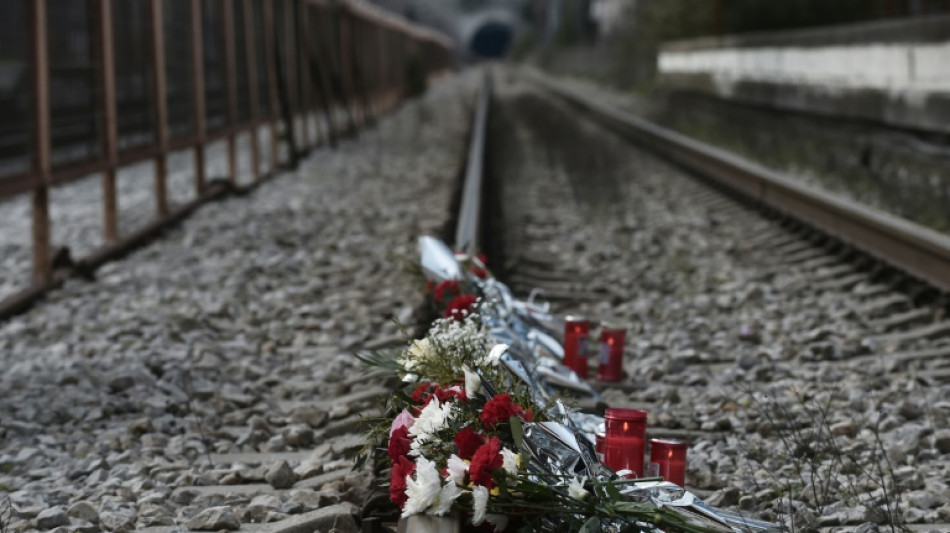
'Serious' safety faults in Greek rail network: watchdog / Photo: © AFP

Greece's rail watchdog on Friday said a probe had uncovered serious signs of poor training among staff on duty during the country's deadliest train tragedy, which killed 57 people last month.
The Regulatory Authority for Railways (RAS) in a statement said the shortcomings constituted an "immediate and serious" threat to public safety, after finding "lack of proof" that recently hired stationmasters had completed the required basic training.
It blamed the state-owned Hellenic Railways Organisation that owns the network for "inadequate" training of "critical" personnel.
"The training provided by OSE... to staff conducting critical safety duties was lacking and therefore inadequate," the independent authority said.
The investigation was launched on March 3, three days after two trains collided, killing 57 people.
RAS on Friday gave OSE five days to provide an explanation, and ordered any staff lacking full training sidelined.
The authority said it was also unclear how many stationmasters in training actually completed the required course.
The stationmaster on duty on the night of the accident has admitted mistakenly allowing the passenger and freight trains to run on the same track for several kilometres.
He and three other railway officials have been charged over the disaster and face a possible life sentence.
But railway unions had long been warning about problems, claiming the network was underfunded and understaffed after a decade of spending cuts.
OSE was mismanaged for decades and successive Greek governments were investigated by the EU for hundreds of millions of euros in illegal state aid to the company.
Greece was ultimately forced to break up the company during the bailout cuts that accompanied the country's decade-long debt crisis.
The Greek state kept ownership of the network, but rail services were sold to Italy's state-owned Ferrovie Dello Stato Italiane (FS) in 2017.
- Violent protests -
The disaster has sparked weeks of angry and occasionally violent protests, and has piled major pressure on the conservative government of Prime Minister Kyriakos Mitsotakis ahead of elections expected in May.
Greece's transport minister resigned after the crash and Mitsotakis has sought to soothe public anger by repeatedly apologising and vowing a transparent probe.
Investigators have separately opened a probe into possible railway funds mismanagement over the last 15 years.
Several people are still in hospital more than two weeks after the accident.
Rail traffic ground to a complete halt across the country for safety purposes.
Acting Transport Minister Georgios Gerapetritis said this week that services would gradually resume from March 22, but safety concerns among staff remain high.
Over 40,000 people protested in cities around Greece on Thursday, with many calling on the government to resign.
Another protest with some 65,000 people nationwide was held last week.
Gerapetritis and former transport ministers will appear before a parliamentary committee on March 20 to answer lawmakers' questions on the tragedy.
(G.Khurtin--DTZ)