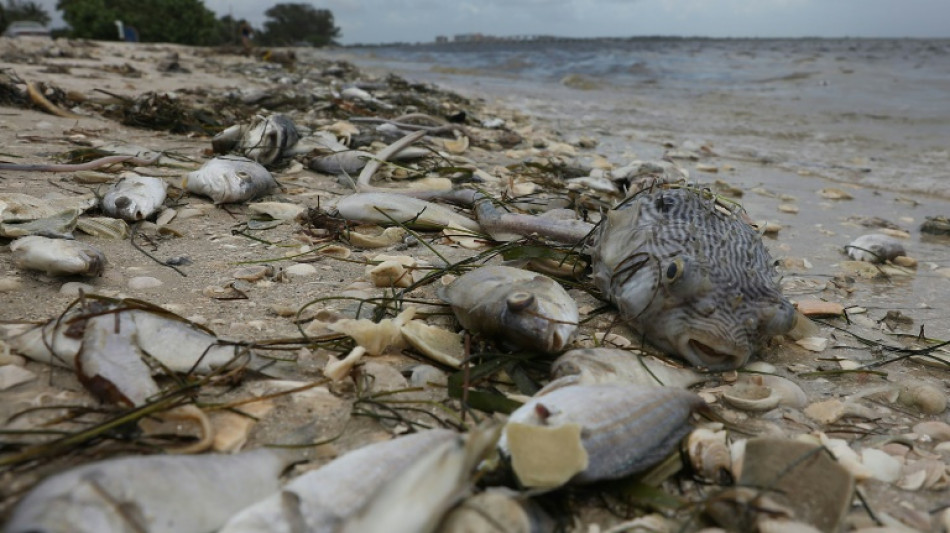
Unwanted visitor ruins spring break in Florida - toxic algae / Photo: © GETTY IMAGES NORTH AMERICA/AFP/File

With its brilliant sun, white sand and turquoise water, Lido Key Beach would make for a perfect postcard of Florida beaches if it weren't for the dozens of dead fish lying on the shore, killed by a toxic algae bloom known as red tide.
The bloom usually hits Florida's Gulf Coast in the summer, but this year it has come during spring, a time when thousands of American families flock to the Sunshine State during school break, and the outbreak bodes ill for its tourism sector.
On the terrace of the Lido Beach Resort, Jeff Napier, a 62-year-old employee, laments the effect red tide has had on business.
"We had a lot of cancellations. People get sick," Napier told AFP. "Why would you want to spend that kind of money and stay here?"
High amounts of the harmful algae, known as Karenia brevis, can kill marine life and cause respiratory complications in some people. It also has a sulfurous, decaying smell.
Dick Bowser experienced that firsthand a few days ago. The 80-year-old tourist walks along the shoreline with a cane in each hand, happy that the ocean currents have turned the tide away from Sarasota, at least for now.
"It smelled horrible. I couldn't stand to be near the beach," Bowser said. "It bothered me in the form of coughing, continuous coughing. I got a sore throat every day, having trouble with my eyes or sinuses."
In Napier's case, the toxic algae gave him five days of migraines, something he doesn't want to experience again.
"They just got to fix that red tide. They got to fix it," he says. "But I don't know what they're going to do about it."
- 'Kill the algae' -
Fifty kilometers (30 miles) from Lido Key Beach, scientists from the Mote Marine Laboratory have been working since 2020 to lessen the impact of red tide, a phenomenon first reported by Spanish explorers in the 15th and 16th centuries, based on accounts of the native populations in the area.
The goal of the research is to "kill the algae, denature the toxin and not have significant impacts on the nontarget species," explains Dr. Michael Crosby, president and CEO of the laboratory.
To achieve this, researchers cultivate specimens of Karenia brevis in huge tanks of seawater that imitate the ecosystem of the Gulf of Mexico and test various substances against it.
So far they have identified a dozen methods that work, and over the next two years they plan to test them in the ocean, Crosby says.
- 'You would still have red tides' -
But Crosby cautions that it is impossible to eradicate red tide completely, because unlike other harmful algae that are often the result of human activity on land, such as from agriculture runoff, Karenia brevis occurs naturally.
"We'll never get rid of red tide entirely," he says.
Florida's red tide begins about 65 kilometers off the state's west coast and may approach the coastline following ocean currents.
The current outbreak was triggered by Hurricane Ian, which hit Florida in September, pushing existing red tide to the surface, explains Crosby.
Once on the coast, microalgae proliferate when they come into contact with water rich in nutrients, both naturally or through agricultural activity.
"We are examining the degree to which it may be possible that humans, especially land-based inputs of nutrients, may exacerbate a red tide in terms of its intensity, or its duration."
"But even if you took all of the humans out of the state of Florida, you would still have red tides," he adds.
Facing the Lido Beach Resort, Napier seems resigned to living with the toxic bloom.
"You need to be aware that there is red tide in Florida. It has been here for hundreds of years."
(V.Sørensen--DTZ)