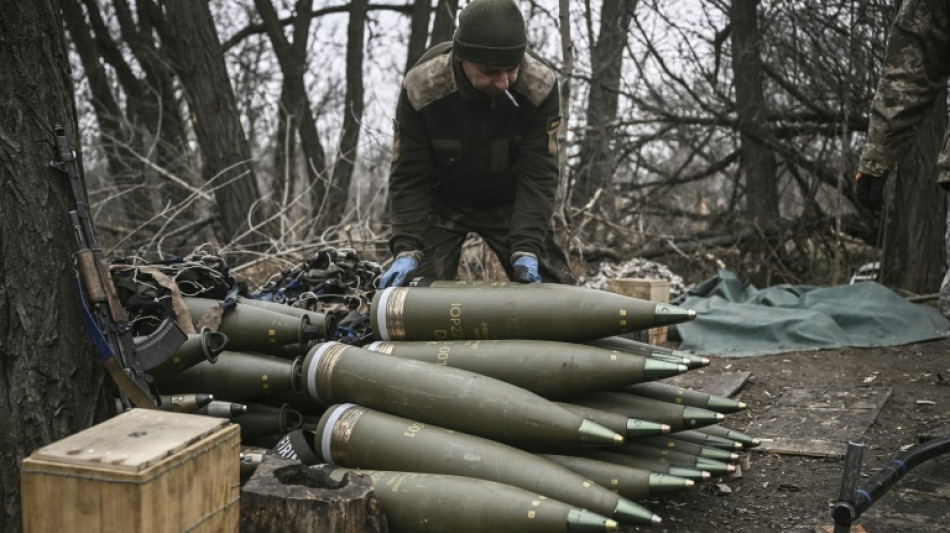
EU hammers out 2-billion-euro ammunition plan for Ukraine / Photo: © AFP

European Union ministers were set to sign off Monday on a two-billion-euro plan to raid their stockpiles and jointly purchase desperately needed artillery shells for Ukraine.
Kyiv has complained that its forces are having to ration firepower as Russia's year-long invasion has turned into a grinding war of attrition.
Ukraine has told the EU it wants 350,000 shells a month to help its troops hold back Moscow's onslaught and allow them to launch fresh counter-offensives later in the year.
Foreign and defence ministers meeting in Brussels are expected to agree on a multipronged initiative aimed at providing Ukraine with one million shells in the next year and replenishing their own stocks.
EU foreign policy chief Josep Borrell said there needed to be a deal, "otherwise, we will be in difficulties in order to continue supplying arms to Ukraine."
"We have to help Ukraine more, quicker and now," said France's Foreign Minister Catherine Colonna.
The first part of the plan involves committing a further one billion euros ($1.06 billion) of shared funding to try to get EU states to tap their already stretched stocks for ammunition that can be sent quickly.
The second part would see the bloc use another one billion euros to order 155-millimetre shells for Ukraine as part of a massive joint procurement push intended to spur EU defence firms to ramp up production.
Buying weaponry together on this scale is a major new step for the EU, which has seen long-standing efforts to work more in unison on defence propelled forward by Russia's war.
Countries have been wrangling over details, like whether the EU's defence agency or member states would negotiate the orders and if they should buy only from producers in Europe.
Diplomats said the plan on the table targets sending the first one billion euro's worth of shells to Ukraine by the end of May and signing the joint contracts by the start of September.
Lithuanian Foreign Minister Gabrielius Landsbergis said the ambition was to supply one million rounds over the next year, but it was not set in stone.
"It is possible that we might not be able to reach it," he said.
- How much in stocks? -
After 12 months of eating into their stockpiles, there are questions over how much EU countries can share immediately without leaving themselves vulnerable.
The bloc has already committed a wide range of military support worth 12 billion euros to Ukraine, with 3.6 billion euros from a joint fund used to help cover the costs.
Officials say that since the invasion last February, 450 million euros from the fund have gone on supplying 350,000 shells to Ukraine.
Key to getting countries to deplete their stocks is convincing them that European industry can step up to produce more.
Ukraine's consumption of ammunition currently far outstrips the amounts its Western backers are manufacturing.
Brussels said EU firms need to switch to "war economy mode" after scaling back in the years following the end of the Cold War.
The industry complains that governments haven't yet signed the long-term contracts they need to invest in more production lines.
The EU is hoping that placing a mammoth joint order for 155-mm shells will incentivise companies to ramp up their output.
It has begun reaching out to 15 firms in 11 EU countries that make the ammunition to urge them to push ahead.
Brussels has said it is looking to iron out regulatory bottlenecks, ease access to financing and even provide central EU funds to help boost capacity.
But several European diplomats say the details of these proposals remain vague and they need more reassurances that they will have an impact.
(I.Beryonev--DTZ)