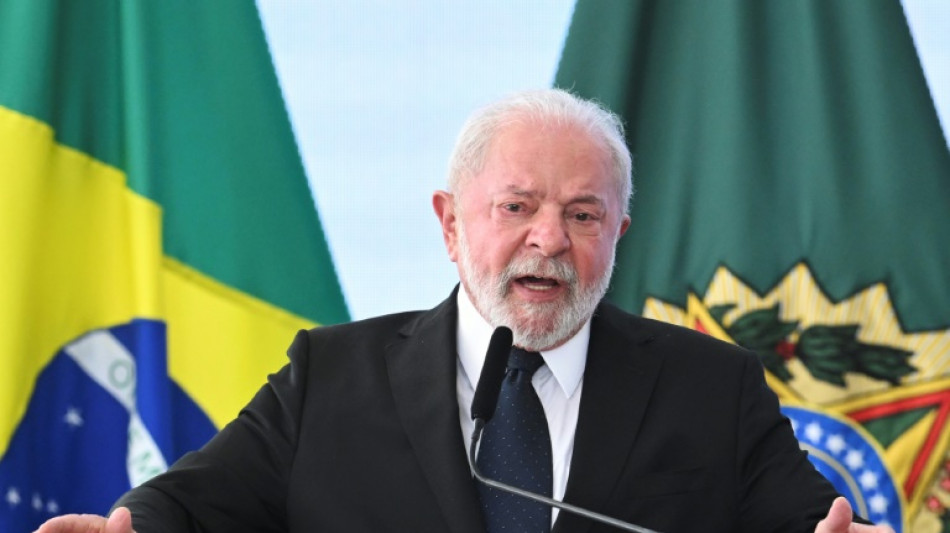
Brazil's Lula irks foreign oil companies with new tax / Photo: © AFP

Brazilian President Luiz Inacio Lula da Silva has not even been in power for 100 days but has already provoked the wrath of foreign oil companies with the creation of a new tax on crude exports.
Multinationals Repsol, TotalEnergies, Shell, Equinor and Galp have petitioned a federal court to suspend the 9.2 percent tax due to run from March to July and announced by the government last month.
That announcement came on the same day that Finance Minister Fernando Haddad partially restored a tax on fuel that had been suspended by Lula's predecessor Jair Bolsonaro during last year's election campaign.
Mining and Energy Minister Alexandre Silveira said the new crude tax would be an "opportunity to attract (investors) interested in the internal refining" of crude to sell to the domestic market rather than to export.
Brazil is the world's ninth largest producer of crude with more than three million barrels a day, mostly drilled from offshore platforms.
Lula, who began his third mandate on January 1, wants to boost the public purse to fund social programs.
During his first two terms as president from 2003-10, his social programs lifted millions out of poverty.
However, unlike the first decade of the century when there was a boom in primary materials, Brazil's economic situation in 2023 is a lot less prosperous.
The latest projection from Brazil's central bank is for growth to be less than one percent this year.
Due to a lack of resources, the government "looked for the easiest solution, which puts it in conflict with fewer people," said economics professor Juliana Inhasz, from the Isper institute.
It is a decision that is "more political than economic" and allows the government to avoid hiking up fuel prices too much, which would anger a far larger number of Brazilians, Inhasz told AFP.
- 'It stinks of Robin Hood' -
The new crude export tax will create "better fiscal balance," according to the government, and will help make up for the 6.6 billion reis ($1.25 billion) missed out on by only partially restoring the fuel tax.
But the oil sector, which employs 450,000 people and is responsible for 15 percent of industry's contribution to GDP, is up in arms.
In a statement sent to AFP, Shell said it was "worried" about a measure announced "without significant dialogue" that created "uncertainty about new decisions regarding investments."
The crude exporters feel unfairly prejudiced by the tax and consider it a "breach of contract" given that it did not exist when they invested in oil exploration in Brazil.
"During the next oil auction, it is possible that the bidders will take into account the risk that the rules will change" at a later date, said Livio Ribeiro, a researcher at the Brazilian Economic Institute at the Getulio Vargas Foundation.
He said this tax sets a "precedent" that creates legal uncertainty and could discourage not just major oil companies but other investors from putting their money in Brazil.
It has attracted scorn not just from foreign oil companies, with newspaper O Globo calling it "a very bad idea" in a recent editorial.
Such measures "stink of Robin Hood, who redistributes money from the rich to the poor. But invariably it turns out to be counterproductive," said the newspaper.
(I.Beryonev--DTZ)