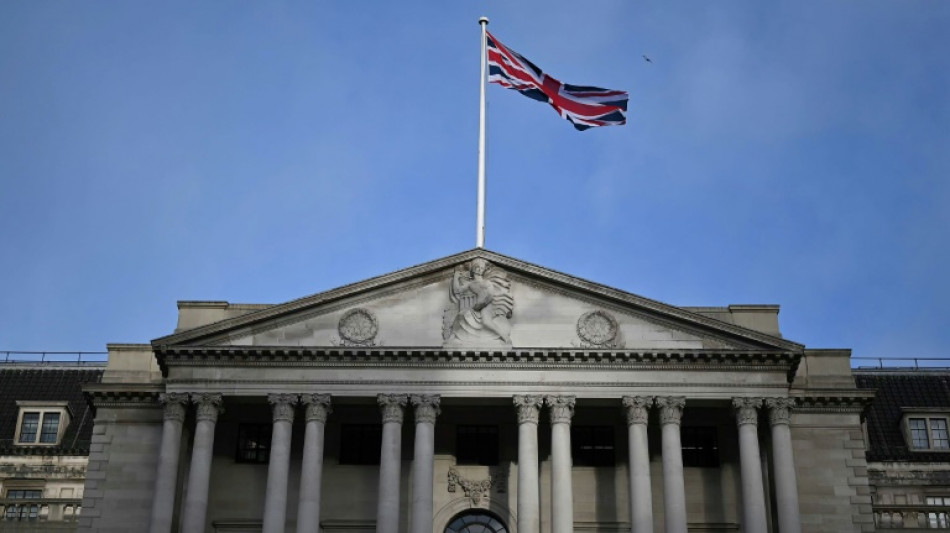
More central banks hike rates despite banking turmoil / Photo: © AFP

The Bank of England joined Norway and Switzerland in hiking interest rates Thursday to tackle stubbornly-high inflation, though banking-sector turmoil could soon lead to a pause in US tightening as hinted by the Federal Reserve.
A day after the Fed lifted US borrowing costs by 25 basis points, the BoE did the same as its key rate reached 4.25 percent -- the highest level since the 2008 global financial crisis.
The central banks pressed on with their monetary tightening even though the troubles in the banking sector have been linked to their rate-hike campaigns.
The BoE acknowledged that "uncertainties around the financial and economic outlook have risen".
It added it was "unclear how credit conditions and economic activity might be affected by recent banking sector stress in a number of advanced economies".
The Swiss National Bank (SNB), which helped oversee the buyout of troubled Credit Suisse by national rival UBS last weekend, lifted its rate by a hefty 50 basis points to 1.5 percent.
Norway's central bank hiked its rate by a more modest 25 basis points to 3.0 percent, though it noted there was "considerable uncertainty about future economic developments".
Policymakers remain laser-focused on fighting inflation, with the European Central Bank (ECB) last week announcing a 50-basis-point increase in eurozone borrowing costs.
The main outlier among major central banks is the Bank of Japan, which steadfastly resists tightening owing to what it deems are temporary boosts to consumer prices in the wake of Russia's invasion of Ukraine.
Over the past year, energy and food bills have rocketed around the world on supply constraints triggered by the ongoing war.
- Need to 'curb inflation' -
Following their monetary policy gatherings, the SNB said it was "countering the renewed increase in inflationary pressure", while Norway's central bank stated that higher rates were "needed to curb inflation".
While the Fed hiked its lending rate to 4.75-5.0 percent, analysts said its accompanying statement signalled it may soon pause monetary tightening.
The Fed statement replaced a previous warning that "ongoing increases... will be appropriate" to tame inflation with a conditional one saying "some additional policy firming may be appropriate".
Recent banking sector developments "are likely to result in tighter credit conditions for households and businesses and to weigh on economic activity, hiring and inflation", the Fed added.
The Swiss rate call, which matched its last increase in December, comes a few days after the SNB joined other major central banks in boosting liquidity in the wake of the latest banking crisis.
Switzerland at the weekend brokered the takeover of crisis-hit Credit Suisse by its Swiss rival UBS.
"The Swiss banking system is very resilient and robust," Swiss National Bank chairman Thomas Jordan told a press conference Thursday in Zurich.
- 'Halt to crisis' -
The SNB said Swiss authorities had "put a halt to the crisis" at Credit Suisse, declaring that their actions preserved financial stability.
A failure to resolve the Credit Suisse crisis "would have triggered a bigger financial crisis, not only in Switzerland, but most likely, globally", Jordan added.
The deal followed the collapse this month of Silicon Valley Bank (SVB) and Signature Bank in the United States, which sent shockwaves across global markets.
The Basel Committee on Banking Supervision, charged with worldwide oversight, said Thursday that it would "learn lessons" from the US bank failures and the emergency buyout of Credit Suisse that have roiled financial markets.
A catalyst for SVB's demise was the Fed's policy shift from near-zero interest rates to an aggressive rate-hiking campaign, which brought down the value of its portfolio of bonds with a lower return.
At the start of the week, there was much talk about how the BoE could decide against lifting its key rate.
However, official data Wednesday showed a surprise acceleration in annual UK inflation to 10.4 percent -- but the government forecasts it will plunge to 2.9 percent by year-end.
"Should inflation fall sharply as predicted, the spotlight will turn to when the central bank can provide some relief to consumers and businesses by reducing interest rates," said AJ Bell analyst Laith Khalaf.
burs-rfj/bcp/lth
(Y.Leyard--DTZ)