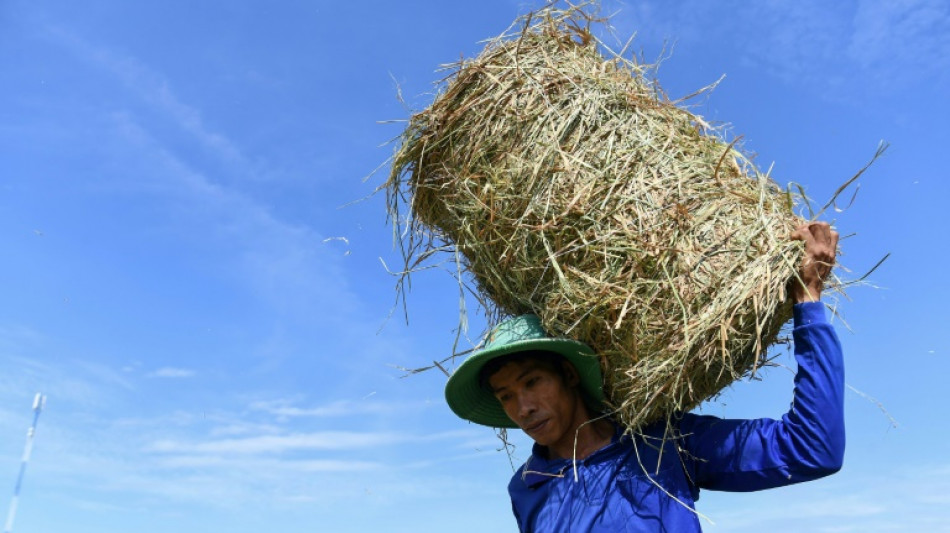
How Vietnam is trying to stop rice warming the planet / Photo: © AFP

As a child, Dong Van Canh watched while the rice fields of Vietnam's Mekong Delta were set alight to make way for the next crop, blackening the sky and flooding the air with potent greenhouse gases.
Rice -- Asia's principal staple -- is to blame for around 10 percent of global emissions of methane, a gas that over two decades traps about 80 times as much heat as carbon dioxide.
Usually associated with cows burping, high levels of methane are also generated by bacteria that grow in flooded rice paddies and thrive if leftover straw rots in the fields after harvest.
The message from scientists is: rice cannot be ignored in the battle to cut emissions.
In the Mekong Delta, Canh, now a 39-year-old rice farmer, does not leave straw out to decay on the paddies -- nor does he burn it, as his parents did before him.
Motivated by the memory of being forced inside his home on days the smoke was thick -- sometimes so acrid it made him choke or faint -- he joined an initiative that removes straw from the fields and turns it into mushrooms and organic fertiliser, earning a small income on the side.
"If we can collect the straw and make money, all of us benefit," he told AFP, running his fingers through a large, soft mound of straw, cow dung and rice husks that will soon become nutritious food for Mekong crops.
- Shrinking emissions -
The programme -- organised by the International Rice Research Institute (IRRI) -- is one of a handful across Vietnam and the region trying to steadily shrink methane emissions from rice production.
Many of the initiatives are not new but have been spotlighted since around 100 countries signed the Global Methane Pledge two years ago, agreeing to reduce emissions by 30 percent from 2020 levels by 2030.
Several of the world's biggest rice producers, including Indonesia, Bangladesh and Vietnam, are on board -- although the two largest, China and India, failed to sign.
In Vietnam, as the harvesting season draws to a close, farmers push carts overflowing with straw bales that will later be soaked and laid out to grow straw mushrooms.
Once the fungi are ready they will be sold before the farmers take back the straw and funnel it into a composting machine. Two months later it will be ready -- and can be sold for around 15 cents a kilogram (2.2 pounds).
"In the past a few farmers did this manually but it took too much manpower and the cost was high. Now we've cut costs by half and we will expand to meet the demands of the market," said Le Dinh Du, a rice farmer who also heads the local district's plant protection department.
"The rice goes on a nice journey. We don't waste anything."
- Methane-producing bacteria -
Vietnam's environment ministry says irrigated rice accounted for almost half of methane emissions in 2019.
Climate-friendly straw management has been introduced and spread "widely to farmers and local agricultural officials" throughout the country, according to CGIAR, an international agricultural research centre.
How many practise what they have learned is unclear. Last year the World Bank said that more than 80 percent of rice straw in the Mekong Delta is still burned in the fields after harvest.
The need to find solutions is pressing.
Unlike other crops, rice paddies have a layer of standing water, so there is no exchange of air between the soil and the atmosphere, explained Bjoern Ole Sander, a senior scientist at the IRRI in Hanoi.
These conditions mean different bacteria are active in rice, compared to wheat or maize fields.
"And these bacteria eat organic matter and produce methane," he said.
As well as straw management, IRRI says another scheme called Alternate Wetting and Drying (AWD), which involves breaking up standing water to replenish oxygen and reduce methane-producing bacteria, could also help cut emissions.
Practised on more than 200,000 hectares (494,210 acres) of rice-growing land in the Mekong delta's An Giang province, CGIAR says it has made a significant difference.
For Mekong farmers that have taken the leap, there is pride in contributing to more sustainable farming while getting the most out of their crops.
"We lived hard lives," said Canh. "But once we realised how to take advantage of the straw, things have gotten easier."
(L.Svenson--DTZ)