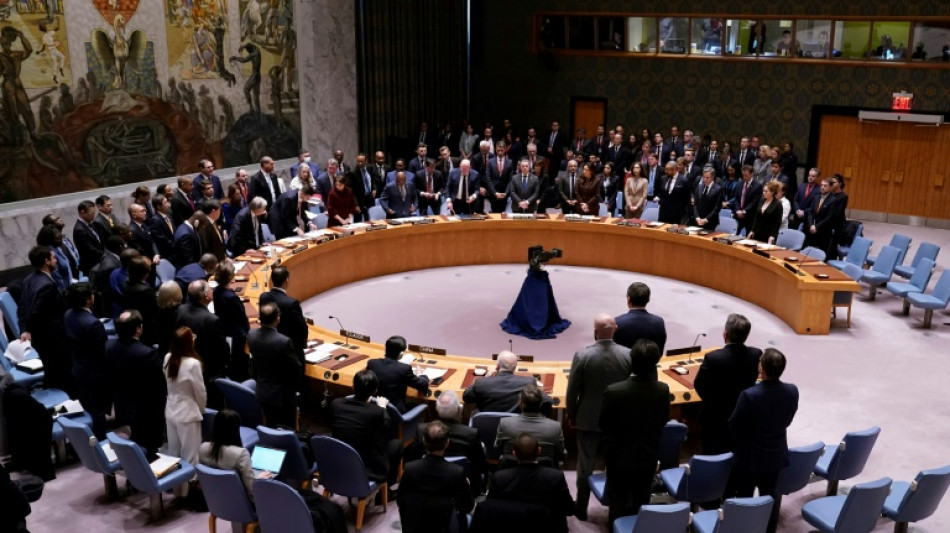
Kyiv seeks Security Council meet to stop Russian 'nuclear blackmail' in Belarus / Photo: © AFP/File

Kyiv on Sunday said it was seeking an emergency meeting of the United Nation's Security Council to counter Russia's "nuclear blackmail" after President Vladimir Putin announced the deployment of tactical nuclear weapons to Belarus.
Putin said the move was similar to the United States transferring weapons onto the territory of its allies, an analogy Germany called "misleading".
"Ukraine expects effective actions to counteract the Kremlin's nuclear blackmail from the United Kingdom, China, the United States and France," the Ukrainian foreign ministry said.
"We demand that an extraordinary meeting of the UN Security Council be immediately convened for this purpose," it added.
On Saturday, Putin announced Russia would station tactical nuclear weapons in neighbour and ally Belarus "without violating our international agreements on nuclear non-proliferation".
The Ukrainian foreign ministry accused Russia of breaching its obligations, and of undermining the "nuclear disarmament architecture and the international security system in general".
It called on "all members of the international community to convey to the criminal Putin regime the categorical unacceptability of its latest nuclear provocations."
Strongman Alexander Lukashenko, who has been in power in Belarus for almost 30 years, is a key Putin ally.
Back in February 2022, Minsk allowed the Kremlin to launch its invasion of Ukraine from Belarusian territory.
- 'Nuclear hostage' -
Fears have since risen that Belarus may join its ally's offensive, but Lukashenko said he would do so "only if attacked".
On Sunday secretary of Ukraine's National Security and Defence Council, Oleksiy Danilov wrote on Twitter that "the Kremlin took Belarus as a nuclear hostage."
He added that the move was "a step towards the internal destabilisation of the country".
Ukrainian presidential aide Mykhaylo Podolyak added that "(Putin) admits that he is afraid of losing and all he can do is scare" people.
In an interview broadcast Saturday, Putin said the move to deploy tactical nuclear weapons to Belarus was "nothing unusual".
"The United States has been doing this for decades. They have long placed their tactical nuclear weapons on the territory of their allies," Putin said.
Putin said he spoke to Lukashenko and said "we agreed to do the same."
Russia will start training crews on April 3 and plans to finish the construction of a special storage facility for tactical nuclear weapons by July 1.
- 'Nuclear intimidation' -
Germany on Sunday called the announcement "another attempt at nuclear intimidation by Russia", an official in the foreign office told AFP.
"The comparison made by President Putin to nuclear sharing in NATO is misleading and does not justify the step announced by Russia," the source said.
Belarus would also "contradict" its own international declarations to be a nuclear weapons-free zone, they said.
Putin has previously said nuclear tensions were "rising" globally but that Moscow would not deploy first.
The Russian leader said renewed discussions with Lukashenko on the issue were spurred by a British official's suggestion to send depleted uranium weapons to Ukraine.
Russia will respond if the West supplied Ukraine with such ammunition, he added.
"Russia of course has what it needs to answer. Without exaggeration, we have hundreds of thousands of such shells. We have not used them yet."
He said the weapons "can be classified as the most harmful and hazardous for humans... and also for the environment".
Depleted uranium munitions are highly effective at piercing armour plate, but their use is controversial.
The metal is toxic for the soldiers who use the weapons and for civilians in areas where they are fired.
(M.Dorokhin--DTZ)