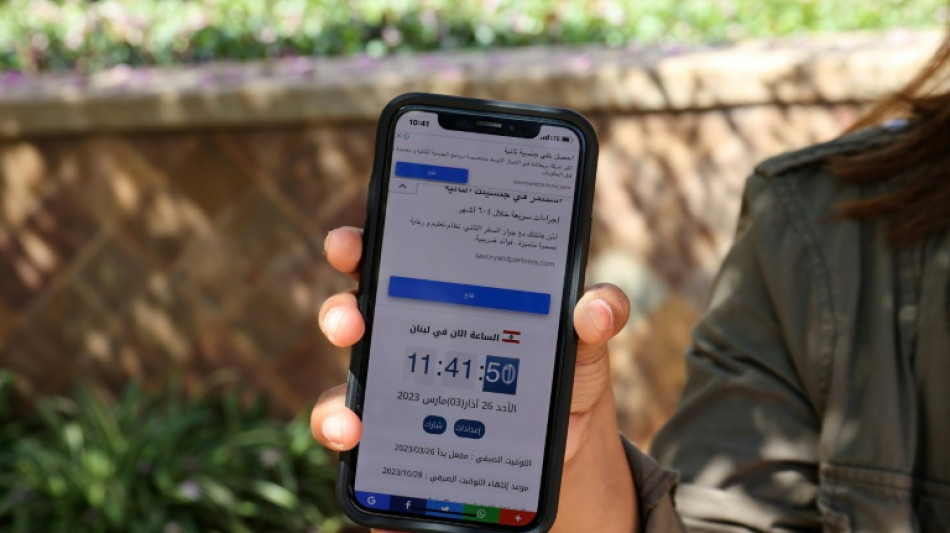
In times of crisis, Lebanese squabble over clock change / Photo: © AFP

Wracked by a crippling economic meltdown and political deadlock, Lebanon on Sunday added a seemingly odd question to its growing list of woes: "What time is it?"
A last-minute decision to delay daylight savings by a month has left the small country divided between two time zones after the move was met with opposition from the influential Maronite Church.
Lebanon's caretaker government announced Thursday its decision to delay rolling clocks forward until April 20, instead of the last week of March as is usually the case in the country and many others in the northern hemisphere.
Institutions including the church, as well as some schools and media outlets instead insisted on turning their clocks forward at midnight (2200 GMT on Saturday).
While the government has not explained the move, a video shared widely on social media may provide an explanation.
It shows a discussion between caretaker prime minister Najib Mikati and parliament speaker Nabih Berri, who asks the premier to delay the clock change until the end of Ramadan, in an apparent attempt to cater to Muslims who fast daily until sunset during the holy month.
Education Minister Abbas Halabi said Sunday the eleventh-hour decision had "inflamed sectarian discourse", arguing a cabinet decision was required to make the change.
In a statement on Twitter, he said schools and universities should observe daylight savings time as initially planned -- but some institutions had already said they would abide by the roll-back.
- 'Purely administrative' -
Pierre Daher, CEO of Lebanese broadcaster LBCI, said "the worst thing is that the decision on when to begin summer time took a sectarian turn."
The channel had said in a statement it would defy the government's decision as the delay would affect its operations.
"Had the government taken the decision a month ago, and not 48 hours in advance, then there wouldn't have been a problem," Daher told AFP.
Three other Lebanese networks also moved clocks forward.
Mikati in a statement on Saturday called the move "purely administrative".
But the powerful Maronite Church said the decision had been taken "without consultations and without any regard for international standards".
"A decision like this should have been announced a year earlier to avoid harming people's lives," church spokesman Walid Ghayad told AFP. "It cannot be made over a cup of coffee."
The church had refused to comply in order to prevent "further isolating Lebanon", he said.
Two prominent Christian political parties have called on the government to reverse its decision.
Gebran Bassil, leader of one of them, the Free Patriotic Movement, tweeted: "Do not change your clocks, they will move forward automatically."
- 'Which timing?' -
Lebanon's two major telecommunications companies advised customers over the weekend to change to manual clock settings on mobile phones to avoid the normally automatic change.
Justice Minister Henri Khoury has supported calls for Mikati to go back on the decision, saying it would have "catastrophic" consequences for an economy in free fall since 2019.
"The decision has created confusion and caused divisions and disturbances among religious authorities, private media and education institutions," Khoury said in a statement.
Flag carrier Middle East Airlines, while implementing the government-ordered delay, said it would move departure times by one hour to adhere to international flight schedules.
At Beirut's international airport on Sunday, passenger Marissa Daoud expressed confusion after flying in from France.
"I don't understand what time it is," she told AFP.
"How am I supposed to set it on my phone? On which timing?"
Lebanese slammed the uncanny dispute on social media, with some sarcastically alluding to sectarian tensions that had fuelled a bloody civil war in 1975-1990.
One user said on Twitter: "Will our children read in history books that the civil war started in Lebanon in 2023 just because the clock wasn't moved forward?"
(N.Loginovsky--DTZ)