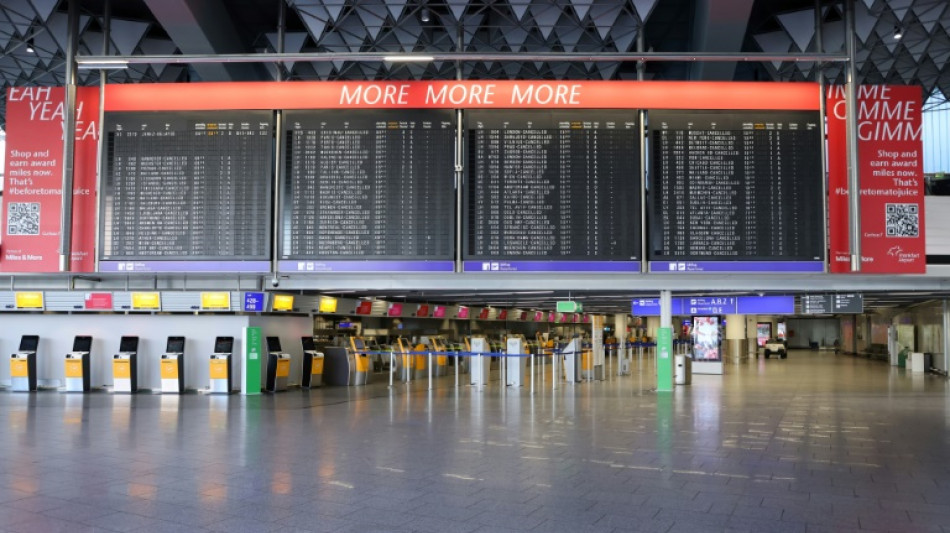
'Mega-strike' disrupts travel in Germany / Photo: © AFP

A major strike brought much of Germany's air traffic, rail service and commuter lines to a halt on Monday as workers demand wage hikes in the face of brisk inflation.
Workers at airports, ports, railways, buses and metro lines throughout much of Europe's top economy heeded a call by the Verdi and EVG unions for the 24-hour walkout.
"A labour struggle that has no impact is toothless," Verdi boss Frank Werneke told public broadcaster Phoenix.
He acknowledged the stoppage would inflict pain on many commuters and holidaymakers, "but better one day of strain with the prospect of reaching a wage agreement than weeks of industrial action".
Berlin's usually bustling central train station was mostly quiet on Monday morning, after the national railway cancelled long-distance and regional links across the country.
Arrival and departure boards at Frankfurt airport, the nation's biggest, and Munich airport showed rows of cancelled flights.
As the industrial action was largely publicised, many commuters had switched to other modes of transport.
In Berlin, Simon, 31, a student, said he was expecting 30 minutes more of commuting time as he had to use two buses rather than the regional train which had been cancelled.
But he said he found "the strike legitimate" as "many people have mobilised for better working conditions".
Retiree Gloria Bierwald, 73, said however that "the strike goes to far".
"What the strikers are asking for is relatively exaggerated. I am of the opinion that people should be satisfied when they have a job."
- Ill-tempered dispute -
To prevent supply gaps, Transport Minister Volker Wissing had ordered states to lift restrictions on truck deliveries on Sunday, while asking airports to allow late-night takeoffs and landings "so stranded passengers can reach their destinations".
Verdi represents around 2.5 million public sector employees, while EVG represents 230,000 workers on the railways and at bus companies.
The rare joint strike marks an escalation of an increasingly ill-tempered dispute over a pay packet to blunt the impact of surging inflation.
Employers, mostly the state and public sector companies, have so far refused the demands, instead offering a rise of five percent with two one-off payments of 1,000 ($1,100) and 1,500 euros, this year and next.
Verdi is demanding a rise of 10.5 percent in monthly salaries, while EVG is seeking a 12-percent increase for those it represents.
- 'Massive impact' -
Martin Seiler, head of human resources at state-owned rail company Deutsche Bahn (DB), has described the nationwide strike as "groundless and unnecessary" and urged the unions to return to the negotiating table "immediately".
The German airport association, which estimated about 380,000 air travellers would be affected, said the walkout "went beyond any imaginable and justifiable measure".
Employers have accused labour representatives of contributing to a wage-price spiral that will only feed inflation, while unions say their members have been asked to bear the burden of the soaring cost of living.
As in many other countries, people in Germany are struggling with high inflation -- it hit 8.7 percent in February -- after Russia's invasion of Ukraine sent food and energy costs soaring.
Similar strikes have taken place in Britain, where public and private sector workers have taken industrial action as inflation remains stubbornly above 10 percent.
Germany's "mega-strike", as local media have dubbed it, follows industrial action in recent months in several sectors, from the postal service to airports and local transport.
A third round of salary negotiations for public sector workers was due to begin on Monday.
Earlier in March, airports in Bremen, Berlin, Hamburg and Hanover cancelled more than 350 flights after security staff walked out. Bus and metro staff in Frankfurt also staged a strike.
Some unions, however, have succeeded in winning big pay increases.
(O.Zhukova--DTZ)