Car battery recycling market gears up for future boom / Photo: © AFP

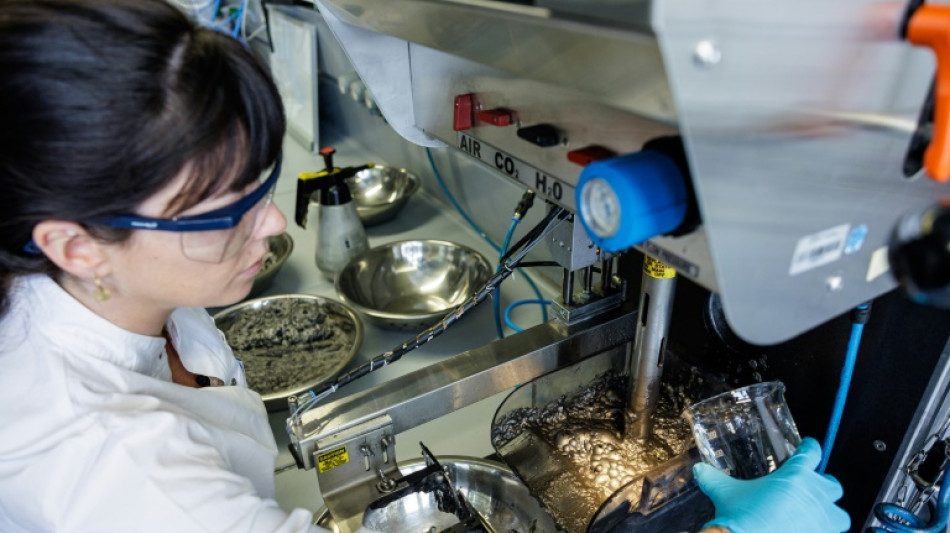
Researcher Anna Vanderbruggen peers into a vat of dark bubbling liquid, the result of a process she has developed to recover graphite from old lithium-ion batteries.
Although graphite represents up to a quarter of the weight of the batteries, no one has yet come up with a viable plan to recycle it, according to Vanderbruggen.
The 29-year-old researcher is still fine-tuning her method but has already received an award from the European Institute of Innovation and Technology (EIT) for her efforts.
As Europe shifts gear from fossil fuel vehicles to electrified cars, recycling graphite as well as other elements in batteries is gradually becoming a major focus.
All the more so as the continent seeks to wean itself off its reliance on countries like China for raw materials.
"Battery manufacturers were not interested" in recycled graphite up to now because "they could get it at low cost in China", Vanderbruggen told AFP.
Her method, developed at the Helmholtz Research Institute in Freiberg, Germany, involves extracting graphite from "black mass", a powder that also contains cobalt, nickel, lithium and manganese.
"You put the black mass in water and add some chemicals and air bubbles, like in a jacuzzi," Vanderbruggen, who is from France, said.
"The graphite attaches itself to the bubbles, whereas the metals are hydrophilic and therefore remain in the water."
Vanderbruggen also works as a consultant for businesses exploring the opportunities that recycling electric car batteries could bring in the future.
- Rising costs -
Increasing raw material costs and shortages have led to a surge of interest in the field.
The price of lithium has increased by 13 percent over the past five years, according to Philippe Barboux, a professor of chemistry at PSL University in Paris.
Lithium has not been recycled on a large scale up to now "because it was not profitable", he said.
But that looks set to change with 350 million electric cars expected to be on the road worldwide by 2030, up from 16.5 million in 2021, according to the International Energy Agency (IEA).
"In 10 years' time, so many batteries will be manufactured that lithium will absolutely have to be recycled, otherwise there won't be enough," Barboux said.
In theory, the technology now exists to recycle almost all the materials that make up lithium-ion batteries, according to the experts interviewed by AFP.
German group Aurubis, one of Europe's largest suppliers of non-ferrous metals, claims to be able to recycle at least 95 percent of the metals that make up "black mass" at a pilot plant it has set up in Hamburg.
French mining group Eramet, Belgium's Umicore and German carmaker Mercedes have also launched similar ventures.
The majority of such projects are still in their pilot stages.
- 'Huge growing market' -
"It's a huge growing market and we want to play a role in it," said Ken Nagayama, head of business development for battery materials at Aurubis, who is currently working on a graphite recycling process.
He believes there will be "sufficient market supply to develop a battery recycling plant in industrial scale during the second half of the decade".
Since the batteries tend to last seven or eight years, there are not yet "enough batteries at the end of their life" to feed the market, said Serge Pelissier, director of research at the Gustave Eiffel University in Lyon.
There are also many different models of car batteries, making it difficult to set up a standardised recycling system like those available for mobile phones and laptops.
The market for car battery recycling will probably not reach its full potential until the "early 2030s", according to Alex Keynes of the Transport and Environment NGO.
Swedish and Norwegian joint venture Northvolt-Hydro, a pioneer in the field, is aiming to recycle the equivalent of 500,000 batteries by 2030.
This would represent around half of the batteries likely to be available for recycling by that time, according to estimates from consultancies.
The European Union wants new batteries to incorporate 16 percent recycled cobalt and six percent recycled lithium and nickel by 2031.
It is also aiming for at least 70 percent of the weight of old batteries to be recycled by 2031.
"If they recover new components like graphite, they will be able to meet these requirements," Vanderbruggen said.
(U.Beriyev--DTZ)